- 16 min read



Imagine you’ve spent hours creating the perfect survey. The questions are clear, the design is polished, and the survey takes less than five minutes to complete. Responses begin flowing in, but something unexpected happens. Many respondents abandon the survey right before finishing.
After reviewing your analytics, you discover the drop-off occurs when participants reach your demographic section.
This is one of the most common mistakes businesses make when designing surveys. Demographic questions for surveys are incredibly valuable, but asking them incorrectly can reduce completion rates, frustrate respondents, and even introduce bias into your data.
Whether you’re collecting customer feedback, conducting market research, measuring employee satisfaction, or running academic research, demographic information helps you understand who your respondents are. Without it, valuable insights become much harder to interpret.
The challenge isn’t deciding whether to ask demographic questions. The challenge is knowing how to ask demographic questions in a survey without making people uncomfortable or encouraging them to quit halfway through.
In this guide, you’ll learn why demographic questions matter, when to ask them, common mistakes to avoid, and discover practical demographic questions for surveys examples you can adapt for your own research.
Why Demographic Questions Matter
Survey results become far more valuable when you understand who provided the answers.
Suppose two hundred people complete your customer satisfaction survey, and the average rating is 7.8 out of 10.
That number is useful.
But it becomes much more actionable when you discover:
- Customers aged 18–24 rated your product 9.2.
- Customers over 55 rated it 6.4.
- New customers were highly satisfied.
- Long-term customers were significantly less satisfied.
The average alone doesn’t reveal these patterns.
Demographic information transforms raw responses into meaningful business insights.
Businesses use demographic data to:
- Understand target audiences
- Segment customers
- Improve marketing campaigns
- Personalize products
- Identify underserved customer groups
- Compare customer experiences
- Support market research
- Improve product development
Without demographic context, survey results often lack the depth needed for confident decision-making.
What Are Demographic Survey Questions?
Demographic survey questions collect background information about respondents rather than opinions or experiences.
These questions describe who the respondent is rather than what they think.
Common demographic categories include:
- Age
- Gender
- Geographic location
- Education
- Employment status
- Occupation
- Household income
- Marital status
- Industry
- Company size
- Language
- Household composition
The specific questions you ask should always support your research objectives.
Collecting unnecessary personal information only increases survey fatigue.
Why Demographic Questions Sometimes Hurt Completion Rates
Many organizations unintentionally place too much emphasis on demographic information.
Imagine opening a survey and seeing questions like:
- What’s your age?
- What’s your income?
- What’s your ethnicity?
- What’s your marital status?
- What’s your education level?
- What’s your ZIP code?
Before you’ve even answered a single question about the actual topic.
Many respondents immediately wonder:
“Why do they need all this information?”
That uncertainty reduces trust.
Once trust decreases, abandonment increases.
The problem isn’t demographic questions themselves.
It’s poor survey design.
Should Demographic Questions Go at the Beginning or End?
This question generates constant debate among survey researchers.
In most situations, demographic questions perform better at the end of the survey.
Why?
By the time respondents reach the final section, they’ve already invested several minutes answering meaningful questions.
Psychologists refer to this as the commitment effect.
People who have already invested time are significantly more likely to finish.
Placing sensitive demographic questions at the beginning creates unnecessary friction before respondents become engaged.
However, there are exceptions.
If demographics determine survey eligibility—for example, only healthcare professionals or parents—you may need screening questions at the beginning.
Keep these eligibility questions brief and explain why they’re necessary.
Explain Why You’re Collecting Demographic Information
People are generally willing to answer personal questions when they understand the purpose.
Instead of immediately asking for income or education, consider adding a brief explanation.
For example:
“The following questions help us understand how different groups experience our product. Your responses remain confidential and are reported only in aggregate.”
That single sentence increases transparency and builds trust.
Respondents are far more comfortable sharing information when they know how it will be used.
Only Ask Questions That Support Your Research
One of the biggest survey mistakes is collecting demographic data “just in case.”
Every question increases survey length.
Every additional question increases the chance someone leaves before completion.
Ask yourself:
“Will this information influence a business decision?”
If the answer is no, remove the question.
For example:
If you’re researching software usability, respondents’ favorite sports team is unlikely to matter.
If you’re studying retirement planning, age probably matters significantly.
Every demographic question should have a clear purpose.
Make Sensitive Questions Optional
- Income.
- Ethnicity.
- Religion.
- Political affiliation.
- Disability status.
- Sexual orientation.
These topics may be highly relevant in some research projects, but they’re also deeply personal.
Whenever possible, mark these questions as optional.
Including options like:
- Prefer not to answer
- I’d rather not say
shows respect for respondent privacy while maintaining data quality.
Forced responses often result in inaccurate answers.
Use Inclusive Answer Choices
Modern surveys should reflect the diversity of their audiences.
For example, instead of offering only:
- Male
- Female
Consider:
- Male
- Female
- Prefer not to answer
Similarly, employment, education, and household questions should include comprehensive answer choices whenever appropriate.
Inclusive surveys improve respondent trust and data accuracy.
Use Ranges Instead of Exact Numbers
Many demographic questions become less intrusive when respondents choose ranges instead of entering exact values.
Instead of asking:
“What is your annual household income?”
Use:
- Under $25,000
- $25,000–$49,999
- $50,000–$74,999
- $75,000–$99,999
- $100,000–$149,999
- $150,000+
The same approach works for age.
Age ranges generally receive higher response rates than requesting exact birth dates.
Keep Demographic Sections Short
Most surveys require surprisingly few demographic questions.
For many customer surveys, four to six questions are enough.
Long demographic sections create unnecessary fatigue.
Remember:
You’re collecting supporting information—not conducting a national census.
Focus only on information directly connected to your research goals.
Demographic Questions for Surveys Examples
Choosing the right questions depends on your audience and objectives, but some demographic questions consistently provide valuable insights across industries.
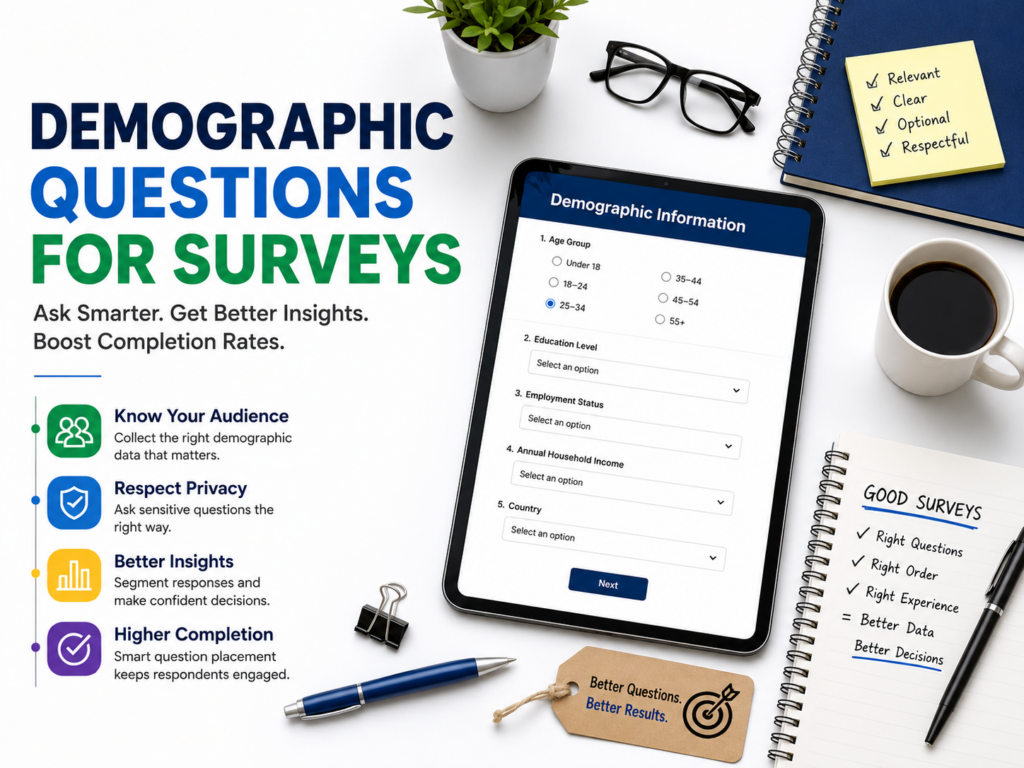
Age
Which age group do you belong to?
- Under 18
- 18–24
- 25–34
- 35–44
- 45–54
- 55–64
- 65+
Gender
How do you describe your gender?
- Male
- Female
- Prefer not to answer
Education
What is the highest level of education you’ve completed?
- High school
- Associate degree
- Bachelor’s degree
- Master’s degree
- Doctorate
- Other
Employment
Which best describes your current employment status?
- Full-time
- Part-time
- Self-employed
- Student
- Retired
- Unemployed
- Other
Industry
Which industry do you primarily work in?
Provide a searchable dropdown when possible rather than overwhelming respondents with dozens of options.
Company Size
How many employees work at your organization?
- 1–10
- 11–50
- 51–200
- 201–500
- 501–1,000
- 1,000+
Geographic Location
Which country do you currently live in?
If local insights matter, ask for state or region instead of exact addresses.
Income
Which range best represents your annual household income?
Always include:
- Prefer not to answer
How Different Industries Use Demographic Questions
E-commerce companies often segment customers by age, location, and household income to improve marketing campaigns and personalize product recommendations.
Healthcare organizations may collect age, gender, insurance status, and geographic information to better understand patient populations and identify disparities in care.
Educational institutions frequently ask about education level, enrollment status, and field of study to evaluate student experiences and improve academic programs.
Human resources teams use demographic data to analyze employee engagement, identify trends across departments, and support diversity and inclusion initiatives.
B2B SaaS companies commonly collect company size, job title, industry, and organizational role to better understand decision-makers and tailor product development efforts.
The right demographic questions depend on the audience, but the guiding principle remains the same: collect only the information needed to make better decisions.
Common Mistakes to Avoid
Even experienced researchers sometimes make demographic questions more complicated than necessary.
One of the biggest mistakes is asking too many personal questions. While demographic data is valuable, respondents rarely enjoy answering lengthy sections about themselves. Every unnecessary question increases survey fatigue.
Another common mistake is using overlapping answer choices. For example:
- 18–25
- 25–35
Someone who is 25 years old doesn’t know which option to choose.
Instead, create mutually exclusive ranges such as:
- 18–24
- 25–34
Poor wording is another frequent issue.
Questions should be neutral, respectful, and easy to understand. Avoid technical language, assumptions, or wording that could make respondents uncomfortable.
Businesses should also avoid making every demographic question mandatory. For sensitive topics such as income or ethnicity, optional responses often improve overall survey completion.
When Demographic Questions Should Be Required
Although optional questions often improve user experience, some research projects genuinely require demographic information.
For example:
Healthcare studies may require age and gender for medical analysis.
Educational surveys may need enrollment status.
Government research often requires geographic location.
Employee engagement surveys may need department or job role.
In these situations, explain why the information is necessary before asking for it.
Transparency builds trust.
Demographic Questions vs. Psychographic Questions
Many people confuse demographic questions with psychographic questions.
They serve different purposes.
Demographics describe who someone is.
Psychographics describe how someone thinks.
For example:
Demographic questions include:
- Age
- Education
- Income
- Occupation
- Geographic location
Psychographic questions explore:
- Values
- Interests
- Lifestyle
- Motivations
- Purchasing behavior
- Personal beliefs
The strongest customer research combines both.
Knowing that your customer is 32 years old tells you something.
Knowing that they prioritize convenience over price tells you much more.
How AI Is Changing Demographic Survey Analysis
Artificial intelligence is transforming survey research.
Instead of manually comparing demographic groups in spreadsheets, AI-powered survey platforms can automatically identify meaningful patterns.
For example, AI may discover:
- Younger respondents consistently rate onboarding higher.
- Enterprise customers request different features than small businesses.
- Customers in specific industries report similar challenges.
- Satisfaction varies significantly across geographic regions.
These insights appear within minutes instead of hours.
AI doesn’t replace demographic questions.
It makes them significantly more valuable.
By connecting demographic information with customer behavior, businesses gain a much clearer understanding of their audience.
Best Practices for Writing Demographic Survey Questions
When designing demographic sections, focus on clarity, relevance, and respect.
Ask only questions that directly support your research objectives.
Place demographic questions near the end of the survey whenever possible.
Use inclusive language and comprehensive answer choices.
Offer “Prefer not to answer” options for sensitive topics.
Use ranges rather than exact values for age and income.
Avoid mandatory responses unless they’re essential.
Keep the demographic section short and easy to complete.
Review your survey from the respondent’s perspective before launching it.
Every question should have a clear purpose.
Real-World Example
Imagine an online learning platform wants to improve course completion rates.
Instead of only asking:
“How satisfied are you with the course?”
they include several carefully selected demographic questions.
The survey reveals:
Students aged 18–24 complete courses at much higher rates than learners over 50.
Working professionals primarily study during evenings.
Parents often abandon longer lessons.
International learners struggle with language complexity.
Without demographic information, the company would only know overall completion rates.
With demographic segmentation, they can personalize learning experiences for different audiences.
This leads to better engagement and improved customer satisfaction.
Why Demographic Questions Improve Business Decisions
Businesses often collect enormous amounts of customer feedback but struggle to identify meaningful patterns.
Demographic information provides the context needed to understand those patterns.
Instead of asking:
“What do customers think?”
Businesses begin asking:
- “What do younger customers think?”
- “What do enterprise customers think?”
- “What do first-time buyers think?”
- “What do customers in healthcare think?”
This level of segmentation transforms generalized insights into targeted business strategies.
Marketing becomes more personalized.
Products become more relevant.
Customer experiences become more meaningful.
Using SurveyFlip to Collect Better Demographic Data
SurveyFlip makes it simple to collect demographic information without compromising the respondent experience.
With customizable survey templates, conditional logic, optional questions, mobile-friendly layouts, and advanced analytics, SurveyFlip helps businesses gather demographic data naturally while maintaining high completion rates.
Whether you’re conducting customer research, employee surveys, academic studies, or market analysis, SurveyFlip allows you to segment responses, identify trends across customer groups, and turn demographic information into actionable insights.
Instead of overwhelming respondents with unnecessary questions, SurveyFlip helps you create smarter surveys that respect privacy while delivering the data your business actually needs.
Final Thoughts
Demographic questions are one of the most valuable parts of any survey—but only when they’re designed thoughtfully.
Collecting age, education, occupation, location, or income isn’t the goal. The goal is understanding how different groups experience your product, service, or organization so you can make better decisions.
By learning how to ask demographic questions in a survey, asking only what’s necessary, respecting respondent privacy, and placing demographic questions strategically, you can improve both completion rates and data quality.
The best surveys don’t simply collect responses.
They collect meaningful context.
And when demographic information is combined with thoughtful survey design, businesses gain deeper customer insights, stronger segmentation, and better decisions driven by real data instead of assumptions.
Frequently Asked Questions (FAQ)
1. What are demographic questions for surveys?
Demographic questions for surveys collect background information about respondents, such as age, gender, education, income, occupation, location, or employment status. This information helps researchers analyze survey responses by different audience segments and identify meaningful patterns.
2. Why are demographic questions important in surveys?
Demographic questions provide context for survey results.
Instead of only knowing what respondents think, businesses can understand who thinks that way.
This helps organizations:
- Segment customers
- Improve marketing strategies
- Personalize products
- Compare different audience groups
- Identify trends
- Make better business decisions
3. When should I ask demographic questions in a survey?
In most cases, demographic questions should appear at the end of the survey.
Respondents are more likely to answer personal questions after they’ve already completed the main survey.
The exception is when demographic information determines eligibility, such as surveys targeting a specific profession or age group.
4. How do I ask demographic questions without lowering completion rates?
Understanding how to ask demographic questions in a survey starts with making respondents feel comfortable.
Some best practices include:
- Ask only relevant questions.
- Place demographics near the end.
- Explain why you’re collecting the information.
- Make sensitive questions optional.
- Include “Prefer not to answer” options.
- Keep the section short and easy to complete.
These practices help improve trust and reduce survey abandonment.
5. What are some demographic questions for surveys examples?
Some common demographic questions for surveys examples include:
- What is your age group?
- What is your gender?
- What is your highest level of education?
- What is your employment status?
- Which industry do you work in?
- What is your household income range?
- Which country or state do you live in?
- What is your job title?
These questions help categorize respondents for deeper analysis.
6. What demographic questions should every customer survey include?
The right questions depend on your research goals, but many customer surveys commonly include:
- Age
- Gender
- Geographic location
- Education
- Employment status
Only collect information that supports your survey objectives.
7. Should demographic questions be required?
Not always.
Sensitive questions such as income, ethnicity, religion, disability status, or political affiliation should usually remain optional.
If demographic information is essential for your research, explain why you’re requesting it before asking respondents to answer.
8. Why should I include a “Prefer not to answer” option?
Some respondents may feel uncomfortable sharing personal information.
Offering a “Prefer not to answer” option:
- Increases trust
- Reduces survey abandonment
- Improves respondent experience
- Prevents inaccurate answers
Respecting privacy often results in higher-quality data overall.
9. How many demographic questions should a survey have?
Most surveys perform well with four to six demographic questions.
Long demographic sections increase survey fatigue and lower completion rates.
Focus only on collecting information that directly supports your research objectives.
10. What is the difference between demographic and psychographic questions?
Demographic questions describe who a respondent is.
Examples include:
- Age
- Income
- Education
- Occupation
- Geographic location
Psychographic questions explore how people think, including:
- Interests
- Values
- Lifestyle
- Attitudes
- Motivations
Combining both types provides a more complete understanding of customers.
11. Should I ask for exact age or age ranges?
Age ranges generally perform better than asking for an exact birth date.
For example:
- 18–24
- 25–34
- 35–44
- 45–54
- 55–64
- 65+
Age ranges feel less intrusive while still providing useful segmentation.
12. How should I ask income questions?
Instead of requesting exact salaries, use income ranges.
Example:
- Under $25,000
- $25,000–$49,999
- $50,000–$74,999
- $75,000–$99,999
- $100,000+
Always include a “Prefer not to answer” option to improve response rates.
13. Can demographic questions introduce bias?
Yes.
Poorly written demographic questions can influence responses or make respondents uncomfortable.
To reduce bias:
- Use neutral language.
- Avoid assumptions.
- Offer inclusive answer choices.
- Keep questions relevant.
- Respect respondent privacy.
Well-designed demographic questions improve data quality rather than reducing it.
14. How do online survey tools help collect demographic data?
Modern survey platforms simplify demographic data collection by offering:
- Conditional logic
- Optional questions
- Mobile-friendly layouts
- Dropdown menus
- Response segmentation
- Real-time analytics
- Automated reporting
These features improve both respondent experience and research quality.
15. How do businesses use demographic survey questions?
Businesses use demographic survey questions to:
- Build customer personas
- Improve audience segmentation
- Personalize marketing campaigns
- Identify new market opportunities
- Measure customer satisfaction across different groups
- Improve products and services
Demographic insights help organizations make more targeted business decisions.
16. Can AI improve demographic survey analysis?
Yes.
AI-powered survey platforms can automatically identify patterns across demographic groups.
For example, AI can detect differences based on:
- Age
- Industry
- Company size
- Geographic location
- Customer type
This helps businesses uncover trends much faster than manual analysis.
17. What are the biggest mistakes when asking demographic questions?
Some of the most common mistakes include:
- Asking too many personal questions
- Placing demographics at the beginning unnecessarily
- Using overlapping answer choices
- Making every question mandatory
- Asking irrelevant questions
- Failing to explain why information is being collected
Avoiding these mistakes improves completion rates and respondent trust.
18. Which industries benefit most from demographic surveys?
Almost every industry benefits from demographic data, including:
- E-commerce
- SaaS
- Healthcare
- Education
- Financial services
- Hospitality
- Human resources
- Retail
- Government
- Nonprofit organizations
Any organization seeking to better understand its audience can benefit from collecting demographic information responsibly.
19. How does SurveyFlip help with demographic surveys?
SurveyFlip allows businesses to create professional demographic surveys using customizable templates, conditional logic, optional fields, mobile-friendly designs, and real-time analytics. It helps organizations collect demographic information respectfully while maintaining high survey completion rates and generating actionable audience insights.
20. What is the key takeaway about demographic questions for surveys?
The biggest takeaway is that demographic questions for surveys should support your research—not overwhelm your respondents. By asking only relevant questions, placing them strategically, respecting privacy, and explaining their purpose, you can collect richer audience insights without hurting completion rates. Done correctly, demographic data transforms survey responses into meaningful, actionable business intelligence.