- 13 min read


The survey industry is undergoing a massive transformation, driven by one of the most disruptive technologies of our time: artificial intelligence. For decades, businesses have relied on surveys to understand customers, measure employee satisfaction, test new products, and gather market intelligence. While surveys have always been a valuable source of information, traditional survey methods often required significant time, effort, and expertise.
Organizations had to manually create questionnaires, distribute them to respondents, wait for responses, clean the data, analyze results, and then translate those findings into actionable business decisions. This process could take days, weeks, or even months depending on the size of the research project.
Today, that reality is changing rapidly.
Artificial intelligence is transforming every stage of the survey lifecycle, from survey creation and respondent engagement to data analysis and predictive insights. Businesses no longer need to rely solely on manual processes. Instead, AI-powered platforms can automate many of the tasks that once consumed countless hours of work.
As a result, AI in market research is becoming a competitive advantage for organizations seeking faster, smarter, and more accurate insights.
The question is no longer whether AI will change online surveys.
The question is how quickly businesses can adapt to this new reality.
The Traditional Challenges of Online Surveys
To understand the impact of AI, it is important to understand the limitations of traditional survey methods.
For many years, survey research followed a relatively straightforward process. Researchers identified objectives, created questions, distributed surveys, collected responses, and analyzed data. While effective, this approach often presented several challenges.
One of the biggest issues was survey design.
Creating effective survey questions requires expertise. Poorly written questions can introduce bias, confuse respondents, or generate inaccurate results. Even experienced researchers sometimes struggle to balance clarity, neutrality, and engagement.
Another common challenge was response rates.
Many people ignore survey invitations because surveys often feel lengthy, repetitive, or irrelevant. Low response rates can reduce data quality and make findings less representative of the target audience.
Analysis was another major obstacle.
Open-ended responses, in particular, required significant manual review. Researchers often spent hours categorizing comments, identifying themes, and searching for meaningful patterns.
These challenges created delays and increased research costs.
Artificial intelligence is helping solve many of these longstanding problems.
The Rise of AI in Market Research
The adoption of AI in business has accelerated dramatically over the past few years, and market research is no exception.
AI in market research refers to the use of machine learning, natural language processing, predictive analytics, and other artificial intelligence technologies to improve how businesses collect and analyze information.
Rather than replacing researchers, AI acts as a powerful assistant.
It helps researchers work faster, uncover deeper insights, and make better decisions based on larger amounts of data than humans could reasonably process on their own.
Modern AI systems can analyze thousands of survey responses in seconds, detect hidden patterns, identify emerging trends, and generate reports that would have previously taken days to produce.
This shift is fundamentally changing the role of surveys in business decision-making.
Instead of simply collecting feedback, organizations can now gain strategic intelligence that helps predict future outcomes and guide long-term planning.
How AI Survey Generators Are Revolutionizing Survey Creation
One of the most visible innovations in the survey industry is the emergence of the AI survey generator.
Traditionally, creating a high-quality survey required careful planning and significant effort. Researchers needed to determine objectives, choose question formats, write clear questions, and structure the survey flow.
This process could be time-consuming, especially for businesses without dedicated research teams.
AI survey generators dramatically simplify this experience.
Instead of building a survey from scratch, users can describe their goal in plain language. For example, a business owner might type:
“Create a customer satisfaction survey for an online clothing store.”
Within seconds, the AI can generate a complete survey with professionally structured questions, recommended answer formats, logical branching, and optimized flow.
This capability is particularly valuable for small businesses, startups, marketers, and HR teams that need quality surveys but may lack survey design expertise.
The result is faster survey deployment and improved survey quality.
AI Is Making Survey Questions Smarter
The quality of survey data depends heavily on the quality of the questions being asked.
A poorly written question can lead respondents toward certain answers, create confusion, or generate unreliable data.
Artificial intelligence helps improve question quality by evaluating wording, readability, and structure.
Advanced AI systems can identify:
- Leading questions
- Double-barreled questions
- Ambiguous wording
- Complex language
- Potential response bias
They can then suggest improvements that make surveys easier to understand and more effective at gathering accurate information.
This is especially important because even small improvements in question design can significantly improve data quality.
When respondents clearly understand questions, their answers become more reliable and actionable.
Personalization Is Transforming the Survey Experience
One of the biggest trends shaping modern surveys is personalization.
Consumers today expect personalized experiences in nearly every aspect of their digital lives. Generic surveys often feel irrelevant and fail to capture meaningful insights.
AI allows surveys to adapt dynamically based on respondent behavior.
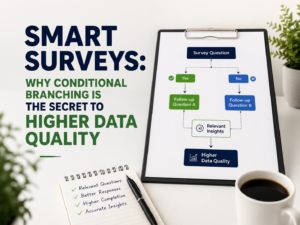
For example, if a customer indicates dissatisfaction with a recent purchase, the survey can automatically present additional questions focused on their concerns.
If another customer reports a highly positive experience, the survey may explore loyalty drivers and referral opportunities instead.
This adaptive approach creates a more conversational experience.
Respondents feel that the survey is relevant to their situation, which increases engagement and completion rates.
Personalized surveys also provide richer data because they focus on issues that matter most to each individual respondent.
AI-Powered Sentiment Analysis Unlocks Deeper Insights
Traditional surveys often rely on rating scales and multiple-choice questions.
While these formats are useful, they sometimes fail to capture the emotions behind customer opinions.
This is where sentiment analysis becomes valuable.
Using natural language processing, AI can analyze written responses and identify emotional tone.
For example, a customer comment may appear neutral at first glance but actually contain subtle frustration or disappointment. AI can detect these emotional signals and categorize them accordingly.
Businesses can use sentiment analysis to understand:
- Customer satisfaction levels
- Brand perception
- Product sentiment
- Employee morale
- Emerging concerns
Instead of manually reading hundreds or thousands of comments, organizations can instantly identify trends and prioritize issues that require attention.
This allows businesses to move beyond simple data collection and gain a deeper understanding of customer and employee experiences.
Faster Data Analysis and Real-Time Insights
One of the most significant benefits of AI-powered surveys is speed.
In traditional research projects, data analysis often represented the longest stage of the process.
Researchers needed to clean datasets, create charts, identify trends, and interpret findings.
AI dramatically reduces this workload.
Modern survey platforms can automatically:
- Analyze responses in real time
- Detect significant trends
- Generate visual dashboards
- Segment audiences
- Identify unusual patterns
- Create executive summaries
This allows organizations to move from data collection to decision-making much faster.
In competitive industries where market conditions change rapidly, faster insights can provide a meaningful advantage.
Businesses can respond to customer needs more quickly and make informed decisions with greater confidence.
Predictive Analytics Is Redefining Market Research
Perhaps the most exciting development in AI in market research is predictive analytics.
Traditional surveys focus primarily on understanding what has already happened.
Predictive analytics goes a step further by estimating what may happen in the future.
By combining survey responses with historical data, AI systems can identify patterns that indicate future behavior.
For example, businesses can use predictive models to estimate:
- Customer churn risk
- Future purchasing behavior
- Employee turnover likelihood
- Product demand trends
- Customer lifetime value
These predictions help organizations become proactive rather than reactive.
Instead of responding to problems after they occur, businesses can take action before issues become serious.
This represents a major shift in how organizations use survey data.
Reducing Survey Fatigue Through Intelligent Design
Survey fatigue has become an increasing challenge as consumers receive more requests for feedback.
Lengthy questionnaires often lead to abandonment, incomplete responses, and lower data quality.
AI helps solve this problem by creating shorter and more efficient surveys.
Instead of presenting every respondent with the same set of questions, AI can determine which questions are most relevant based on previous answers.
This approach reduces unnecessary questions while preserving the quality of the collected data.
Respondents spend less time completing surveys, and organizations receive more accurate information.
The result is a better experience for both researchers and participants.
The Impact of AI on Customer Feedback Programs
Customer feedback programs are benefiting enormously from AI-powered survey technologies.
Businesses can now collect feedback continuously and analyze results automatically.
Instead of waiting for quarterly reviews or annual reports, organizations can monitor customer sentiment in real time.
AI systems can alert businesses when:
- Satisfaction scores decline
- Negative sentiment increases
- New issues emerge
- Customer expectations change
This allows companies to respond faster and improve customer experiences before problems escalate.
As customer expectations continue to rise, real-time feedback capabilities are becoming increasingly important.
AI Is Transforming Employee Surveys Too
The impact of AI extends beyond customer research.
Employee surveys are also becoming more sophisticated through artificial intelligence.
Organizations can use AI-powered surveys to measure:
- Employee engagement
- Workplace satisfaction
- Organizational culture
- Change management readiness
- AI adoption readiness
AI helps HR teams analyze large volumes of employee feedback quickly and identify patterns that might otherwise go unnoticed.
This enables organizations to make more informed decisions about workforce development and employee experience initiatives.
Challenges and Considerations
Despite its many advantages, AI is not without challenges.
Organizations must be careful to use AI responsibly and ethically.
Data privacy remains a major concern, particularly when collecting sensitive information.
Businesses must also recognize that AI is not perfect. Algorithms can sometimes misinterpret context or introduce unintended bias.
Human oversight remains essential.
The most successful organizations combine AI efficiency with human expertise.
Researchers should use AI as a tool that enhances decision-making rather than replacing critical thinking entirely.
The Future of AI-Powered Surveys
The future of online surveys will likely look very different from today’s traditional questionnaires.
We are already seeing the emergence of:
- Conversational AI surveys
- Voice-enabled surveys
- Real-time sentiment tracking
- Predictive survey recommendations
- Personalized survey journeys
- Automated action plans
Surveys are becoming less like forms and more like intelligent conversations.
As technology continues to evolve, survey experiences will become more engaging, more personalized, and more effective at generating meaningful insights.
Businesses that embrace these innovations will gain a significant advantage in understanding customers, employees, and markets.
Final Thoughts
The growth of AI in market research is reshaping the survey industry from the ground up.
From the rise of the AI survey generator to advanced sentiment analysis, predictive analytics, and personalized survey experiences, artificial intelligence is helping organizations collect better data faster than ever before.
The benefits extend beyond efficiency. AI empowers businesses to understand customers more deeply, anticipate future trends, and make smarter decisions based on actionable insights.
As online surveys continue to evolve, artificial intelligence will become an increasingly important part of how organizations gather feedback and conduct research.
For businesses seeking to stay competitive in 2026 and beyond, adopting AI-powered survey technology is no longer simply an innovation—it is rapidly becoming a necessity.
Frequently Asked Questions (FAQ)
1. What is AI in market research?
AI in market research refers to the use of artificial intelligence technologies such as machine learning, natural language processing, and predictive analytics to collect, analyze, and interpret research data more efficiently. AI helps businesses gain faster insights, identify trends, and make data-driven decisions.
2. How is AI changing online surveys?
AI is transforming online surveys by automating survey creation, personalizing questions, improving response rates, analyzing feedback in real time, and generating actionable insights. It reduces manual work while increasing the accuracy and speed of research.
3. What is an AI survey generator?
An AI survey generator is a tool that automatically creates survey questions and survey structures based on a user’s objective or prompt. Instead of manually building surveys, users can generate professional questionnaires within seconds.
4. What are the benefits of using AI-powered surveys?
AI-powered surveys offer several advantages, including:
- Faster survey creation
- Improved question quality
- Higher response rates
- Personalized survey experiences
- Real-time analytics
- Automated reporting
- Better data accuracy
- Predictive insights
5. Can AI improve survey response rates?
Yes. AI can personalize survey experiences, optimize question order, reduce survey length, and target the right audience. These improvements often lead to higher completion and response rates.
6. How does AI analyze survey responses?
AI uses technologies like natural language processing (NLP) and machine learning to evaluate survey responses. It can identify patterns, detect sentiment, categorize feedback, and uncover insights that may be difficult to find manually.
7. What is sentiment analysis in surveys?
Sentiment analysis is an AI-driven process that evaluates the emotional tone of open-ended survey responses. It helps businesses understand whether customer or employee feedback is positive, negative, or neutral.
8. How does AI help with customer feedback surveys?
AI helps businesses analyze customer feedback faster by identifying recurring themes, measuring sentiment, detecting satisfaction trends, and highlighting areas that need improvement. This allows companies to respond more quickly to customer needs.
9. Can AI predict customer behavior from survey data?
Yes. Advanced AI systems can use predictive analytics to forecast future customer behavior, such as:
- Customer churn
- Purchase intent
- Brand loyalty
- Product demand
- Customer lifetime value
These insights help businesses make proactive decisions.
10. How does AI reduce survey fatigue?
AI reduces survey fatigue by showing only the most relevant questions to respondents. Adaptive survey logic shortens surveys, improves engagement, and increases completion rates without sacrificing data quality.
11. Is AI replacing market researchers?
No. AI is enhancing the work of market researchers rather than replacing them. While AI automates repetitive tasks and data analysis, human expertise is still needed for strategy, interpretation, decision-making, and research design.
12. What industries use AI in market research?
Many industries are adopting AI-powered market research, including:
- Retail and e-commerce
- Healthcare
- Education
- Technology
- Financial services
- Hospitality
- SaaS companies
- Consumer goods
Any organization that collects feedback or conducts research can benefit from AI.
13. Are AI-generated surveys accurate?
AI-generated surveys can be highly accurate when used correctly. Modern AI tools are trained on research best practices and can create well-structured questions. However, human review is still recommended to ensure relevance and alignment with business objectives.
14. What challenges come with AI-powered surveys?
Some challenges include:
- Data privacy concerns
- Potential algorithm bias
- Overreliance on automation
- Need for human oversight
- Integration with existing systems
Organizations should balance AI capabilities with ethical and strategic considerations.
15. What is the future of AI in market research?
The future of AI in market research includes conversational surveys, voice-based feedback collection, predictive analytics, automated recommendations, real-time sentiment tracking, and hyper-personalized survey experiences. These innovations will make research faster, smarter, and more actionable.
16. Why should businesses adopt AI survey tools in 2026?
Businesses that adopt AI survey tools can collect higher-quality data, analyze results faster, improve customer understanding, reduce research costs, and gain a competitive advantage through quicker and more informed decision-making.