- 14 min read


Surveys are supposed to give you clarity. But in reality, many surveys create confusion instead. People abandon them halfway. Others rush through just to finish. And the data you finally collect often feels unreliable. The root problem is simple. Most surveys are built in a straight line. Every respondent sees the same questions, in the same order, no matter who they are or what they answered before. This is where Branching Logic changes everything.
It transforms surveys from static forms into dynamic experiences. It makes questions feel relevant. It respects the respondent’s time. And most importantly, it dramatically improves the quality of the data you collect.
Let’s explore how.
What Is Branching Logic and Why It Matters
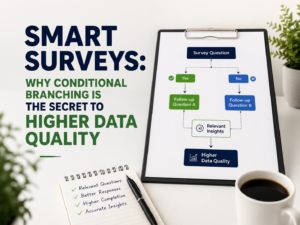
Branching Logic is a survey design technique that adjusts the flow of questions based on a respondent’s previous answers. Instead of forcing everyone through a fixed path, it creates multiple paths within a single survey.
Think of it like a conversation with a smart interviewer.
If someone tells you they’ve never used your product, you wouldn’t ask them about advanced features. You would ask why they haven’t tried it. A human naturally adapts like this.
Branching Logic brings that same intelligence into surveys.
This matters because relevance is everything in data collection. When people see questions that clearly apply to them, they engage more. They think more carefully before answering. And they are far less likely to abandon the survey.
In short, better experience leads to better data.
The Hidden Problem with Traditional Surveys
To understand the value of Branching Logic, it helps to look at what happens without it.
Traditional surveys follow a linear structure. Everyone answers every question. At first, this may seem thorough. But in reality, it creates several hidden issues.
Respondents quickly encounter questions that don’t apply to them. When that happens, they either guess, select random options, or skip entirely. Over time, this introduces noise into your dataset.
There is also the problem of fatigue. Long, repetitive surveys feel like work. People lose interest. Their answers become less thoughtful. Some drop out before finishing.
Even worse, irrelevant questions can frustrate users. A non-customer being asked detailed product questions feels disconnected from the survey. That frustration reduces trust and engagement.
All of this leads to one outcome: low-quality data.
Branching Logic solves these issues at the source.
How Branching Logic Works in Practice
At a technical level, Branching Logic is based on simple “if-then” rules.
A respondent answers a question. The system evaluates that answer. Based on predefined conditions, the survey automatically directs the respondent to the next relevant question.
But what feels simple on the surface creates a powerful effect underneath.
Instead of a single path, your survey becomes a network of paths. Each respondent moves through a route that is tailored to their situation. Two people can take the same survey but experience completely different question flows.
For the respondent, this feels natural. There is no visible complexity. They simply move from one relevant question to another, without interruption.
For the researcher, this means each answer comes from a qualified context. And that context is what makes data meaningful.
Different Types of Branching Logic
This is not just one feature. It exists in several forms, each serving a different purpose.
The most basic form is skip logic. This simply removes irrelevant questions. If someone indicates they don’t use a service, the survey skips all related follow-up questions. This keeps the survey short and focused.
Another common type is display logic. Instead of jumping to a new section, it shows or hides questions instantly based on responses. This creates a smoother experience, especially in forms where multiple questions appear on the same page.
Then there is advanced branching, which allows for multiple conditions and complex paths. This is often used in detailed research surveys where respondents are segmented into different groups. Each group receives a unique set of questions tailored to their profile.
While these types vary in complexity, they all serve the same goal: making surveys smarter and more relevant.
How Branching Logic Improves Data Quality
The real power of Branching Logic lies in how it transforms the quality of data.
First, it removes irrelevant responses. When people are only shown questions that apply to them, they no longer need to guess or provide forced answers. This immediately reduces noise in your dataset.
Second, it improves accuracy. Relevance increases attention. When respondents feel that a question is meaningful to them, they take more time to answer thoughtfully. This leads to more honest and precise responses.
Third, it reduces survey fatigue. Instead of answering 30 generic questions, a respondent might only answer 10 highly relevant ones. This shorter, more focused experience keeps engagement high from start to finish.
Another major benefit is higher completion rates. When surveys feel personalized, people are more willing to complete them. A higher completion rate means a larger and more reliable dataset.
Finally, Branching Logic enables deeper insights. Because you can ask follow-up questions based on specific answers, you gain context. You don’t just know what people think — you understand why they think it.
And that “why” is what drives better decisions.
Real-World Applications of Branching Logic
Branching Logic is used across industries because its benefits are universal.
In customer feedback surveys, it helps separate experiences clearly. Satisfied customers can be guided toward testimonials or ratings, while dissatisfied customers are asked detailed questions about their issues. This allows businesses to capture both positive and negative feedback in a structured way.
In market research, it enables segmentation. Different audience groups can receive different questions within the same survey. This ensures that responses are relevant to each segment, improving the quality of insights.
In employee engagement surveys, it helps tailor questions based on roles or departments. Managers and entry-level employees often have very different perspectives. Branching Logic ensures each group is asked the right questions.
In healthcare surveys, it ensures that patients only see questions related to their condition or experience. This not only improves accuracy but also makes the survey more comfortable to complete.
Across all these use cases, the principle remains the same: relevance leads to better data.
Why Branching Logic Outperforms Traditional Surveys
The difference between traditional surveys and those using Branching Logic is not just technical. It is experiential.
Traditional surveys feel like forms. They are rigid and impersonal.
Branching Logic surveys feel like conversations. They adapt. They respond. They make sense.
This shift has a direct impact on data quality. When people feel understood, they provide better answers. When surveys respect their time, they are more likely to complete them.
In other words, Branching Logic doesn’t just improve surveys. It improves the relationship between the survey and the respondent.
Best Practices for Using Branching Logic Effectively
While Branching Logic is powerful, it needs to be used thoughtfully.
It starts with planning. Before building a survey, it is important to map out the different paths a respondent might take. This helps avoid confusion later.
Simplicity is also key. It is tempting to create highly complex logic structures, but this can make surveys harder to manage and analyze. A clear and focused structure is always more effective.
Testing is critical. Every possible path should be tested to ensure there are no broken flows or missing questions. Even a small mistake in logic can affect the entire dataset.
It is also important to maintain balance. While personalization is valuable, the data still needs to be comparable across respondents. This ensures meaningful analysis at the end.
Common Mistakes That Affect Data Quality
One of the most common mistakes is overcomplicating the logic. Too many conditions can create confusion and increase the risk of errors.
Another issue is creating dead ends. If a respondent reaches a point where no further questions are available, it disrupts the experience and can lead to incomplete data.
Skipping important questions is another risk. If logic rules are not carefully designed, some respondents may miss critical questions entirely.
Finally, poor testing can quietly damage your results. Without proper testing, logic errors may go unnoticed until after data collection is complete.
Avoiding these mistakes ensures that Branching Logic works as intended.
The Future of Branching Logic in Surveys
Branching Logic is evolving quickly.
With the rise of artificial intelligence, surveys are becoming even more adaptive. Future surveys will not only respond to answers but also predict the most relevant questions in real time.
Personalization will go deeper. Surveys will adjust tone, length, and content based on user behavior.
This shift will make surveys feel less like questionnaires and more like guided conversations.
And as this happens, the quality of data will continue to improve.
The Advantages of Branching Logic
More Relevant Questions for Every Respondent
One of the biggest strengths of Branching Logic is relevance.
Instead of forcing everyone through the same path, it adapts the survey based on individual answers. This means respondents only see questions that actually apply to them.
When questions feel relevant, people stay engaged. They don’t feel like they’re wasting time. And that improves the overall experience.
Higher Data Accuracy and Quality
Better questions lead to better answers.
When respondents are asked only what matters to them, they don’t need to guess or skip. They can answer confidently and honestly.
This reduces noise in your data and gives you insights you can actually trust.
Reduced Survey Fatigue
Long surveys often lead to drop-offs.
But with Branching Logic, each respondent answers fewer questions. The survey becomes shorter and more focused for them.
This reduces mental effort and keeps users engaged from start to finish.
Improved Completion Rates
When surveys feel easy and personalized, people are more likely to complete them.
Branching Logic removes unnecessary friction. It creates a smooth flow that feels natural. As a result, more respondents reach the end of the survey.
Higher completion rates mean more usable data.
Deeper and More Meaningful Insights
Branching Logic allows you to ask follow-up questions based on specific answers.
This helps you go beyond surface-level responses. You can explore the reasons behind opinions, behaviors, and decisions.
Instead of just collecting data, you start understanding context.
Better User Experience
At its core, Branching Logic improves how a survey feels.
It turns a static form into something interactive. Something responsive. Something that feels almost like a conversation.
And when users enjoy the experience, they respond better.
The Disadvantages of Branching Logic
More Complex to Design
Branching Logic requires planning.
You can’t just write questions and publish. You need to think about different paths, user scenarios, and logical flows.
Without proper structure, it can quickly become confusing.
Risk of Logic Errors
A small mistake in logic can have a big impact.
For example, a wrong condition might skip important questions. Or send respondents to the wrong section.
These errors are not always obvious. And they can affect your data without you noticing.
Harder to Analyze If Not Planned Well
While Branching Logic improves data quality, it can complicate analysis if not structured properly.
Different respondents may answer different sets of questions. If there is no consistency, comparing results across groups can become difficult.
That’s why planning for analysis is just as important as designing the survey.
Time-Consuming Setup
Creating a well-structured branching survey takes more time than a simple linear one.
You need to map flows, test paths, and verify conditions. This extra effort can be challenging, especially for beginners.
Over-Branching Can Reduce Clarity
More logic does not always mean better surveys.
If you add too many conditions, the structure becomes difficult to manage. It may also increase the chance of missing important insights.
Simplicity often leads to better results.
Requires Thorough Testing
Testing is not optional with Branching Logic.
Every possible path must be checked. If even one path is broken, it can affect a portion of your respondents.
This adds an extra step before launching your survey.
Final Thoughts
At its core, Branching Logic is about respect.
It respects the respondent’s time.
It respects their context.
And it respects the importance of accurate data.
When surveys become more human, the data becomes more meaningful.
If you want reliable insights, better decisions, and higher engagement, Branching Logic is not optional anymore.
Frequently Asked Questions (FAQs) About Branching Logic
What is Branching Logic in surveys?
Branching Logic is a feature that allows a survey to change its question flow based on a respondent’s previous answers. Instead of showing the same questions to everyone, it creates a personalized path for each participant.
This makes surveys more relevant, easier to complete, and more effective at collecting accurate data.
How does Branching Logic improve data quality?
Branching Logic improves data quality by ensuring that respondents only see questions that apply to them. This reduces random answers, eliminates guesswork, and keeps responses focused.
When people answer relevant questions, they provide more thoughtful and honest feedback. That leads to cleaner, more reliable data.
What is the difference between Branching Logic and Skip Logic?
Skip Logic is actually a type of Branching Logic.
Skip Logic simply skips irrelevant questions based on an answer. Branching Logic is broader. It includes multiple paths, conditions, and dynamic question flows.
In short, all skip logic is branching logic, but not all branching logic is just skipping questions.
Does Branching Logic make surveys shorter?
Yes, in most cases it does.
Because respondents only see relevant questions, they avoid unnecessary sections. This reduces the total number of questions each person answers, making the survey feel faster and more engaging.
Can Branching Logic increase survey completion rates?
Absolutely.
When surveys feel personalized and easy to follow, people are more likely to complete them. Branching Logic removes frustration and keeps respondents engaged, which directly improves completion rates.
Is Branching Logic difficult to set up?
Not anymore.
Most modern survey tools offer simple visual builders where you can create logic rules without coding. You just define conditions like “if answer is X, go to question Y.”
With a bit of planning, it becomes very easy to implement.
Can Branching Logic handle complex surveys?
Yes, and this is where it becomes very powerful.
You can create multiple paths for different audience segments, behaviors, or responses. This allows you to run advanced surveys within a single structure while still keeping the experience smooth for respondents.
Does Branching Logic affect data analysis?
It actually improves analysis.
Because responses are more relevant and segmented, it becomes easier to compare groups and identify patterns. You get more meaningful insights instead of mixed or noisy data.
When should you use Branching Logic in a survey?
You should use Branching Logic whenever your audience is not identical.
If your survey includes different types of users, experiences, or behaviors, branching helps tailor the questions accordingly. This ensures each respondent gets the most relevant experience.
Can too much Branching Logic be a problem?
Yes, it can.
Overcomplicating your survey with too many conditions can make it harder to manage and analyze. It can also increase the risk of errors.
The key is to keep your logic simple, clear, and well-tested.
Is Branching Logic suitable for all types of surveys?
In most cases, yes.
It works especially well for customer feedback, market research, employee surveys, and product research. However, for very short or simple surveys, it may not always be necessary.
How do you test Branching Logic before launching a survey?
You should manually go through every possible path in your survey. Answer questions in different ways to ensure the logic works correctly. This helps you catch missing questions, broken flows, or incorrect conditions before real respondents see the survey.