- 15 min read



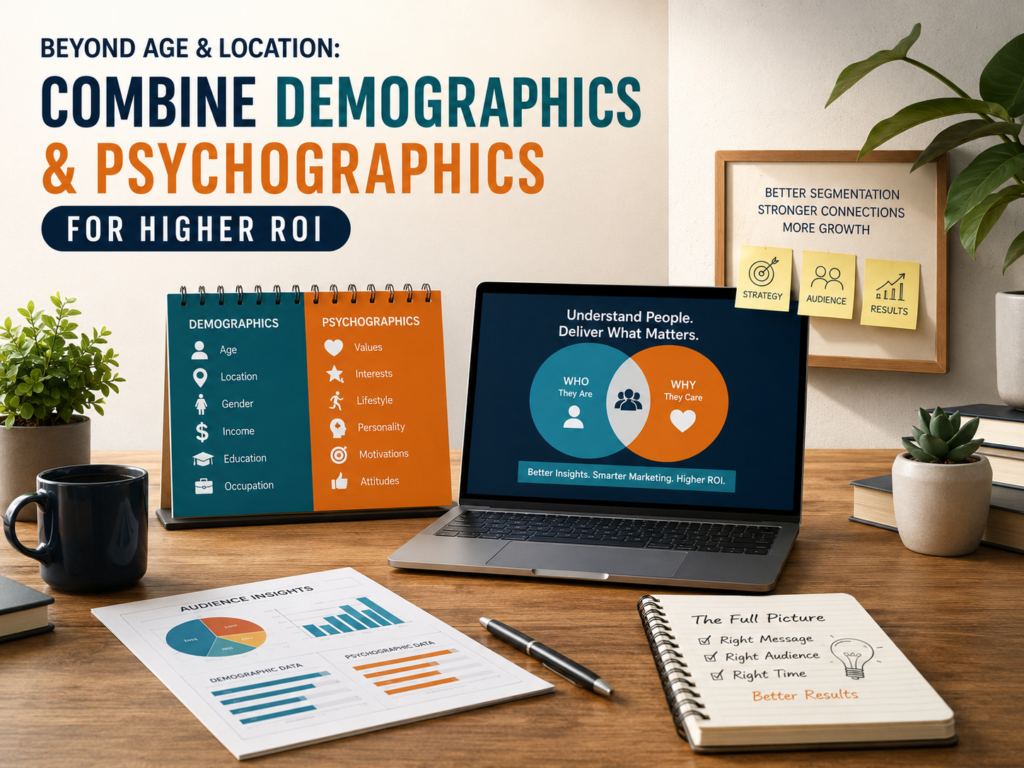
Modern marketing is no longer about reaching the largest possible audience. It’s about reaching the right audience with the right message at the right time.
For years, businesses relied heavily on demographic information such as age, gender, income, and location to define their target market. While these data points remain valuable, they only tell part of the story.
Imagine two people who are both 32 years old, live in New York City, earn $90,000 per year, and work in technology. On paper, they look almost identical. Yet one may be an adventurous traveler who values sustainability and premium products, while the other prefers saving money, enjoys gaming at home, and rarely shops outside major sales.
Their demographics are nearly identical.
Their buying behavior is completely different.
This is why today’s highest-performing marketers combine demographic information with psychographic insights. Understanding demographic vs psychographic segmentation allows businesses to move beyond basic customer profiles and create marketing campaigns that truly resonate.
In this guide, you’ll learn the differences between demographics and psychographics, discover the benefits of combining demographics and psychographics, explore various market segmentation types, and learn how to build an effective demographic and psychographic profile template that improves marketing ROI.
Why Traditional Demographics Are No Longer Enough
For decades, demographics formed the foundation of market segmentation.
Businesses grouped customers based on measurable characteristics such as:
- Age
- Gender
- Income
- Education
- Occupation
- Marital status
- Geographic location
These variables remain useful because they are easy to collect and analyze.
However, demographics answer only one question:
Who is your customer?
They do not explain:
- Why customers buy
- What motivates them
- What values influence decisions
- What problems they want solved
- How they make purchasing decisions
Without these answers, marketers often struggle to create highly relevant messaging.
Understanding Demographic vs Psychographic Segmentation
To build stronger customer profiles, it’s important to understand demographic vs psychographic segmentation.
Although both approaches categorize audiences, they focus on different aspects of customer behavior.
What Is Demographic Segmentation?
Demographic segmentation groups customers using objective characteristics.
Examples include:
- Age
- Gender
- Income
- Education
- Occupation
- Family size
- Location
These characteristics help businesses identify broad audience groups.
For example:
- Women aged 25–40
- College graduates
- Homeowners
- Urban professionals
Demographic data is relatively easy to collect through surveys, CRM systems, and public datasets.
What Is Psychographic Segmentation?
Psychographic segmentation focuses on the psychological characteristics that influence buying behavior.
These include:
- Lifestyle
- Interests
- Values
- Beliefs
- Personality
- Attitudes
- Hobbies
- Goals
- Motivations
Instead of asking:
“Who is the customer?”
Psychographics asks:
“Why does this customer make purchasing decisions?”
This deeper understanding helps marketers create messages that feel personal and relevant.
Demographics Tell You Who. Psychographics Tell You Why.
Consider an outdoor clothing company.
Demographic Data
- Age: 30
- Income: $80,000
- Lives in Colorado
- Married
This provides useful information.
But now consider psychographics.
Psychographic Data
- Loves hiking
- Values sustainability
- Prefers premium brands
- Travels frequently
- Enjoys outdoor adventures
- Supports environmentally friendly companies
Now the business understands much more than basic demographics.
It understands motivations.
That insight dramatically improves marketing effectiveness.
Why Combining Demographics and Psychographics Produces Better Results
The real marketing advantage comes from combining demographics and psychographics.
Together, they create a complete customer profile.
Instead of targeting:
“Women aged 25–40.”
You can target:
“Women aged 25–40 who value eco-friendly products, travel frequently, prioritize wellness, and prefer premium brands.”
This level of precision improves nearly every aspect of marketing.
Benefits of Combining Demographics and Psychographics
Businesses that combine both segmentation methods often experience stronger marketing performance.
Benefits include:
- Higher conversion rates
- Better audience targeting
- More personalized messaging
- Increased customer engagement
- Higher advertising ROI
- Improved customer retention
- Better product positioning
- More effective content marketing
The more accurately businesses understand customers, the more relevant their communications become.
Understanding Market Segmentation Types
Effective marketing typically uses multiple market segmentation types rather than relying on a single approach.
Demographic Segmentation
Focuses on measurable customer characteristics.
Best for identifying broad audience groups.
Geographic Segmentation
Groups customers based on:
- Country
- State
- City
- Climate
- Population density
Useful for localized marketing campaigns.
Behavioral Segmentation
Examines customer actions such as:
- Purchase history
- Product usage
- Brand loyalty
- Shopping frequency
- Customer lifecycle stage
Behavior often predicts future purchases.
Psychographic Segmentation
Explores customer motivations.
Includes:
- Interests
- Values
- Lifestyle
- Attitudes
- Personality
Psychographics explains why customers behave the way they do.
Why Psychographics Improve Marketing ROI
Most purchasing decisions are emotional before they become logical.
Customers often justify purchases logically after making emotionally driven decisions.
Psychographic research helps businesses identify emotional triggers such as:
- Security
- Convenience
- Prestige
- Belonging
- Sustainability
- Innovation
- Status
- Self-improvement
Marketing messages that connect with these motivations typically outperform generic campaigns.
This is one reason psychographic segmentation often produces higher ROI.
How Surveys Help Collect Demographic and Psychographic Data
Surveys remain one of the most effective methods for collecting both demographic and psychographic information.
Demographic questions might include:
- What is your age?
- What is your occupation?
- Where do you live?
- What is your education level?
Psychographic questions explore motivations instead.
Examples include:
- Which values are most important when choosing a brand?
- What motivates you to purchase premium products?
- Which hobbies do you enjoy?
- What challenges are you trying to solve?
- What influences your purchasing decisions?
Combining both types of questions creates richer customer insights.
Target Audience Demographics and Psychographics
Successful marketing depends on understanding both target audience demographics and psychographics.
For example, consider a fitness brand.
Demographics
- Age: 28–45
- Income: $60,000+
- Urban professionals
Psychographics
- Health-conscious
- Enjoys outdoor activities
- Values convenience
- Interested in nutrition
- Seeks work-life balance
- Motivated by long-term wellness
This combined profile provides far more actionable insights than demographics alone.
Creating a Demographic and Psychographic Profile Template
Every business should build a structured demographic and psychographic profile template for its ideal customers.
A comprehensive template might include:
Demographic Information
- Age
- Gender
- Location
- Education
- Occupation
- Income
- Family status
Psychographic Information
- Goals
- Values
- Interests
- Hobbies
- Lifestyle
- Personality traits
- Buying motivations
- Pain points
- Challenges
- Preferred brands
- Media habits
This profile becomes a valuable resource for marketing, product development, customer service, and sales teams.
Using Customer Personas to Bring Data to Life
Once demographic and psychographic data has been collected, businesses can build customer personas.
Rather than viewing customers as statistics, personas describe realistic customer profiles.
Example:
Sarah
- 35 years old
- Marketing Manager
- Lives in Chicago
- Travels frequently
- Values convenience
- Prefers premium software
- Listens to business podcasts
- Shops online regularly
- Willing to pay more for excellent customer support
Personas help teams make customer-focused decisions.
Applying Segmentation Across Marketing Channels
Combined audience data improves performance across every marketing channel.
Email Marketing
Send personalized messages based on customer interests and motivations.
Paid Advertising
Create highly targeted campaigns that speak to specific customer values.
Content Marketing
Publish articles that address audience goals, pain points, and interests.
Product Development
Build features customers actually want.
Customer Experience
Deliver more relevant recommendations and support.
Common Mistakes Businesses Make
Many businesses collect demographic information but ignore psychographics.
Others collect psychographic data without understanding demographic context.
Some common mistakes include:
- Assuming demographics explain buying behavior
- Creating overly broad customer segments
- Ignoring customer motivations
- Collecting data without acting on it
- Failing to update customer profiles regularly
Avoiding these mistakes leads to more effective segmentation strategies.
Using AI to Improve Customer Segmentation
Artificial intelligence is making audience segmentation smarter than ever.
Modern AI tools can:
- Analyze survey responses
- Identify hidden audience segments
- Detect behavioral patterns
- Predict purchasing behavior
- Recommend personalized campaigns
Rather than manually analyzing thousands of responses, AI helps marketers uncover insights faster and with greater accuracy.
How SurveyFlip Helps Build Better Customer Profiles
SurveyFlip enables businesses to collect both demographic and psychographic data through customizable online surveys.
With flexible question types, advanced survey logic, and powerful reporting, organizations can create detailed audience profiles that support better marketing, stronger customer relationships, and more informed business decisions.
Whether you’re researching a new market, refining customer personas, or improving campaign targeting, SurveyFlip helps transform survey responses into actionable audience insights.
Measuring ROI from Better Segmentation
Improved audience segmentation often leads to measurable business improvements, including:
- Higher click-through rates
- Increased email engagement
- Better ad performance
- Improved conversion rates
- Lower customer acquisition costs
- Higher customer lifetime value
- Stronger brand loyalty
When businesses understand not only who their customers are but also why they buy, every marketing dollar works harder.
The Future of Audience Segmentation
As AI, predictive analytics, and first-party data become increasingly important, audience segmentation will continue to evolve.
Future marketing strategies will likely rely on:
- Real-time customer profiles
- AI-generated audience segments
- Dynamic personalization
- Predictive behavior modeling
- Automated customer journey optimization
Organizations that combine demographic and psychographic insights today will be better prepared for the future of customer-centric marketing.
Final Thoughts
Understanding demographic vs psychographic segmentation is essential for businesses that want to create more effective marketing strategies in 2026. Demographics help identify who your customers are, while psychographics reveal why they make purchasing decisions.
By combining demographics and psychographics, businesses gain a complete picture of their audience, allowing them to personalize campaigns, improve customer experiences, and achieve higher returns on marketing investments.
Whether you’re exploring different market segmentation types, defining target audience demographics and psychographics, or building a demographic and psychographic profile template, the key is simple: collect meaningful customer insights and use them to guide every marketing decision.
The businesses that know their customers best will always have the greatest opportunity to grow.
Frequently Asked Questions (FAQ)
1. What is demographic vs psychographic segmentation?
Demographic vs psychographic segmentation refers to two different ways of understanding your target audience.
Demographic segmentation groups customers based on measurable characteristics such as age, gender, income, education, occupation, and geographic location.
Psychographic segmentation focuses on the attitudes, values, interests, lifestyles, personalities, motivations, and beliefs that influence purchasing decisions.
While demographics explain who your customers are, psychographics explain why they buy.
2. Why is psychographic segmentation important?
Psychographic segmentation helps businesses understand what motivates customers beyond basic demographic information. By identifying customer values, interests, goals, and pain points, companies can create more personalized marketing campaigns, improve customer experiences, and increase conversion rates.
This deeper understanding often leads to stronger customer relationships and higher marketing ROI.
3. What is the difference between demographics and psychographics?
The main difference is the type of information each method collects.
Demographic data includes:
- Age
- Gender
- Income
- Education
- Occupation
- Marital status
- Location
Psychographic data includes:
- Lifestyle
- Interests
- Values
- Personality
- Hobbies
- Goals
- Opinions
- Buying motivations
Both types of information work best when used together.
4. Why should businesses combine demographics and psychographics?
Combining demographics and psychographics creates a much more complete customer profile.
For example, knowing that your audience is between 25 and 40 years old is useful, but understanding that they value sustainability, prefer premium products, and enjoy outdoor activities helps you create far more relevant marketing campaigns.
This combination improves personalization, customer engagement, and sales performance.
5. What are the main market segmentation types?
The four primary market segmentation types are:
- Demographic segmentation
- Geographic segmentation
- Behavioral segmentation
- Psychographic segmentation
Many successful businesses use all four together to build highly targeted marketing strategies.
6. Which type of segmentation is most effective?
There isn’t a single “best” segmentation method.
Demographic segmentation helps identify broad customer groups, while psychographic segmentation explains customer motivations. Behavioral segmentation reveals purchasing habits, and geographic segmentation supports location-based marketing.
The most effective strategy combines multiple segmentation methods to gain a complete understanding of the audience.
7. How can surveys collect psychographic data?
Surveys are one of the most effective ways to collect psychographic information because they allow businesses to ask customers directly about their opinions, values, interests, motivations, and lifestyle choices.
Questions might include:
- What factors influence your purchasing decisions?
- What values are most important when choosing a brand?
- Which hobbies or interests describe you?
- What challenges are you trying to solve?
These responses help build detailed customer profiles.
8. What questions should I ask to collect demographic information?
Common demographic survey questions include:
- What is your age?
- What is your gender?
- What is your highest level of education?
- What is your annual household income?
- What industry do you work in?
- Where do you currently live?
These questions help classify respondents into meaningful customer groups.
9. What questions should I ask to collect psychographic information?
Useful psychographic questions include:
- What motivates you when choosing a product?
- Which values matter most to you?
- What are your biggest challenges?
- Which activities do you enjoy outside of work?
- What type of brands do you trust?
- How do you typically research products before purchasing?
These questions provide deeper insights into customer behavior.
10. What is a demographic and psychographic profile template?
A demographic and psychographic profile template is a structured framework that helps businesses organize customer information.
A typical profile includes:
Demographic Information
- Age
- Gender
- Occupation
- Income
- Education
- Location
Psychographic Information
- Goals
- Values
- Interests
- Lifestyle
- Personality
- Buying motivations
- Pain points
- Preferred brands
- Shopping behavior
This template helps teams create more accurate customer personas.
11. How do demographics and psychographics improve marketing ROI?
Better audience insights lead to better marketing decisions.
When businesses understand both who customers are and why they buy, they can:
- Create more relevant advertisements
- Improve email marketing personalization
- Increase conversion rates
- Reduce wasted advertising spend
- Build stronger customer relationships
These improvements often result in higher returns on marketing investments.
12. Can small businesses benefit from psychographic segmentation?
Absolutely.
Small businesses often have limited marketing budgets, making accurate audience targeting even more important. Collecting psychographic insights helps small businesses create highly relevant messaging that competes effectively against larger brands.
13. How does AI improve customer segmentation?
AI helps businesses analyze large amounts of customer data quickly. It can identify hidden audience segments, recognize purchasing patterns, predict future customer behavior, and recommend personalized marketing strategies.
When combined with survey data, AI makes audience segmentation faster and more accurate.
14. What industries use demographic and psychographic segmentation?
Almost every industry benefits from customer segmentation, including:
- E-commerce
- SaaS
- Retail
- Healthcare
- Education
- Hospitality
- Financial services
- Human resources
- Manufacturing
- Nonprofit organizations
Any organization that wants to better understand its customers can use these segmentation methods.
15. How often should customer profiles be updated?
Customer preferences and behaviors change over time, so businesses should review and update customer profiles regularly.
Many organizations update their audience segmentation every 6 to 12 months or after major changes such as launching new products, entering new markets, or observing significant shifts in customer behavior.
Regular updates ensure marketing strategies remain accurate and relevant.
16. How can SurveyFlip help with audience segmentation?
SurveyFlip enables businesses to collect both demographic and psychographic data through customizable online surveys. With flexible question types, conditional logic, and detailed reporting, organizations can create richer customer profiles, build more accurate buyer personas, and make data-driven marketing decisions based on real customer insights.
17. What are common mistakes when creating customer segments?
Some of the most common mistakes include:
- Relying only on demographic information
- Ignoring customer motivations
- Creating audience segments that are too broad
- Failing to validate assumptions with survey data
- Not updating customer profiles regularly
- Collecting data without using it to improve marketing strategies
Avoiding these mistakes leads to more accurate segmentation and better business outcomes.
18. Why is audience segmentation more important in 2026?
As digital marketing becomes more competitive and privacy regulations reduce access to third-party data, businesses increasingly rely on first-party customer insights. Combining demographic and psychographic data allows organizations to deliver personalized experiences, improve customer engagement, and maximize marketing performance in a privacy-first environment.
19. Can demographic and psychographic segmentation improve customer retention?
Yes. Understanding customers beyond basic demographics helps businesses create personalized experiences, recommend relevant products, and communicate in ways that align with customer values and motivations. These improvements strengthen customer relationships and increase long-term loyalty.
20. What’s the biggest takeaway from demographic vs psychographic segmentation?
The biggest lesson is that demographics tell you who your customers are, while psychographics reveal why they make decisions. Businesses that combine both types of data gain a more complete understanding of their audience, allowing them to create better products, more effective marketing campaigns, and stronger customer experiences that drive sustainable growth.