- 10 min read

Employee expectations have changed dramatically in recent years. In 2026, employees no longer want to feel like they are simply completing tasks for a paycheck. Modern teams want meaningful work, supportive leadership, career growth opportunities, flexibility, recognition, and healthy workplace culture.
At the same time, businesses are facing new challenges related to employee retention, productivity, burnout, remote work management, and workplace satisfaction.
This is why Employee Engagement Surveys have become one of the most important tools for modern organizations.
Businesses today can no longer rely on assumptions about employee happiness or team morale. Leaders need real insights directly from employees to understand what is working, what is creating frustration, and what changes are needed to improve workplace culture.
However, not all engagement surveys are effective.
Many organizations still use generic surveys with repetitive questions that fail to uncover real employee concerns. Employees often respond with neutral answers because the surveys feel disconnected, impersonal, or performative.
The most effective Employee Engagement Surveys 2026 are designed to reveal honest employee opinions, uncover hidden workplace issues, and generate actionable insights that improve company culture and business performance.
Modern survey platforms powered by AI and automation are now helping companies collect deeper employee insights faster and more accurately than ever before.
What Are Employee Engagement Surveys?
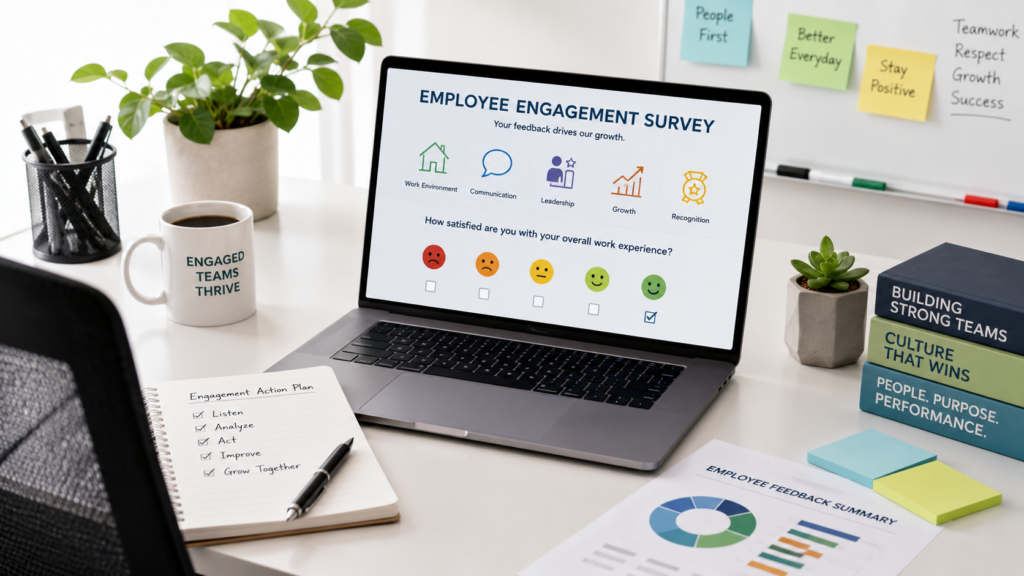
Employee Engagement Surveys are structured feedback surveys designed to measure how employees feel about their work environment, leadership, responsibilities, company culture, communication, career growth, and overall workplace experience.
The purpose of these surveys is not simply to collect opinions.
The real goal is to understand:
- Employee motivation
- Workplace satisfaction
- Team morale
- Productivity barriers
- Leadership effectiveness
- Burnout risks
- Retention challenges
A strong engagement survey helps organizations identify both strengths and weaknesses within the workplace.
This information allows businesses to make smarter decisions that improve employee experience, increase retention, and strengthen overall organizational performance.
Why Employee Engagement Matters More in 2026
Employee engagement has become directly connected to business success.
Companies with highly engaged employees often experience:
- Higher productivity
- Lower turnover rates
- Better customer experiences
- Stronger collaboration
- Improved innovation
- Better company culture
On the other hand, disengaged employees can negatively impact team performance, morale, and long-term growth.
Modern employees expect workplaces that value communication, transparency, flexibility, and career development.
In 2026, remote work, hybrid teams, and digital collaboration have also changed how organizations manage employee relationships.
Because of these changes, businesses must actively listen to employees more consistently than ever before.
This is why Employee Engagement Surveys 2026 are becoming increasingly important for organizations of all sizes.
Why Traditional Engagement Surveys Often Fail
Many companies conduct employee surveys but still fail to uncover real employee concerns.
This usually happens because traditional surveys often feel:
- Too generic
- Too long
- Too repetitive
- Too infrequent
- Too disconnected from real workplace experiences
Employees may avoid giving honest feedback if they believe leadership will ignore their responses or if they fear negative consequences.
Poorly designed surveys also create survey fatigue, which reduces participation and response quality.
Modern engagement surveys must feel relevant, personalized, and actionable.
Employees are far more likely to provide honest feedback when they believe their opinions genuinely matter.
Questions That Actually Reveal What Employees Think
The quality of survey questions determines the quality of insights organizations receive.
Many businesses make the mistake of asking overly broad questions that fail to uncover meaningful employee experiences.
Strong Employee Engagement Surveys use carefully designed questions that encourage honest reflection and detailed feedback.
Instead of asking only:
“Are you satisfied with your job?”
Businesses should explore deeper workplace experiences.
For example:
- Do you feel your work is valued by leadership?
- Do you have opportunities for professional growth?
- Do you feel comfortable sharing ideas and concerns?
- Does your manager provide helpful support and communication?
- Do you feel recognized for your contributions?
- Does your workload feel manageable?
- Do you feel connected to company goals and vision?
These types of questions help organizations identify emotional, cultural, and operational issues that directly affect engagement.
Why Open-Ended Questions Matter
Open-ended questions are becoming increasingly important in Employee Engagement Surveys 2026 because they allow employees to explain experiences in their own words.
While rating scales provide useful measurable data, open-ended responses often reveal deeper emotional insights and workplace concerns.
For example, asking:
“What is one thing the company could improve to support employees better?”
can uncover issues leadership never anticipated.
Employees may reveal:
- Communication frustrations
- Burnout concerns
- Leadership challenges
- Workflow inefficiencies
- Team collaboration problems
Modern AI-powered survey tools can now analyze open-ended feedback automatically using sentiment analysis and pattern recognition.
This allows businesses to identify recurring themes much faster.
The Role of AI in Modern Employee Engagement Surveys
Artificial intelligence is transforming how businesses collect and analyze employee feedback.
Traditional surveys often required HR teams to manually review large amounts of data, which consumed significant time and resources.
Modern AI-powered survey platforms can now:
- Detect employee sentiment automatically
- Identify engagement trends
- Predict burnout risks
- Analyze open-ended responses
- Personalize survey experiences
- Generate automated reports
- Identify hidden workplace patterns
This helps organizations move beyond surface-level feedback toward deeper employee understanding.
AI also helps businesses identify issues earlier before disengagement turns into resignations or productivity problems.
Why Anonymous Surveys Improve Honesty
Employees are more likely to provide honest feedback when they feel psychologically safe.
Anonymous surveys reduce fear of judgment or retaliation and encourage employees to speak more openly about workplace experiences.
This is especially important when discussing:
- Leadership effectiveness
- Workplace culture
- Team conflicts
- Burnout
- Communication issues
Organizations that guarantee confidentiality generally receive more accurate and actionable feedback.
Trust is one of the most important elements of effective employee engagement strategies.
Best Employee Engagement Survey Tools in 2026
The rise of AI and automation has significantly improved the quality of employee survey platforms.
The best employee engagement survey tools now offer features such as:
- Real-time analytics
- AI-powered sentiment analysis
- Automated reporting
- Pulse surveys
- Mobile-friendly interfaces
- Personalized survey flows
- Predictive workforce analytics
Modern survey platforms help HR teams and business leaders monitor engagement continuously instead of relying only on annual surveys.
Continuous listening strategies are becoming the new standard in workplace feedback management.
Pulse Surveys Are Replacing Annual Surveys
Traditional annual employee surveys are becoming less effective because workplace conditions can change quickly.
Modern businesses increasingly use pulse surveys instead.
Pulse surveys are short, frequent surveys designed to monitor employee sentiment regularly throughout the year.
These surveys help organizations identify:
- Sudden morale changes
- Burnout risks
- Leadership concerns
- Workplace frustrations
- Team engagement trends
This creates faster feedback loops and allows businesses to respond more quickly to employee concerns.
The shift toward continuous listening is one of the biggest trends in Employee Engagement Surveys 2026.
Employee Burnout Is a Growing Concern
Burnout has become one of the biggest workplace challenges in recent years.
Heavy workloads, remote work stress, communication overload, and poor work-life balance are contributing to employee exhaustion across industries.
Modern engagement surveys help organizations identify burnout risks early.
Questions related to:
- Workload balance
- Stress levels
- Mental fatigue
- Team support
- Work-life balance
can help businesses understand whether employees are struggling silently.
Organizations that actively monitor employee wellbeing often improve retention and workplace satisfaction significantly.
Why Acting on Survey Feedback Is Critical
One of the biggest mistakes companies make is collecting employee feedback without taking meaningful action afterward.
Employees quickly become disengaged if surveys appear performative rather than impactful.
When organizations conduct Employee Engagement Surveys, employees expect:
- Leadership transparency
- Visible improvements
- Open communication
- Real workplace changes
Even small improvements based on survey feedback can increase employee trust significantly.
The goal of engagement surveys is not simply to gather data.
The goal is to improve workplace experiences continuously.
Mobile-Friendly Employee Surveys Are Essential
Modern employees increasingly access workplace systems through smartphones and mobile devices.
This means employee surveys must be optimized for mobile experiences.
Mobile-friendly engagement surveys improve:
- Participation rates
- Accessibility
- Completion rates
- User experience
Employees are far more likely to complete surveys when the process feels fast, simple, and convenient.
In 2026, mobile-first survey design is becoming a standard expectation.
The Future of Employee Engagement Surveys
The future of employee feedback is becoming more intelligent, predictive, and personalized.
Emerging trends include:
- AI-powered engagement analysis
- Predictive employee retention insights
- Conversational employee surveys
- Real-time sentiment monitoring
- Personalized survey experiences
- Automated workforce analytics
Organizations are moving away from reactive HR management toward proactive employee experience strategies.
The companies that actively listen to employees and adapt quickly will have major advantages in talent retention and workplace culture.
Final Thoughts
Employee engagement is no longer just an HR metric.
It is now one of the most important drivers of productivity, retention, workplace culture, and long-term business success.
Well-designed Employee Engagement Surveys help organizations understand what employees truly think, identify workplace challenges early, and create stronger employee experiences.
Businesses using modern AI-powered survey systems and the best employee engagement survey tools are gaining deeper workforce insights than ever before.
As workplace expectations continue evolving, Employee Engagement Surveys 2026 will become even more essential for organizations that want to build healthy, productive, and future-ready teams.
The companies that listen to employees today will be the ones that lead tomorrow.
Frequently Asked Questions (FAQ)
1. What are Employee Engagement Surveys?
Employee Engagement Surveys are surveys designed to measure how employees feel about their workplace, leadership, communication, job satisfaction, company culture, and overall work experience.
2. Why are Employee Engagement Surveys important?
Employee engagement surveys help businesses understand employee concerns, improve workplace culture, increase productivity, strengthen retention, and reduce burnout by collecting honest employee feedback.
3. How often should companies conduct employee engagement surveys?
Many businesses now use continuous feedback strategies instead of yearly surveys. In 2026, companies commonly use quarterly or monthly pulse surveys to monitor employee sentiment more consistently.
4. What questions should be included in Employee Engagement Surveys?
Effective surveys often ask questions about:
- Leadership support
- Career growth opportunities
- Workplace communication
- Recognition and appreciation
- Work-life balance
- Team collaboration
- Employee wellbeing
These questions help reveal what employees truly think about the workplace.
5. What are pulse surveys?
Pulse surveys are short and frequent employee surveys used to monitor engagement, morale, stress levels, and workplace satisfaction regularly throughout the year.
6. Why are anonymous employee surveys important?
Anonymous surveys encourage employees to provide more honest feedback without fear of judgment or negative consequences. This improves the quality and accuracy of survey responses.
7. How does AI improve Employee Engagement Surveys?
AI-powered survey tools can:
- Analyze employee sentiment
- Detect burnout risks
- Identify engagement trends
- Analyze open-ended feedback
- Generate automated reports
- Predict retention challenges
This helps businesses gain deeper workforce insights faster.
8. What are the best employee engagement survey tools in 2026?
The best employee engagement survey tools typically offer:
- AI-powered analytics
- Real-time reporting
- Pulse surveys
- Mobile-friendly design
- Automated insights
- Personalized survey experiences
- Predictive workforce analytics
Modern tools help organizations improve employee experience continuously.
9. What are common mistakes businesses make with employee surveys?
Common mistakes include:
- Asking too many questions
- Ignoring survey feedback
- Conducting surveys too rarely
- Using generic questions
- Failing to communicate survey results
- Not taking action after collecting feedback
These mistakes reduce employee trust and engagement.
10. What is the future of Employee Engagement Surveys?
The future of Employee Engagement Surveys 2026 includes AI-powered sentiment analysis, predictive employee analytics, conversational surveys, real-time engagement tracking, and personalized employee feedback systems designed to improve workplace culture proactively.