- 10 min read
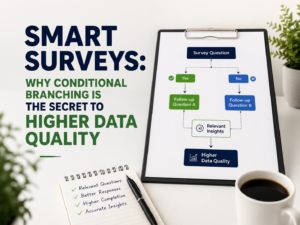



The survey industry is going through one of the biggest transformations in its history. For years, businesses relied on traditional feedback forms, manual reports, and delayed customer insights to understand their audiences. That approach worked in the past because customer expectations were lower, competition moved slower, and businesses had more time to react.
But in 2026, the digital economy operates at a completely different speed.
Modern businesses need real-time customer insights, predictive intelligence, faster decision-making, and personalized customer experiences. This is exactly why the future of surveys is being reshaped by artificial intelligence, automation, and predictive analytics.
Today’s online survey tools are evolving far beyond simple questionnaires. They are becoming intelligent customer insight systems capable of understanding customer behavior, predicting future trends, and helping businesses make smarter decisions faster than ever before.
The future of online survey technology is not simply about collecting feedback anymore. It is about turning customer data into actionable intelligence that drives business growth.
Companies that continue using outdated survey systems risk falling behind competitors that are already leveraging AI-powered customer intelligence platforms.
How Online Survey Tools Have Changed Over the Years
Traditional survey systems were designed for a much slower business environment. Companies would manually create surveys, send them to customers through email or websites, wait days or weeks for responses, and then manually analyze spreadsheets to identify patterns.
This process created several major challenges.
Businesses often experienced:
- Slow feedback cycles
- Delayed decision-making
- Generic customer experiences
- Low survey participation
- Manual reporting workloads
- Limited personalization
- Difficulty identifying hidden insights
In many cases, businesses discovered customer problems too late to respond effectively.
For example, a company might only realize customers were frustrated after losing large numbers of users or receiving public negative reviews.
In today’s highly competitive digital market, businesses can no longer afford that delay.
Modern online survey tools are solving these problems by using artificial intelligence, automation, machine learning, and predictive analytics to create faster and smarter customer feedback systems.
The role of surveys is evolving from basic data collection into continuous customer intelligence management.
AI Is Transforming the Entire Survey Experience
Artificial intelligence is now becoming the foundation of modern survey technology.
Instead of manually building surveys question by question, businesses can now use AI-powered systems that automatically generate intelligent survey flows based on business goals, customer behavior, and previous feedback data.
AI is changing nearly every part of the survey process.
Modern AI-powered online survey tools can:
- Generate surveys automatically
- Personalize question sequences
- Analyze customer sentiment instantly
- Detect emotional patterns
- Predict customer behavior
- Summarize feedback automatically
- Identify hidden trends in responses
This dramatically reduces manual work while increasing the quality of insights businesses receive.
For example, AI can now analyze open-ended responses and detect whether customers sound frustrated, satisfied, confused, or disappointed without requiring manual review from support teams or analysts.
This creates faster and more scalable customer intelligence systems.
Automation Is Making Feedback Collection Smarter
Automation is another major force shaping the future of online survey technology.
In the past, businesses typically launched surveys occasionally as part of large campaigns or quarterly research projects.
Modern survey systems now operate continuously in the background.
Businesses can automatically trigger surveys:
- After product purchases
- Following customer support conversations
- During onboarding processes
- After subscription renewals
- Following app usage
- After service completion
This allows businesses to collect feedback naturally throughout the customer journey instead of relying only on occasional surveys.
Automation also helps companies respond faster when problems occur.
For example, if a customer reports a negative support experience, modern survey systems can instantly notify customer service teams in real time.
This allows businesses to solve issues before frustration grows into customer churn or negative online reviews.
The speed of response is becoming one of the biggest competitive advantages in customer experience management.
Predictive Analytics Is Changing Business Decision-Making
One of the most powerful innovations in modern survey technology is predictive analytics.
Traditional surveys mainly focused on understanding past experiences. Predictive analytics goes much further by helping businesses anticipate future customer behavior.
Using machine learning and AI, modern online survey tools can identify patterns that predict:
- Customer churn risks
- Future buying behavior
- Loyalty trends
- Product adoption rates
- Support escalation risks
- Customer satisfaction changes
This gives businesses the ability to act proactively instead of reactively.
For example, imagine a SaaS company noticing patterns that suggest certain users are likely to cancel subscriptions soon. Predictive analytics can identify those users early based on survey responses, platform activity, and customer sentiment.
The company can then intervene immediately with personalized onboarding help, discounts, or customer support before losing the customer.
This predictive capability is becoming one of the most valuable features in the future of online survey systems.
Personalized Surveys Are Becoming the Industry Standard
Customers in 2026 expect personalized digital experiences everywhere.
Generic surveys with repetitive questions often feel outdated and irrelevant. As a result, businesses are increasingly using AI-powered personalization to improve engagement and response quality.
Modern online survey tools can dynamically adjust survey experiences based on:
- Customer history
- Product usage
- Customer journey stages
- Previous survey responses
- Behavioral patterns
- Purchase activity
Instead of showing the same questions to every user, intelligent systems now create personalized survey flows tailored to individual customer experiences.
For example:
- New customers may receive onboarding-related questions
- Returning customers may receive loyalty-focused surveys
- E-commerce customers may receive delivery experience surveys
- SaaS users may receive feature-specific feedback requests
This level of personalization significantly improves survey completion rates because customers feel the questions are more relevant to their experiences.
The future of surveys is becoming increasingly customer-centric rather than form-centric.
Real-Time Insights Are Becoming Essential
Businesses today operate in extremely fast-moving environments where customer expectations change rapidly.
Waiting weeks for survey reports is no longer practical.
Modern online survey tools now provide businesses with:
- Live dashboards
- Instant analytics
- Automated reporting
- Real-time sentiment analysis
- Immediate alerts for negative feedback
This allows companies to identify problems and opportunities much faster than traditional feedback systems.
For example, if a software update suddenly creates customer frustration, businesses can detect negative sentiment immediately and respond before large-scale customer dissatisfaction spreads online.
This real-time intelligence helps organizations become more agile and customer-focused.
Conversational Surveys Are Growing Rapidly
Another major trend shaping the future of online survey systems is conversational feedback collection.
Traditional surveys often feel robotic and impersonal. Conversational surveys aim to create more natural interactions that resemble real human conversations.
Modern platforms increasingly use:
- Chat-style surveys
- AI-powered survey assistants
- Interactive question flows
- Voice-based feedback systems
These conversational experiences improve engagement because users feel more comfortable interacting naturally rather than filling out static forms.
As generative AI continues improving, conversational surveys will likely become even more advanced and human-like in the coming years.
Mobile-First Survey Design Is Now Mandatory
Most customer feedback in 2026 is collected through smartphones and tablets.
This shift has dramatically changed how surveys must be designed.
Long pages, slow-loading forms, and complicated interfaces perform poorly on mobile devices.
Modern online survey tools now prioritize:
- Mobile-first interfaces
- Faster loading speeds
- Simple layouts
- Touch-friendly interactions
- Shorter question flows
- Responsive designs
Businesses that fail to optimize surveys for mobile users often experience lower completion rates and reduced engagement.
The future of surveys depends heavily on creating smooth and effortless mobile experiences.
AI Is Improving Data Quality and Accuracy
One of the biggest challenges with traditional surveys was poor data quality.
Many users would:
- Rush through questions
- Skip sections
- Provide inconsistent answers
- Abandon surveys halfway
AI-powered systems are helping solve these problems.
Modern survey platforms can now:
- Detect suspicious response behavior
- Identify inconsistent answers
- Predict survey fatigue
- Optimize question order dynamically
- Reduce unnecessary questions automatically
This leads to more accurate insights and stronger business intelligence.
Businesses are no longer just collecting more data—they are collecting better data.
The Future of Online Surveys Will Be Fully Intelligent
The future of online survey technology is moving toward fully intelligent customer listening ecosystems.
Future survey systems will likely include:
- AI-generated surveys
- Hyper-personalized feedback flows
- Predictive customer intelligence
- Voice and video feedback collection
- Emotion recognition technology
- Fully automated insight generation
Surveys are evolving into always-active customer intelligence systems that continuously help businesses understand customer behavior.
The companies adopting these technologies early are gaining major competitive advantages in customer experience management, marketing strategy, and product development.
Why Businesses Must Adapt Now
Customer expectations are evolving rapidly, and businesses that fail to modernize their survey systems may struggle to stay competitive.
Companies still relying on outdated feedback methods often experience:
- Lower engagement rates
- Slower decision-making
- Poor customer insights
- Reduced customer loyalty
- Missed growth opportunities
Modern businesses need faster, smarter, and more predictive customer intelligence systems.
Organizations investing in AI-powered online survey tools today are positioning themselves for stronger long-term growth in an increasingly data-driven economy.
Final Thoughts
The survey industry is entering a completely new era powered by AI, automation, and predictive analytics.
Modern online survey tools are no longer just digital forms. They are intelligent systems capable of helping businesses understand customers more deeply, predict future behavior, improve customer experiences, and make smarter business decisions in real time.
The future of online survey technology is becoming more personalized, automated, predictive, and conversational with every passing year.
Businesses that embrace these innovations early will be far better prepared to compete in the rapidly evolving digital economy of 2026 and beyond.
The future of surveys is not simply digital anymore. The future is intelligent.
Frequently Asked Questions (FAQ)
1. What are online survey tools?
Online survey tools are digital platforms that help businesses create, distribute, and analyze surveys to collect customer feedback, market research data, employee insights, and other valuable information.
2. How is AI changing online survey tools?
AI is transforming survey platforms by automating survey creation, personalizing question flows, analyzing customer sentiment, detecting patterns, and generating real-time insights faster than traditional survey systems.
3. What is the future of online survey technology?
The future of online survey technology includes AI-powered automation, predictive analytics, conversational surveys, real-time customer intelligence, voice feedback systems, and hyper-personalized survey experiences.
4. What is predictive analytics in surveys?
Predictive analytics uses AI and machine learning to analyze survey responses and customer behavior patterns to predict future outcomes such as customer churn, loyalty, buying behavior, or satisfaction trends.
5. Why are automated surveys becoming popular?
Automated surveys save time, improve efficiency, and allow businesses to collect feedback continuously throughout the customer journey without requiring manual management.
6. How do AI-powered surveys improve customer experience?
AI-powered surveys personalize questions, reduce irrelevant content, improve survey timing, and create more engaging experiences that increase response rates and customer satisfaction.
7. Are conversational surveys better than traditional surveys?
Conversational surveys often improve engagement because they feel more natural and interactive compared to static forms. Many businesses are now using chat-style and AI-driven survey experiences.
8. Why is real-time feedback important in 2026?
Real-time feedback helps businesses identify customer issues immediately, respond faster, improve customer experience, and make quicker data-driven decisions in competitive markets.
9. How do online survey tools help businesses grow?
Modern survey tools help businesses understand customer behavior, improve products and services, increase customer loyalty, reduce churn, and make smarter strategic decisions using actionable insights.
10. What industries benefit most from modern online survey tools?
Industries including SaaS, e-commerce, healthcare, education, finance, hospitality, retail, and enterprise businesses all benefit from AI-powered online survey systems and predictive customer intelligence.