- 11 min read



Whether you’re running customer surveys, lead generation campaigns, market research, employee feedback, or event registrations, knowing how to collect demographic data effectively can dramatically improve your decision-making without hurting your response rate.
The challenge isn’t whether you should ask demographic questions—it’s how you ask them.
Ask too many questions, and people abandon your form. Ask irrelevant questions, and respondents lose trust. Collect too little information, and your data becomes difficult to segment and analyze.
This guide explains the best practices for collecting demographic information while maintaining user trust and helping you increase form conversion rates. You’ll also find practical demographic survey questions examples that you can adapt for your own surveys and online forms.
What Is Demographic Data?
Demographic data refers to statistical information that describes specific characteristics of a population. Businesses, researchers, nonprofits, educational institutions, healthcare providers, and marketers use demographic information to better understand their audience.
Common demographic questions include information about:
- Age
- Gender identity
- Geographic location
- Education level
- Employment status
- Household income
- Marital status
- Industry
- Occupation
- Race or ethnicity (when appropriate)
- Household size
Unlike behavioral data, which measures what people do, demographic data helps explain who your audience is.
When combined with customer behavior, demographic insights help organizations create personalized experiences, improve products, identify target audiences, and make smarter business decisions.
Why Demographic Data Matters
Collecting demographic information isn’t simply about gathering statistics. It’s about understanding the people behind your responses.
High-quality demographic data helps organizations:
- Create accurate customer personas
- Segment audiences more effectively
- Personalize marketing campaigns
- Improve customer experience
- Analyze survey responses by audience groups
- Identify underserved markets
- Support diversity and inclusion initiatives
- Make data-driven business decisions
For example, a software company may discover that users between 25 and 34 prefer mobile onboarding while older users favor desktop tutorials. That insight becomes actionable only because demographic information was collected alongside user feedback.
Why Many Forms Fail When Asking Demographic Questions
Many organizations unintentionally reduce completion rates because they ask demographic questions poorly.
Some common mistakes include:
- Asking every possible demographic question
- Making optional questions mandatory
- Requesting sensitive information too early
- Using outdated or biased answer choices
- Asking questions with no clear purpose
- Displaying long blocks of demographic questions at the beginning of the form
Respondents today are more privacy-conscious than ever. Every additional question increases cognitive load and gives users another reason to leave the form.
The solution is thoughtful form design rather than eliminating demographic questions altogether.
How to Collect Demographic Data Without Reducing Conversion Rates
Only Ask Questions That Support Your Goal
Every demographic question should have a specific business purpose.
Before adding a question, ask yourself:
- Will this information influence future decisions?
- Will I segment reports using this data?
- Will it improve personalization?
- Will it help answer my research question?
If the answer is no, remove it.
A shorter form almost always performs better than one filled with unnecessary questions.
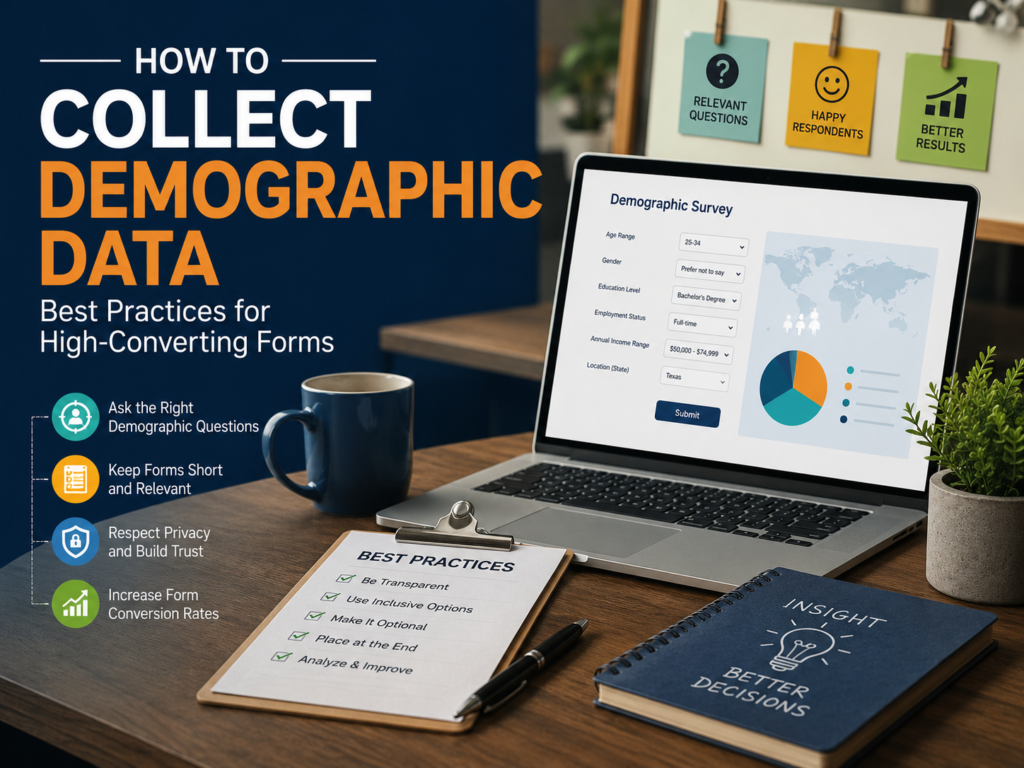
Place Demographic Questions at the End
One of the simplest ways to increase form conversion rates is to move demographic questions toward the end of your survey.
People are much more likely to answer personal questions after they’ve already invested time completing the primary survey.
Instead of beginning with:
- Age
- Gender
- Income
- Ethnicity
Start with:
- Product experience
- Customer satisfaction
- Event feedback
- Purchase experience
- Service quality
After respondents finish the main questions, demographic questions feel less intrusive.
Explain Why You’re Collecting the Information
Transparency builds trust.
A simple sentence before demographic questions can significantly improve completion rates.
Examples include:
“We collect this information to better understand our audience and improve our services.”
Or:
“Your responses help us create more personalized experiences. Individual answers will remain confidential.”
When respondents understand the reason behind the questions, they’re more willing to answer honestly.
Make Sensitive Questions Optional
Not every respondent will feel comfortable sharing personal information.
Questions about:
- Income
- Race
- Ethnicity
- Gender identity
- Disability
- Religion
should generally remain optional unless absolutely necessary.
Allowing respondents to skip these questions demonstrates respect and often increases overall survey completion.
Include “Prefer Not to Say”
One of the easiest ways to improve user experience is offering an alternative option.
Instead of forcing respondents to answer sensitive questions, include:
- Prefer not to answer
- Prefer not to say
- I’d rather not disclose
This maintains data quality while respecting privacy.
Use Inclusive Answer Choices
Modern surveys should reflect today’s diverse audiences.
Instead of limiting gender options to only “Male” and “Female,” consider including:
- Male
- Female
- Prefer not to say
Similarly, relationship status, household type, education, and employment questions should use inclusive language whenever appropriate.
Inclusive surveys create better experiences and improve response accuracy.
Keep Demographic Sections Short
Respondents rarely enjoy filling out long demographic questionnaires.
A good rule is limiting demographic questions to only those essential for analysis.
For most customer surveys, five to eight demographic questions are enough.
Use Conditional Logic
Smart forms only display relevant questions.
For example:
If someone selects “Student,” you might ask:
“What level of education are you currently pursuing?”
If someone selects “Employed,” you could ask:
“What industry do you work in?”
Conditional logic keeps surveys shorter and more relevant.
Protect User Privacy
Privacy is one of the biggest factors affecting survey participation.
Always:
- Explain how information will be used
- Store data securely
- Avoid collecting unnecessary personal identifiers
- Follow applicable privacy regulations
- Clearly communicate confidentiality
Trust directly influences completion rates.
Demographic Survey Questions Examples
Below are practical demographic survey questions examples that organizations commonly use.
Age
What is your age?
- Under 18
- 18–24
- 25–34
- 35–44
- 45–54
- 55–64
- 65+
- Prefer not to say
Gender
How do you describe your gender?
- Male
- Female
- Prefer not to say
Location
Where do you currently live?
- State
- City
- ZIP Code
- Country
Depending on your goals, collecting only the ZIP Code or state may be sufficient.
Employment Status
Which best describes your employment status?
- Full-time employed
- Part-time employed
- Self-employed
- Student
- Retired
- Unemployed
- Other
Education
What is the highest level of education you have completed?
- High school
- Associate degree
- Bachelor’s degree
- Master’s degree
- Doctorate
- Professional certification
- Other
Household Income
Which annual household income range best describes you?
Present income as ranges rather than requesting exact numbers.
For example:
- Under $25,000
- $25,000–$49,999
- $50,000–$74,999
- $75,000–$99,999
- $100,000–$149,999
- $150,000+
- Prefer not to say
Marital Status
What is your current marital status?
- Single
- Married
- Divorced
- Widowed
- Prefer not to say
Industry
Which industry do you currently work in?
Provide either a searchable dropdown or a categorized list to improve usability.
Which Demographic Questions Should You Avoid?
Not every survey requires every demographic question.
Avoid collecting information that has no analytical value.
Examples include:
- Social Security numbers
- Exact birthdates when age ranges are sufficient
- Full home addresses when ZIP Codes work
- Personal identifiers unrelated to your research
- Sensitive information without clear justification
Collect only what you truly need.
Tips to Increase Form Conversion Rates
If your goal is to increase form conversion rates, demographic questions should never become obstacles.
Some proven optimization strategies include:
Keep Forms Short
Shorter forms reduce abandonment and improve completion rates.
Show Progress Indicators
People are more likely to finish surveys when they know how much remains.
Use Mobile-Friendly Layouts
A significant percentage of respondents complete forms on smartphones.
Large buttons, readable text, and responsive layouts improve the user experience.
Group Related Questions
Place all demographic questions together in one clearly labeled section near the end.
Avoid Mandatory Personal Questions
Requiring sensitive information often causes respondents to leave before submitting.
Test Different Versions
Run A/B tests to compare:
- Number of demographic questions
- Question order
- Required versus optional fields
- Multi-page versus single-page forms
Even small improvements can significantly increase completion rates.
Common Mistakes When Collecting Demographic Data
Organizations frequently make avoidable errors that reduce data quality.
These include:
- Asking too many demographic questions
- Collecting information without a purpose
- Using outdated response options
- Forgetting “Prefer not to say”
- Ignoring accessibility
- Making every question mandatory
- Placing demographic questions first
- Using confusing terminology
- Failing to explain why information is collected
Avoiding these mistakes leads to cleaner datasets and happier respondents.
How Demographic Data Improves Survey Analysis
Collecting demographic information becomes valuable during analysis.
Instead of viewing overall satisfaction scores, you can compare responses across different audience segments.
For example:
- Do younger customers report higher satisfaction?
- Which income groups purchase premium plans?
- Which regions generate the most referrals?
- Does education level influence product adoption?
- Which industries have the highest retention rates?
These insights help organizations make more informed decisions than overall averages alone.
Final Thoughts
Learning how to collect demographic data effectively is about balancing insight with user experience. The goal isn’t to gather every possible detail—it’s to collect meaningful information that improves decision-making while respecting respondents’ time and privacy.
Well-designed demographic questions should feel relevant, transparent, and easy to answer. By asking only necessary questions, placing them strategically within your form, using inclusive response options, and protecting user privacy, you can gather higher-quality data while continuing to increase form conversion rates.
Whether you’re creating customer feedback forms, employee surveys, market research questionnaires, or lead generation forms, thoughtful demographic design leads to more accurate segmentation, stronger analytics, and better business outcomes. Use the demographic survey questions examples in this guide as a starting point, then tailor your questions to match your audience and research goals.
Frequently Asked Questions (FAQs)
1. How do you collect demographic data effectively?
The best way to collect demographic data is to ask only questions that are relevant to your research or business goals. Keep demographic questions near the end of your form, make sensitive questions optional, explain why you’re collecting the information, and use inclusive response options. Following these best practices helps improve response quality while maintaining a positive user experience.
2. What are demographic questions?
Demographic questions are survey questions that collect information about a respondent’s background and characteristics. Common demographic questions include age, gender, education, employment status, income, marital status, location, ethnicity, and household size. This information helps businesses and researchers segment audiences and analyze survey results more effectively.
3. What are some demographic survey questions examples?
Some common demographic survey questions examples include:
- What is your age?
- What is your gender?
- What is your highest level of education?
- What is your employment status?
- Which state do you currently live in?
- What is your annual household income?
- What industry do you work in?
- What is your marital status?
These questions should always be tailored to the purpose of your survey.
4. Why is demographic data important?
Demographic data helps organizations understand who their customers, employees, or survey respondents are. It allows businesses to segment audiences, personalize marketing campaigns, improve products and services, identify market trends, and make more informed decisions based on specific customer groups.
5. How many demographic questions should a survey include?
Most surveys only need between five and eight demographic questions. Asking too many personal questions can overwhelm respondents and reduce completion rates. Only include questions that provide meaningful insights for your analysis.
6. Where should demographic questions appear in a survey?
Demographic questions are usually placed at the end of a survey. Respondents are more likely to answer personal questions after completing the main survey, which can help increase form conversion rates and reduce survey abandonment.
7. Should demographic questions be required?
In most cases, demographic questions—especially sensitive ones like income, race, ethnicity, or gender identity—should be optional. Providing options such as “Prefer not to say” helps build trust and encourages more people to complete the survey.
8. How can demographic questions increase form conversion rates?
Well-designed demographic questions improve the user experience by being concise, relevant, and respectful of privacy. Keeping them optional, limiting the number of questions, using conditional logic, and explaining why the information is needed can significantly increase form conversion rates.
9. What demographic information should you avoid collecting?
Avoid collecting information that isn’t necessary for your survey objectives. For example, don’t ask for Social Security numbers, exact birthdates, full home addresses, or other highly sensitive personal details unless there is a legitimate business or legal reason to do so.
10. What is the difference between demographic data and behavioral data?
Demographic data describes who your respondents are, such as their age, education, or occupation. Behavioral data focuses on what they do, including purchasing habits, website activity, product usage, or engagement with your brand. Combining both types of data provides a more complete understanding of your audience.