- 18 min read


Building a successful product isn’t about having the best idea in the room. It’s about solving the right problem for the right people. Countless products fail every year—not because they lack features or engineering talent, but because they were designed around assumptions instead of real customer needs.
That’s why product discovery has become one of the most important stages of modern product development. Before writing code, creating wireframes, or launching new features, successful teams spend time understanding users, validating ideas, and testing assumptions.
One of the most widely respected approaches for achieving this is the double diamond design process. Originally developed by the UK Design Council, the framework helps teams explore problems thoroughly before narrowing down solutions. Instead of rushing toward implementation, it encourages structured discovery, experimentation, and validation.
Today, businesses have an advantage that wasn’t available when the framework was first introduced. Modern online survey tools allow product managers, UX researchers, marketers, and founders to collect customer feedback quickly, validate ideas continuously, and make evidence-based decisions throughout every phase of product discovery.
In this guide, you’ll learn how the double diamond model works, why the double diamond framework UX approach remains relevant in 2026, and how to use surveys in product discovery to build products customers genuinely want.
Why Product Discovery Often Goes Wrong
Most failed products don’t fail because of poor execution.
They fail because teams solve the wrong problem.
It’s surprisingly common for businesses to spend months building features customers never requested. Internal meetings, stakeholder opinions, and competitor analysis often dominate the planning process, while direct customer input becomes an afterthought.
Imagine spending six months developing a feature your customers barely use. The engineering effort, design work, marketing budget, and launch campaign may all be successful—but if the feature doesn’t solve a meaningful customer problem, it won’t deliver business value.
Product discovery exists to reduce this risk.
Rather than asking, “Can we build this?” successful teams first ask, “Should we build this?”
The double diamond design process provides a structured way to answer that question.
What Is the Double Diamond Design Process?
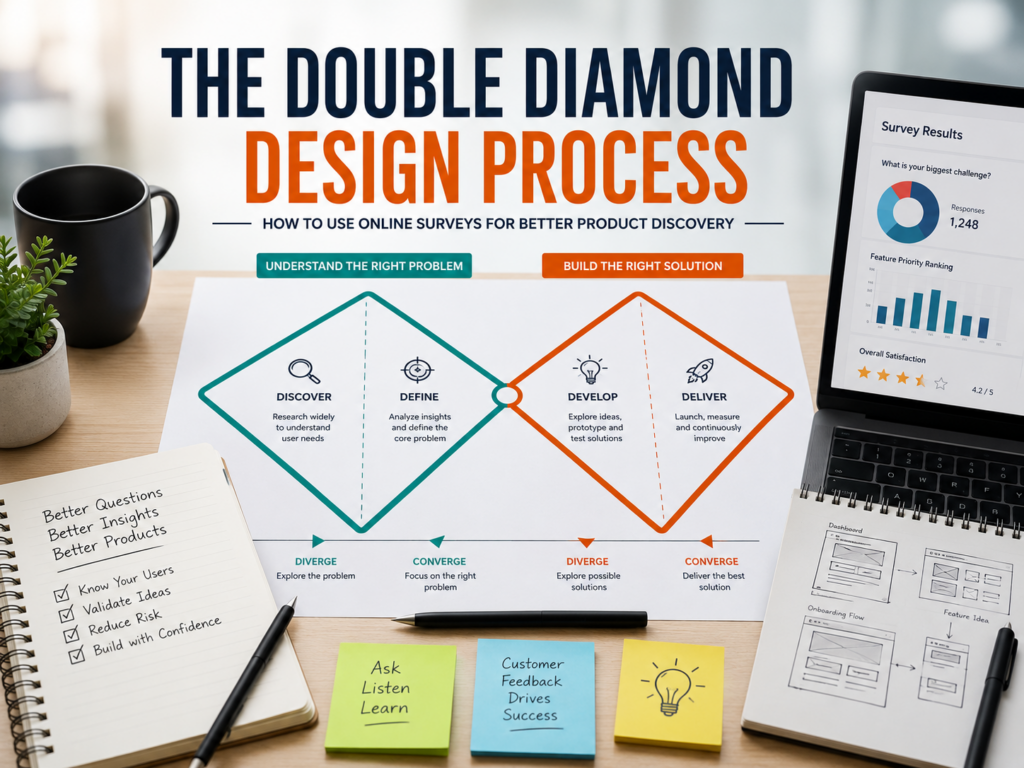
The double diamond design process is a problem-solving framework that divides product development into four connected stages.
Each stage represents a different way of thinking.
Instead of moving directly toward solutions, teams first expand their understanding before narrowing their focus. They repeat this pattern twice—once for defining the problem and again for creating the solution.
The four stages are:
- Discover
- Define
- Develop
- Deliver
Visually, these stages create two connected diamonds.
The first diamond focuses on understanding the problem.
The second focuses on designing the solution.
This structured approach helps teams avoid making expensive assumptions while encouraging continuous customer validation.
Understanding the Double Diamond Model
The double diamond model alternates between divergent thinking and convergent thinking.
During divergent thinking, teams explore multiple possibilities without immediately choosing one direction.
During convergent thinking, they analyze findings, prioritize insights, and make decisions.
This cycle encourages creativity while keeping product development grounded in real customer needs.
Let’s explore each phase in more detail.
Stage One: Discover
The Discover phase is all about learning.
Instead of searching for confirmation, teams search for understanding.
This stage encourages curiosity.
Product teams gather as much information as possible about customer behaviors, pain points, goals, expectations, and frustrations.
Research activities may include:
- Customer interviews
- Market research
- Competitor analysis
- Customer support reviews
- Website analytics
- User behavior analysis
- Product usage data
- Customer surveys
Among these methods, online survey tools have become one of the fastest ways to collect customer insights at scale.
Rather than interviewing ten customers individually, surveys allow businesses to hear from hundreds—or even thousands—of users within days.
For example, instead of assuming customers want a faster dashboard, a product team might ask:
- What is the biggest challenge you face while using our platform?
- Which task takes longer than expected?
- What feature do you use most frequently?
- What frustrates you the most?
These responses help reveal whether performance, usability, missing features, or something entirely different represents the true customer problem.
Why Surveys Matter During Discovery
Surveys help eliminate guesswork.
Without customer feedback, product teams often rely on internal opinions.
The loudest stakeholder isn’t always the most informed one.
A well-designed survey allows product decisions to reflect customer priorities rather than organizational assumptions.
Modern survey platforms also enable businesses to:
- Reach large audiences quickly
- Segment responses
- Identify recurring themes
- Measure customer sentiment
- Compare different customer groups
- Detect emerging trends
This makes surveys an essential discovery tool.
Stage Two: Define
Once research has been collected, the next challenge is making sense of it.
The Define stage transforms raw information into clear product opportunities.
Instead of asking dozens of unrelated questions, teams begin identifying patterns.
- Which problems appear most frequently?
- Which customer groups experience similar frustrations?
- Which issues have the greatest business impact?
This stage involves organizing survey results, grouping similar responses, prioritizing opportunities, and creating a clear problem statement.
Suppose survey results reveal:
- 58% struggle to complete onboarding.
- 46% can’t easily find reporting tools.
- 39% abandon the product during setup.
Instead of attempting to solve everything at once, the product team may conclude:
“Our highest priority is simplifying onboarding because it creates the largest barrier to product adoption.”
This becomes the problem the team will solve.
Without proper definition, product teams often attempt to solve multiple unrelated issues simultaneously.
The Define stage prevents that mistake.
Using Survey Data to Prioritize Problems
One of the greatest strengths of surveys is that they provide measurable evidence.
Rather than relying on anecdotal feedback, teams can compare:
- Frequency
- Severity
- Customer impact
- Business impact
- Customer segments
For example, if one issue affects 70% of new customers while another affects only 8%, prioritization becomes much easier.
Survey data helps teams invest resources where they create the greatest value.
Stage Three: Develop
Once the problem has been clearly defined, attention shifts toward creating possible solutions.
The Develop stage encourages experimentation.
Instead of committing to a single idea immediately, teams generate multiple concepts.
These may include:
- New workflows
- Interface changes
- Feature ideas
- Navigation improvements
- Onboarding redesigns
- Pricing experiments
Rather than assuming one solution will work, teams compare several possibilities.
Surveys become valuable again during this stage.
Instead of asking customers about existing problems, businesses begin validating proposed solutions.
For example:
- Which onboarding design feels easier to understand?
- Which dashboard layout appears most intuitive?
- Which feature would provide the greatest value?
- Which pricing model seems fairest?
This allows teams to gather customer feedback before development begins.
Validating concepts early often saves months of unnecessary work.
Concept Testing with Online Survey Tools
Modern online survey tools allow product teams to upload images, prototypes, videos, and mockups directly into surveys.
Customers can review early concepts and provide immediate feedback.
Businesses may test:
- Landing pages
- Mobile interfaces
- Product naming
- Logo designs
- Feature concepts
- Pricing options
- Marketing messages
Instead of debating internally, teams can simply ask customers.
The result is faster validation and more confident decision-making.
Stage Four: Deliver
The Deliver phase focuses on implementation and continuous improvement.
Launching a product doesn’t end customer research.
It begins another learning cycle.
Successful product teams continue collecting feedback after launch.
Post-launch surveys help answer questions like:
- Was the new feature easy to use?
- Did onboarding improve?
- What remains confusing?
- Which features need further improvement?
- Would customers recommend the product?
These insights support ongoing optimization rather than treating launch day as the finish line.
The double diamond framework UX encourages continuous iteration.
Every launch creates new opportunities for learning.
Why Continuous Feedback Creates Better Products
Customer expectations change constantly.
Markets evolve.
Competitors innovate.
User behaviors shift.
A product that perfectly solved customer problems last year may feel outdated today.
That’s why modern product teams continuously gather feedback rather than relying on one-time research.
Regular surveys allow organizations to identify changing priorities before competitors do.
Instead of reacting months later, businesses adapt while opportunities still exist.
How to Use Surveys in Product Discovery
Understanding how to use surveys in product discovery requires matching survey objectives to each phase of the Double Diamond Framework.
During the Discover stage, surveys should focus on understanding customer behaviors, frustrations, unmet needs, and goals. Questions should encourage respondents to describe their experiences, explain their biggest challenges, and identify areas where existing solutions fall short.
During the Define stage, surveys become more structured. Product teams can ask customers to rank priorities, rate the severity of different problems, or identify which challenges affect them most frequently. This helps narrow a broad collection of research into a focused problem statement supported by data.
In the Develop stage, surveys shift toward concept validation. Instead of asking about current experiences, businesses present early ideas, interface designs, workflows, or feature concepts and gather reactions before investing in development. This reduces risk by validating assumptions before significant resources are committed.
Finally, during the Deliver stage, surveys measure success after launch. Customer satisfaction, usability, adoption rates, and feature effectiveness become the primary focus. Continuous feedback helps teams identify improvements and prioritize future iterations.
Using surveys throughout the entire product lifecycle ensures that customer feedback remains at the center of every decision rather than becoming a one-time activity.
Combining Quantitative and Qualitative Feedback
The most effective product teams rarely rely on only one type of data.
Numbers reveal patterns.
Words explain them.
Suppose your survey shows that only 38% of users successfully complete onboarding.
That’s valuable information.
But it doesn’t explain why.
Now imagine following that rating question with:
“What prevented you from completing onboarding?”
Suddenly you discover that customers are confused by technical terminology, struggle to locate important settings, or abandon the process because verification emails arrive too slowly.
The quantitative data identifies the problem.
The qualitative responses explain it.
When both types of insights are analyzed together, product teams gain a much deeper understanding of customer behavior.
Using Online Survey Tools to Accelerate Product Discovery
Modern online survey tools have transformed product research.
In the past, gathering customer feedback often required lengthy interviews, expensive focus groups, or manually reviewing spreadsheets filled with responses.
Today’s survey platforms simplify nearly every stage of the process.
Businesses can distribute surveys through email, websites, mobile apps, QR codes, and social media within minutes. Responses begin arriving immediately, allowing product teams to monitor trends in real time.
Advanced survey platforms also offer features such as:
- Conditional logic
- Custom branding
- Mobile-friendly surveys
- Response segmentation
- Real-time dashboards
- AI-powered summaries
- Exportable reports
- Team collaboration
Instead of spending days organizing raw data, teams can focus on understanding customer needs and making informed decisions.
Real-World Example: Improving SaaS Onboarding with the Double Diamond Model
Imagine a SaaS company notices that trial users are abandoning the product before completing setup.
Rather than immediately redesigning the onboarding flow, the product team applies the double diamond model.
During the Discover stage, they launch a survey asking new users about their onboarding experience. Many respondents mention confusion around account configuration and unclear setup instructions.
In the Define stage, the team identifies onboarding complexity as the primary issue affecting activation rates.
During Develop, designers create three simplified onboarding concepts and use surveys to collect customer feedback on each version.
Customers overwhelmingly prefer one design because it provides clearer instructions and fewer required steps.
The team launches the updated experience during the Deliver stage.
Post-launch surveys reveal that onboarding satisfaction has increased significantly, activation rates improve, and support requests decline.
Without structured customer feedback, the team may have spent months improving the wrong part of the product.
Common Mistakes Product Teams Make
Even experienced product teams sometimes misuse the double diamond framework UX process.
One common mistake is skipping the Discover stage entirely.
Teams often assume they already understand customer problems based on support tickets or internal opinions.
Unfortunately, assumptions rarely replace customer research.
Another mistake is collecting feedback without acting on it.
Surveys should influence product decisions.
If responses are collected but ignored, customers quickly lose confidence that their opinions matter.
Some organizations also wait until after launch to gather feedback.
While post-launch surveys are valuable, they should complement—not replace—research conducted during product discovery.
Finally, many teams ask leading questions that unintentionally encourage certain responses.
For example:
“How much do you love our new dashboard?”
This wording introduces bias.
A better question would be:
“How would you describe your experience using the new dashboard?”
Neutral questions generate more reliable insights.
Best Practices for Survey-Based Product Discovery
If you want surveys to strengthen your product discovery process, keep these best practices in mind.
Start with clear research objectives. Every survey should answer a specific business question.
Keep surveys concise. Long questionnaires reduce completion rates and often produce lower-quality responses.
Mix open-ended and closed-ended questions. Quantitative data measures customer behavior, while qualitative feedback explains it.
Segment responses whenever possible. New customers, long-term users, enterprise clients, and free users often have different priorities.
Review responses continuously rather than waiting until the survey closes. Modern dashboards make it possible to identify emerging trends as feedback arrives.
Most importantly, close the feedback loop. Let customers know when their suggestions have influenced product improvements. People are far more likely to participate in future research when they see their feedback making a difference.
Why the Double Diamond Framework Still Matters in 2026
Product development has become faster than ever.
Agile methodologies, AI-assisted development, rapid prototyping, and continuous deployment allow companies to release new features within days instead of months.
Despite these advances, one principle remains unchanged:
Building the wrong solution quickly is still building the wrong solution.
The double diamond design process remains valuable because it slows down thinking before speeding up execution.
Instead of encouraging teams to build immediately, it encourages them to understand first.
This approach reduces wasted development effort, improves customer satisfaction, and increases the likelihood of building products that solve meaningful problems.
As customer expectations continue to evolve, organizations that consistently validate ideas through research will outperform those relying solely on intuition.
How SurveyFlip Supports Better Product Discovery
Successful product discovery depends on continuous customer feedback, and that’s exactly where SurveyFlip helps.
SurveyFlip enables product managers, UX researchers, marketers, and founders to create professional surveys for every stage of the double diamond model. Whether you’re exploring customer pain points, validating feature concepts, testing prototypes, or measuring post-launch satisfaction, SurveyFlip provides the tools needed to collect meaningful insights quickly.
With customizable survey templates, advanced logic, real-time analytics, AI-friendly reporting, and flexible distribution options, SurveyFlip helps teams reduce guesswork and make faster, evidence-based product decisions.
Instead of relying on assumptions, businesses can confidently prioritize features based on real customer feedback.
Final Thoughts
The double diamond design process isn’t simply another product development framework—it’s a mindset that encourages curiosity before commitment. By separating problem discovery from solution development, teams avoid rushing into expensive decisions based on assumptions.
Modern online survey tools make this framework even more powerful. Surveys allow businesses to understand customers at scale, validate ideas before development begins, and continuously improve products after launch.
Whether you’re building a SaaS platform, launching a mobile app, redesigning a website, or introducing a new product feature, learning how to use surveys in product discovery can dramatically improve your decision-making process.
The strongest products aren’t created by guessing what customers want. They’re built by listening carefully, validating continuously, and allowing real customer insights to shape every stage of development.
When combined with the double diamond framework UX, surveys become more than a research tool—they become the foundation of smarter product strategy, better user experiences, and long-term business growth.
Frequently Asked Questions (FAQ)
1. What is the Double Diamond design process?
The double diamond design process is a product design and problem-solving framework developed by the UK Design Council. It consists of four stages—Discover, Define, Develop, and Deliver—that help teams first understand customer problems and then create, test, and refine solutions. The framework encourages evidence-based decision-making instead of relying on assumptions.
2. What are the four stages of the Double Diamond model?
The double diamond model consists of four stages:
- Discover – Research customer needs, challenges, and opportunities.
- Define – Analyze research findings and identify the core problem.
- Develop – Brainstorm, prototype, and validate possible solutions.
- Deliver – Launch, measure results, and continuously improve the solution.
Each stage helps teams reduce uncertainty and make better product decisions.
3. Why is the Double Diamond framework important in UX?
The double diamond framework UX approach helps designers focus on solving the right problems before designing solutions. Instead of making assumptions about user needs, UX teams gather customer insights, validate ideas, and iterate based on real feedback, resulting in products that are more intuitive, useful, and user-centered.
4. How do online survey tools support product discovery?
Modern online survey tools allow businesses to collect customer feedback quickly and at scale. They help product teams identify customer pain points, validate ideas, prioritize features, test prototypes, and measure satisfaction throughout the product development lifecycle. This enables faster, more informed decision-making.
5. How can I use surveys in product discovery?
Understanding how to use surveys in product discovery starts with aligning survey questions to each stage of the Double Diamond Framework.
Use surveys to:
- Discover customer needs and pain points.
- Validate which problems are most important.
- Test feature ideas and prototypes.
- Measure satisfaction after launch.
- Collect ongoing customer feedback for future improvements.
Surveys help reduce guesswork and ensure product decisions are based on real customer insights.
6. What types of surveys work best during the Discover stage?
During the Discover stage, exploratory surveys work best. These surveys include open-ended questions that encourage respondents to describe their challenges, goals, frustrations, and expectations.
Examples include:
- What is your biggest challenge?
- What task takes the most time?
- What would you improve about your current solution?
These questions uncover valuable customer insights before defining the problem.
7. What survey questions should I ask during the Define stage?
The Define stage focuses on prioritizing problems.
Useful survey questions include:
- Which challenge affects you most?
- How often do you experience this issue?
- How important is solving this problem?
- Which improvement would create the biggest impact?
These questions help teams identify the highest-priority opportunities.
8. How can surveys validate product ideas before development?
Before investing in development, surveys can present customers with feature concepts, interface mockups, pricing options, or workflow ideas.
Respondents can rate, rank, or comment on these concepts, helping businesses identify the most promising solution before writing code.
This reduces development risk and improves product-market fit.
9. Why should product teams collect feedback after launch?
Launching a product is not the end of product discovery.
Post-launch surveys help measure:
- Customer satisfaction
- Ease of use
- Feature adoption
- Product usability
- Improvement opportunities
Continuous feedback ensures products continue evolving alongside customer needs.
10. What is the biggest benefit of the Double Diamond model?
The biggest advantage of the double diamond model is that it helps teams solve the right problem before building a solution.
Instead of rushing into development, businesses spend time understanding customer needs, reducing wasted resources and increasing the likelihood of building successful products.
11. How do surveys improve product decision-making?
Surveys provide direct customer feedback rather than relying on assumptions or internal opinions.
They help teams:
- Validate ideas
- Prioritize features
- Measure customer satisfaction
- Understand user behavior
- Identify emerging trends
- Support evidence-based decisions
This leads to more confident product planning.
12. What are common mistakes when using the Double Diamond Framework?
Some common mistakes include:
- Skipping customer research
- Defining problems too quickly
- Relying on internal assumptions
- Ignoring customer feedback
- Testing solutions with too few users
- Treating product discovery as a one-time activity instead of an ongoing process
Avoiding these mistakes leads to better product outcomes.
13. Can startups benefit from the Double Diamond Framework?
Absolutely.
Startups often have limited budgets and resources, making it especially important to validate ideas before investing in development.
Using the double diamond design process helps startups reduce risk, understand customer needs earlier, and improve product-market fit before scaling.
14. What is the difference between product discovery and product development?
Product discovery focuses on identifying customer problems and validating possible solutions.
Product development focuses on designing, building, testing, and launching the chosen solution.
Discovery answers “What should we build?”
Development answers “How do we build it?”
15. Are online surveys better than customer interviews?
Both methods have unique strengths.
Customer interviews provide deeper conversations and richer context.
Online survey tools allow businesses to collect feedback from much larger audiences quickly and cost-effectively.
Many successful product teams combine interviews with surveys to gain both qualitative depth and quantitative validation.
16. How often should product teams run customer surveys?
Customer feedback should be collected continuously rather than only during major product launches.
Many organizations run surveys:
- After onboarding
- Following feature releases
- After customer support interactions
- Quarterly for product feedback
- Annually for broader customer satisfaction
Continuous feedback keeps product decisions aligned with evolving customer needs.
17. What role does AI play in survey-based product discovery?
AI helps product teams analyze survey responses more efficiently by:
- Detecting sentiment
- Identifying recurring themes
- Summarizing written feedback
- Categorizing responses
- Highlighting emerging trends
This allows businesses to extract actionable insights from large volumes of customer feedback much faster.
18. How does SurveyFlip support the Double Diamond Framework?
SurveyFlip helps teams collect customer insights throughout every stage of the double diamond framework UX process.
Whether you’re exploring customer problems, validating concepts, testing prototypes, or measuring post-launch satisfaction, SurveyFlip provides customizable surveys, advanced logic, real-time reporting, and powerful analytics that support better product discovery and smarter decision-making.
19. Who should use the Double Diamond design process?
The double diamond design process is valuable for:
- Product managers
- UX designers
- UX researchers
- Startup founders
- SaaS companies
- Marketing teams
- Innovation teams
- Digital agencies
- Customer experience professionals
Any organization developing products, services, or digital experiences can benefit from this structured framework.
20. What is the key takeaway about the Double Diamond Framework?
The key takeaway is that successful products begin with understanding customers—not assumptions. By combining the double diamond model with online survey tools, businesses can discover real user problems, validate ideas before development, and continuously improve their products using customer feedback. This customer-centered approach reduces risk, improves product-market fit, and leads to more successful product outcomes.