- 18 min read


The healthcare industry has entered a new era where patient experience is just as important as clinical outcomes. Patients now schedule appointments online, access medical records through portals, consult physicians via telehealth, and communicate with providers through digital platforms. As healthcare becomes increasingly digital, patient feedback has become one of the most valuable resources for improving care.
For healthtech companies, collecting meaningful feedback is no longer optional. Whether you’re building telemedicine software, patient engagement platforms, remote monitoring solutions, mental health applications, or hospital management systems, understanding the patient experience directly impacts product quality, customer retention, and regulatory compliance.
However, healthcare surveys are fundamentally different from standard customer surveys.
Patients expect privacy.
Healthcare organizations must comply with strict regulations.
Sensitive health information requires secure handling.
At the same time, surveys still need to be engaging enough to achieve high completion rates.
Finding that balance can be challenging.
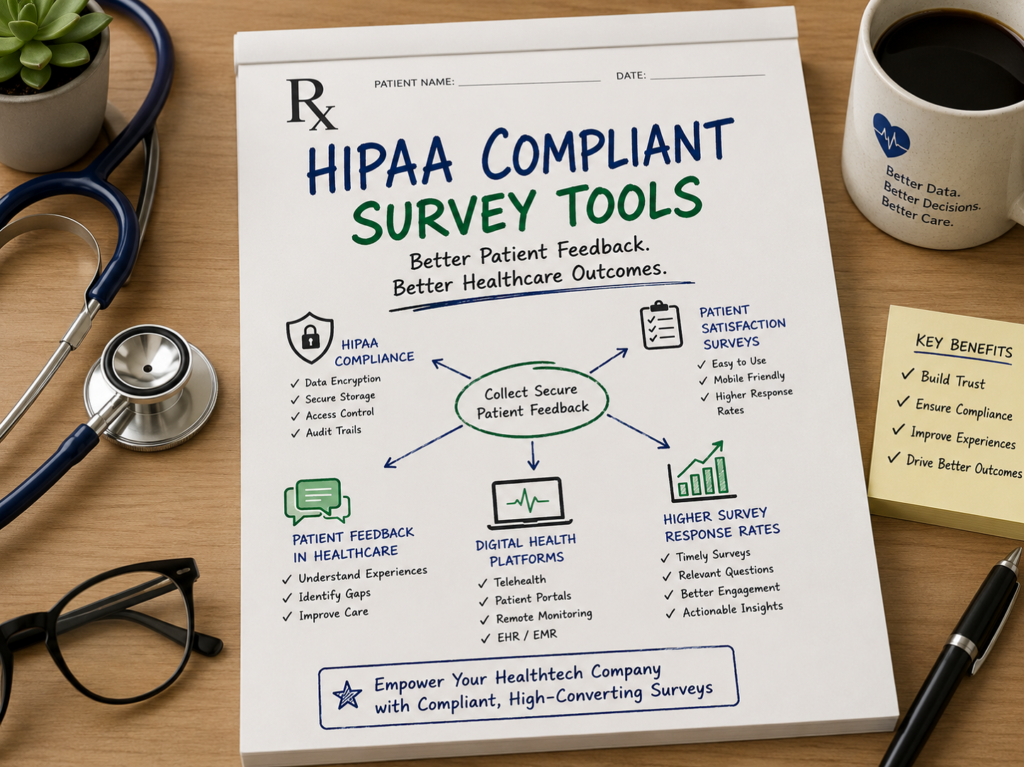
This guide explains how HIPAA compliant survey tools help organizations collect secure patient feedback while improving response rates, strengthening patient trust, and supporting better healthcare experiences.
Why Patient Feedback Matters More Than Ever
Healthcare decisions affect people’s lives.
Unlike shopping for clothing or ordering food online, patients often complete surveys immediately after highly emotional experiences.
They may have undergone surgery.
Visited an emergency room.
Attended a mental health consultation.
Completed physical therapy.
Started a new treatment.
Each interaction provides valuable insight that healthcare organizations can use to improve care quality.
High-quality patient satisfaction surveys help organizations understand:
- Overall patient satisfaction
- Communication quality
- Appointment scheduling experiences
- Provider interactions
- Wait times
- Telehealth usability
- Treatment understanding
- Patient confidence
- Accessibility concerns
- Follow-up effectiveness
Without patient feedback, healthcare providers often rely solely on assumptions or isolated complaints.
Surveys provide measurable data that supports continuous improvement.
The Growing Role of Healthtech Companies
The healthcare technology market continues to expand rapidly.
Today’s healthtech companies develop solutions for nearly every stage of the patient journey.
Examples include:
- Telemedicine platforms
- Electronic Health Records (EHR)
- Patient portals
- Remote patient monitoring
- Digital therapeutics
- Mental health applications
- Online pharmacy platforms
- Medical scheduling software
- Healthcare CRM systems
- Clinical workflow automation
Although these products differ significantly, they share one common need:
Understanding the patient experience.
Every feature should ultimately improve healthcare delivery.
Patient surveys provide the evidence needed to validate whether those improvements actually occur.
Why Healthcare Surveys Require Special Attention
Healthcare surveys collect some of the most sensitive information possible.
Unlike retail surveys asking about shopping preferences, healthcare surveys may involve:
- Medical history
- Treatment outcomes
- Mental health
- Prescription experiences
- Physical symptoms
- Insurance information
- Provider communication
- Personal health concerns
Because of this, security becomes essential.
Patients are much less likely to provide honest feedback if they doubt their information will remain confidential.
Trust directly affects survey quality.
What Are HIPAA Compliant Survey Tools?
HIPAA compliant survey tools are survey platforms designed to help healthcare organizations collect patient information while meeting the privacy and security requirements established under the Health Insurance Portability and Accountability Act (HIPAA).
These platforms typically include features such as:
- Data encryption
- Secure data storage
- User authentication
- Role-based access controls
- Audit logs
- Secure cloud infrastructure
- Business Associate Agreements (BAAs)
- Protected Health Information (PHI) safeguards
Not every online survey platform is suitable for healthcare.
Organizations should carefully verify that their chosen platform supports HIPAA compliance before collecting protected patient information.
Why HIPAA Compliance Builds Patient Trust
Compliance isn’t only about avoiding legal risk.
It’s about earning patient confidence.
Patients who believe their information is protected are significantly more likely to provide honest, thoughtful responses.
Transparency also improves participation.
Clearly communicating:
- Why feedback is being collected
- How responses will be protected
- Who can access the information
- Whether responses remain anonymous
helps reduce hesitation.
Patients appreciate organizations that respect privacy.
That trust translates into higher response quality.
Designing Patient Satisfaction Surveys That People Actually Complete
Many healthcare surveys fail for a surprisingly simple reason.
They’re too long.
Patients often receive surveys immediately after appointments, treatments, or hospital visits.
Long questionnaires become overwhelming.
Instead of asking thirty questions, focus on the most valuable ones.
Successful patient satisfaction surveys usually prioritize:
Overall experience.
Communication.
Ease of access.
Quality of care.
Likelihood to recommend.
Open-ended improvement suggestions.
Shorter surveys consistently produce better completion rates.
Keep Language Clear and Patient-Friendly
Healthcare professionals frequently use terminology unfamiliar to patients.
Survey questions should avoid technical language whenever possible.
Instead of asking:
“Did your provider adequately explain your post-operative recovery protocol?”
Consider:
“Did your healthcare provider clearly explain how to care for yourself after your procedure?”
Simple language improves comprehension.
Better comprehension produces more accurate responses.
Ask Questions That Lead to Action
Every survey question should support a future decision.
For example:
Instead of asking:
“Were you satisfied?”
Ask:
“What could we have done to improve your visit?”
Specific questions generate actionable insights.
Healthcare teams can actually use those responses to improve patient experiences.
Timing Matters More Than Most Organizations Realize
Sending surveys months after an appointment significantly reduces response quality.
Patients forget details.
Memories fade.
Healthcare organizations often achieve better healthcare survey response rates by sending surveys within 24 to 72 hours after an interaction.
This timing captures experiences while they’re still fresh.
Whether following a telehealth appointment, hospital discharge, or clinic visit, prompt surveys generally perform better than delayed requests.
Optimize Surveys for Mobile Devices
Most patients now access healthcare information through smartphones.
Appointment reminders.
Prescription notifications.
Telehealth sessions.
Patient portals.
Healthcare surveys should follow the same pattern.
Mobile-first survey design improves accessibility and significantly increases completion rates.
Essential mobile design practices include:
- Large buttons
- Readable fonts
- Minimal scrolling
- Simple navigation
- Fast loading speeds
- Touch-friendly answer choices
Patients should complete surveys comfortably on any device.
Use Conditional Logic to Personalize Surveys
Not every patient should answer every question.
Conditional logic creates more personalized experiences.
For example:
- Patients who completed a virtual appointment receive telehealth questions.
- Patients visiting an emergency department receive questions about wait times.
- Patients completing physical therapy receive treatment progress questions.
Relevant surveys feel shorter and more engaging.
This often improves response quality while reducing abandonment.
Measuring Patient Feedback Across Digital Health Platforms
Modern digital health platforms generate numerous patient interactions.
Feedback can be collected after:
- Video consultations
- Appointment scheduling
- Prescription refills
- Patient portal usage
- Mobile app interactions
- Symptom tracking
- Health coaching sessions
- Billing experiences
Collecting feedback across multiple touchpoints provides a more complete understanding of the patient journey.
Instead of evaluating isolated appointments, organizations begin measuring entire healthcare experiences.
Common Survey Metrics Healthcare Organizations Should Track
Effective healthcare surveys typically measure several key performance indicators.
Patient Satisfaction Score (PSS) provides an overall assessment of care quality.
Net Promoter Score (NPS) measures patient loyalty and willingness to recommend the organization.
Customer Effort Score (CES) evaluates how easy it was for patients to complete important tasks such as scheduling appointments or accessing medical information.
Organizations should also monitor survey completion rates, response rates, average completion time, and recurring themes within open-ended responses.
Together, these metrics provide a comprehensive view of patient experience.
Using Patient Feedback to Improve Healthcare
Collecting feedback is only the beginning.
The real value comes from acting on it.
Successful healthcare organizations regularly analyze patient responses to identify trends and prioritize improvements.
Common improvements driven by patient feedback include:
- Shorter appointment wait times
- Better provider communication
- Simplified patient portals
- Improved telehealth experiences
- Faster follow-up communication
- Clearer billing information
- Better appointment scheduling
- Improved accessibility
When patients see their feedback leading to meaningful improvements, trust and engagement increase over time.
Common Mistakes Healthtech Companies Should Avoid
Many healthcare surveys unintentionally reduce participation.
Some organizations ask unnecessary personal questions.
Others overwhelm patients with lengthy questionnaires.
Some surveys contain confusing medical terminology.
Others fail to explain privacy protections.
Another frequent mistake is sending surveys too often.
Patients experiencing survey fatigue become less likely to participate in future research.
Healthcare organizations should prioritize quality over quantity.
One thoughtful survey is often more valuable than several repetitive ones.
Improve Healthcare Survey Response Rates Without Sacrificing Compliance
One of the biggest concerns for healthcare organizations is balancing privacy with participation. Strict compliance requirements are essential, but they shouldn’t make surveys difficult to complete.
The organizations achieving the highest healthcare survey response rates understand that patient experience extends beyond the appointment itself.
A few practical improvements can significantly increase participation:
- Keep surveys under five minutes whenever possible.
- Display a progress indicator so patients know how much remains.
- Use simple, conversational language instead of clinical jargon.
- Optimize every survey for mobile devices.
- Send surveys shortly after the healthcare interaction.
- Explain how feedback improves patient care.
- Reassure respondents that their information is protected.
Patients are much more likely to participate when surveys feel respectful, transparent, and easy to complete.
Choosing the Right Questions
Every question should support a specific improvement initiative.
Rather than creating lengthy questionnaires, focus on the patient journey.
For example:
Appointment Experience
- Was scheduling your appointment easy?
- Did you receive appointment reminders at the right time?
- Was the check-in process simple?
Provider Communication
- Did your healthcare provider listen carefully?
- Were your questions answered clearly?
- Did you understand your treatment plan?
Telehealth Experience
- Was the video connection reliable?
- Was joining the appointment simple?
- Would you use virtual care again?
Patient Portal Experience
- Was it easy to access your medical records?
- Could you quickly find the information you needed?
- Was messaging your provider straightforward?
Overall Experience
- How satisfied were you with today’s visit?
- What could we improve?
- Would you recommend our organization to others?
These focused questions produce actionable insights while keeping surveys concise.
The Role of AI in Modern Patient Feedback
Artificial intelligence is changing how healthcare organizations analyze patient feedback.
Instead of manually reading thousands of responses, AI can automatically identify recurring themes and emerging concerns.
For example, AI can detect trends such as:
- Patients repeatedly mentioning long wait times.
- Frustration with appointment scheduling.
- Positive comments about specific providers.
- Growing demand for virtual appointments.
- Confusion around medication instructions.
- Billing-related complaints.
AI can also perform sentiment analysis, categorize open-ended responses, and generate reports in minutes.
This enables healthcare leaders to respond much faster than traditional manual analysis.
Importantly, AI should support—not replace—human judgment, especially when interpreting sensitive healthcare feedback.
Using Surveys Throughout the Patient Journey
Many organizations only survey patients after appointments.
The most successful healthtech companies collect feedback across multiple stages of the patient journey.
Before Care
Understand expectations.
Examples include:
- How easy was it to schedule?
- Was finding information straightforward?
During Care
Capture immediate experiences.
Examples include:
- Was communication clear?
- Did you feel involved in decisions?
After Care
Measure satisfaction and outcomes.
Examples include:
- Did you understand your discharge instructions?
- Are you satisfied with your overall experience?
Long-Term Follow-Up
Monitor ongoing outcomes.
Examples include:
- Has your health improved?
- Are you still using the recommended treatment?
- Would you choose this provider again?
Continuous feedback creates a much richer understanding of patient experiences.
Security Best Practices for Healthcare Surveys
Using HIPAA compliant survey tools is only one part of protecting patient information.
Healthcare organizations should also:
- Limit access to survey responses.
- Encrypt data during storage and transmission.
- Use secure authentication methods.
- Regularly review access permissions.
- Train employees on data privacy.
- Avoid collecting unnecessary Protected Health Information (PHI).
- Store survey data only as long as required.
- Maintain audit logs for compliance purposes.
Strong security practices demonstrate respect for patient privacy while supporting regulatory compliance.
How Survey Data Supports Better Business Decisions
Patient surveys don’t just improve patient satisfaction.
They also influence strategic decisions across healthcare organizations.
Survey insights help teams:
Improve Products
Digital health platforms can prioritize features patients actually want instead of relying on assumptions.
Enhance Patient Experience
Recurring complaints often highlight opportunities for process improvements.
Reduce Churn
Understanding patient frustrations early helps organizations address issues before patients switch providers.
Increase Adoption
Patient feedback identifies usability barriers within mobile apps, patient portals, and telehealth systems.
Support Compliance
Well-documented feedback demonstrates a commitment to continuous quality improvement.
Real-World Example
Imagine a telehealth platform experiencing declining patient retention.
Instead of guessing why, the company launches a secure survey using a HIPAA compliant survey tool.
Within two weeks, clear patterns emerge.
Patients consistently report:
- Difficulty joining video appointments.
- Confusion about appointment reminders.
- Limited visibility into follow-up instructions.
- Trouble accessing prescriptions after visits.
The product team immediately prioritizes improvements.
Three months later:
- Appointment attendance increases.
- Support requests decrease.
- Patient satisfaction improves.
- Retention rises.
None of these improvements required guessing.
They came directly from patient feedback.
Why Survey Timing Matters
Healthcare organizations often delay surveys for administrative reasons.
Unfortunately, delayed surveys produce weaker data.
Sending surveys within 24–72 hours offers several advantages:
- Better recall
- Higher completion rates
- More detailed comments
- Greater emotional accuracy
- Faster issue resolution
Patients remember experiences more clearly shortly after receiving care.
This produces richer and more reliable feedback.
SurveyFlip for Healthtech Companies
For healthtech companies looking to improve patient engagement, SurveyFlip provides a flexible survey platform that supports secure, user-friendly feedback collection.
Organizations can create mobile-optimized surveys, personalize questions with conditional logic, automate follow-up surveys, monitor responses in real time, and generate actionable reports.
When paired with appropriate HIPAA-compliant workflows and security practices, SurveyFlip helps healthcare organizations collect meaningful patient feedback while maintaining an excellent survey experience.
Whether you’re measuring patient satisfaction surveys, evaluating digital health platforms, or improving patient feedback in healthcare, SurveyFlip simplifies the entire feedback process.
Final Thoughts
Patient surveys are no longer just quality assurance tools.
They’ve become essential components of modern healthcare strategy.
For today’s healthtech companies, understanding patient experiences is critical to improving products, strengthening relationships, increasing retention, and delivering better care.
The key is balancing compliance with usability.
By choosing HIPAA compliant survey tools, respecting patient privacy, asking thoughtful questions, and acting on the insights collected, healthcare organizations can build surveys that patients actually complete—and trust.
The organizations that listen to patients consistently make better decisions.
And in healthcare, better decisions don’t just improve products.
They improve lives.
Frequently Asked Questions (FAQ)
1. What are HIPAA compliant survey tools?
HIPAA compliant survey tools are survey platforms designed to help healthcare organizations securely collect, store, and manage patient feedback while meeting the privacy and security requirements of the Health Insurance Portability and Accountability Act (HIPAA). These tools typically include encryption, access controls, audit logs, secure hosting, and support for Business Associate Agreements (BAAs).
2. Why do healthtech companies need HIPAA compliant survey tools?
Healthtech companies often collect patient information, healthcare experiences, or Protected Health Information (PHI). Using HIPAA compliant survey tools helps protect patient privacy, reduce compliance risks, build trust, and ensure feedback is collected securely.
3. What are patient satisfaction surveys?
Patient satisfaction surveys measure how patients feel about their healthcare experience. They commonly evaluate:
- Appointment scheduling
- Wait times
- Provider communication
- Quality of care
- Telehealth experiences
- Patient portal usability
- Overall satisfaction
These surveys help healthcare organizations improve patient care and service quality.
4. What should be included in a patient satisfaction survey?
A well-designed patient satisfaction survey may include questions about:
- Ease of scheduling appointments
- Wait times
- Staff professionalism
- Provider communication
- Treatment understanding
- Facility cleanliness
- Digital health experience
- Overall satisfaction
- Likelihood to recommend the provider
- Suggestions for improvement
Keep surveys concise to improve completion rates.
5. How can healthcare organizations improve healthcare survey response rates?
Improving healthcare survey response rates starts with creating a better survey experience.
Best practices include:
- Send surveys within 24–72 hours.
- Keep surveys under five minutes.
- Optimize for mobile devices.
- Use clear, patient-friendly language.
- Explain why feedback matters.
- Reassure patients about privacy.
- Avoid asking unnecessary questions.
These strategies increase participation while maintaining data quality.
6. Why is patient feedback important in healthcare?
Patient feedback in healthcare helps organizations understand what patients experience throughout their care journey.
It supports improvements in:
- Clinical services
- Communication
- Patient safety
- Digital experiences
- Appointment scheduling
- Customer service
- Overall patient satisfaction
Listening to patients leads to better healthcare outcomes and stronger patient relationships.
7. When should healthcare surveys be sent?
The best time is usually within 24 to 72 hours after the patient interaction.
This timing ensures:
- Better recall
- Higher response rates
- More accurate feedback
- Faster issue identification
Waiting weeks often reduces both response quality and participation.
8. Can healthcare surveys be anonymous?
Yes.
Many healthcare organizations offer anonymous surveys to encourage honest feedback.
However, some surveys require patient identification for follow-up care or quality improvement initiatives.
Organizations should always explain whether responses are anonymous or confidential before collecting data.
9. What information should healthcare surveys avoid collecting?
Healthcare surveys should avoid collecting unnecessary Protected Health Information (PHI).
Only request information that directly supports your research or quality improvement goals.
Collecting unnecessary sensitive data increases privacy risks and may complicate HIPAA compliance.
10. How do digital health platforms use patient surveys?
Modern digital health platforms use surveys to evaluate:
- Telehealth appointments
- Mobile app usability
- Patient portal experiences
- Prescription management
- Appointment scheduling
- Remote patient monitoring
- Virtual care satisfaction
These insights help improve digital healthcare experiences and product development.
11. How can healthtech companies increase patient trust during surveys?
Trust begins with transparency.
Healthcare organizations should:
- Explain why feedback is being collected.
- Describe how information will be protected.
- Use HIPAA compliant survey tools.
- Avoid unnecessary personal questions.
- Keep surveys short and relevant.
- Clearly communicate privacy policies.
Patients are more likely to participate when they feel their information is secure.
12. How long should a healthcare survey be?
Most patient surveys should take three to five minutes to complete.
Short surveys generally produce:
- Higher completion rates
- Better-quality responses
- Less survey fatigue
Focus on asking only questions that support meaningful improvements.
13. Can AI improve patient feedback analysis?
Yes.
Artificial intelligence can help healthcare organizations:
- Identify recurring themes
- Detect patient sentiment
- Categorize open-ended responses
- Highlight emerging issues
- Generate real-time reports
- Identify trends across patient groups
AI speeds up analysis while helping teams uncover valuable insights faster.
14. What security features should HIPAA compliant survey tools include?
Reliable HIPAA compliant survey tools typically provide:
- End-to-end encryption
- Secure cloud hosting
- Role-based access controls
- Audit logs
- Multi-factor authentication
- Data backup
- Business Associate Agreements (BAAs)
- Secure data storage
These features help protect sensitive patient information.
15. How often should healthcare organizations collect patient feedback?
Feedback collection should be ongoing rather than occasional.
Many organizations survey patients after:
- Appointments
- Hospital discharge
- Telehealth visits
- Prescription fulfillment
- Patient portal interactions
- Support requests
Continuous feedback allows organizations to identify trends and improve patient experiences over time.
16. What mistakes reduce healthcare survey response rates?
Common mistakes include:
- Sending surveys too late
- Asking too many questions
- Using medical jargon
- Making surveys difficult on mobile devices
- Failing to explain privacy protections
- Collecting unnecessary personal information
Avoiding these mistakes improves both participation and data quality.
17. Why are mobile-friendly surveys important for healthcare?
Many patients interact with healthcare providers through smartphones.
Mobile-optimized surveys make it easier for patients to respond immediately after appointments, increasing both convenience and completion rates.
Responsive design is essential for today’s digital healthcare environment.
18. How do patient surveys improve healthcare outcomes?
Patient surveys help organizations:
- Identify service gaps
- Improve provider communication
- Reduce patient frustration
- Enhance digital experiences
- Increase patient loyalty
- Improve operational efficiency
- Support continuous quality improvement
Better feedback leads to better healthcare decisions.
19. Can SurveyFlip be used by healthtech companies?
SurveyFlip helps healthtech companies create professional, mobile-friendly surveys with conditional logic, automated workflows, real-time analytics, and customizable templates. When implemented within an organization’s HIPAA-compliant processes and security requirements, it supports efficient patient feedback collection and actionable healthcare insights.
20. What is the biggest takeaway about HIPAA compliant survey tools?
The biggest lesson is that HIPAA compliant survey tools should do more than protect patient data—they should also make it easy for patients to provide meaningful feedback. By combining strong security, thoughtful survey design, and actionable analytics, healthcare organizations and healthtech companies can improve patient satisfaction, increase response rates, strengthen trust, and deliver better care.