- 14 min read

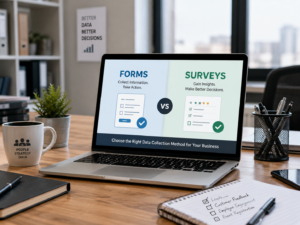

In today’s data-driven business landscape, surveys have become one of the most effective ways to understand customers, employees, students, event attendees, and target markets. Whether you’re gathering customer feedback, conducting market research, measuring employee engagement, or validating a new product idea, the quality of your survey often determines the quality of your insights.
However, many people face the same question before launching their first survey:
How to create a survey effectively?
Should you use pre-built templates? Should you design everything from scratch? Or should you leverage the latest AI-powered survey creation tools?
Each approach offers unique advantages and challenges. Choosing the right method can save time, improve response rates, and generate more actionable data.
This guide explores the pros and cons of each approach and helps you determine the best strategy for your specific needs.
Why Survey Design Matters
Creating a survey may seem simple at first glance. Most survey platforms allow users to drag and drop questions in minutes.
However, designing an effective survey requires more than simply adding questions.
Poorly designed surveys often lead to:
- Low completion rates
- Confusing responses
- Survey fatigue
- Biased results
- Unusable data
- Poor decision-making
An effective survey should be easy to understand, quick to complete, and aligned with a clear business objective.
Whether you’re using a free online survey maker, pre-built templates, or an AI-powered solution, the ultimate goal remains the same: collect accurate and actionable insights.
Understanding Your Survey Goal Before You Begin
Before learning how to create a survey, you need to understand why you’re creating one.
Many survey projects fail because organizations start writing questions before defining their objectives.
Ask yourself:
- What decision will this survey support?
- Who is the target audience?
- What information do I need?
- How will I use the results?
- What actions will be taken based on the feedback?
For example, a customer satisfaction survey has different goals than a market research survey.
Similarly, an employee engagement survey requires a different structure than an event feedback questionnaire.
Defining your objective first makes every other decision easier.
Option 1: Using Online Survey Templates
One of the fastest ways to create a survey is by using online survey templates.
Templates are pre-designed survey frameworks created for common use cases such as:
- Customer satisfaction surveys
- Employee engagement surveys
- Market research surveys
- Event feedback surveys
- Product feedback surveys
- Training evaluation surveys
- Net Promoter Score (NPS) surveys
Instead of starting with a blank page, users can customize existing questions and branding.
Advantages of Online Survey Templates
Faster Launch Times
Templates significantly reduce setup time.
Instead of spending hours deciding which questions to ask, you begin with a proven structure and make adjustments as needed.
This is especially valuable for small businesses, startups, and busy teams.
Industry-Tested Questions
Many templates are built using established research practices.
The questions often follow best practices that help improve response quality and reduce survey bias.
Reduced Design Mistakes
Survey design mistakes are common among beginners.
Templates help eliminate common problems such as:
- Leading questions
- Poor question order
- Redundant questions
- Overly complex language
Consistent Data Collection
Organizations that conduct surveys regularly benefit from standardized templates that make data easier to compare over time.
Limitations of Online Survey Templates
Although templates are useful, they are not perfect.
Some templates may contain questions that are irrelevant to your audience.
Others may not fully address your specific business objectives.
Using templates without customization can result in collecting unnecessary data while missing important insights.
The best approach is to treat templates as a starting point rather than a finished solution.
Option 2: Creating a Survey from Scratch
Some businesses prefer complete control over survey design.
Creating a survey from scratch allows organizations to build every question, section, and workflow according to their exact needs.
This approach is often used for highly specialized research projects and unique business scenarios.
Benefits of Building a Survey from Scratch
Complete Customization
Every question can be tailored to your audience, objectives, and industry.
This flexibility ensures that every question serves a specific purpose.
Better Alignment with Business Goals
Custom surveys often generate more relevant insights because they are designed specifically for the organization’s objectives.
Greater Creative Freedom
Survey creators can experiment with question formats, logic flows, and respondent experiences without template restrictions.
Challenges of Building from Scratch
While customization is valuable, creating surveys from scratch requires experience.
Common challenges include:
Longer Development Time
Designing a high-quality survey takes time.
Researching questions, organizing sections, and testing the survey can require significant effort.
Higher Risk of Bias
Without survey design knowledge, creators may unintentionally introduce biased wording or confusing questions.
Increased Complexity
Advanced surveys often require skip logic, branching paths, scoring systems, and segmentation rules that can become difficult to manage.
For beginners, starting completely from scratch can sometimes create more problems than solutions.
Option 3: Using an AI Survey Generator
Artificial intelligence is transforming survey creation.
Modern platforms now offer AI survey generator free tools that automatically generate survey questions, survey structures, response options, and even survey logic based on a simple prompt.
For example, a user might enter:
“Create a customer satisfaction survey for an online retail business.”
Within seconds, the AI can generate a complete survey framework.
How AI Survey Generators Work
AI survey tools analyze user goals and generate recommended questions based on established survey design practices.
Many AI-powered survey platforms can:
- Generate survey questions
- Recommend question types
- Create survey structures
- Suggest response scales
- Improve question wording
- Reduce survey bias
- Optimize survey length
This significantly reduces the effort required to create professional surveys.
Benefits of AI Survey Creation
Speed
AI dramatically accelerates survey development.
What once took hours can now be completed in minutes.
Better Question Quality
AI models are trained using vast amounts of survey and research content, helping generate clearer and more effective questions.
Reduced Writer’s Block
Many users struggle to decide what questions to ask.
AI provides a starting point that can be refined later.
Accessibility for Beginners
Users with little survey experience can create professional-quality surveys without extensive training.
Potential Drawbacks of AI Survey Generators
Although AI is powerful, human review remains essential.
AI-generated surveys may occasionally:
- Include generic questions
- Miss industry-specific nuances
- Overlook business context
- Generate unnecessary questions
The most effective approach is often to use AI as a starting point and then customize the survey based on organizational needs.
Comparing Templates, Scratch-Built Surveys, and AI
Templates Are Best For:
- Beginners
- Common survey types
- Fast deployment
- Standardized feedback programs
Scratch-Built Surveys Are Best For:
- Complex research projects
- Specialized industries
- Unique business requirements
- Advanced survey professionals
AI Survey Generators Are Best For:
- Rapid survey creation
- Small businesses
- Startups
- Marketing teams
- Customer feedback programs
- Users seeking efficiency
Each method has value depending on the project’s complexity and goals.
How a Free Online Survey Maker Simplifies the Process
A modern free online survey maker helps organizations create, distribute, and analyze surveys without technical expertise.
Today’s survey platforms often include:
- Drag-and-drop builders
- Survey templates
- AI-assisted survey generation
- Custom branding
- Mobile optimization
- Logic branching
- Analytics dashboards
- Real-time reporting
These features help businesses launch surveys quickly while maintaining professional quality.
For many organizations, combining templates, AI, and customization within a single platform offers the best overall experience.
Why SurveyFlip Combines All Three Approaches
SurveyFlip allows organizations to create surveys using whichever approach fits their needs.
Users can:
- Start with professionally designed templates
- Build completely from scratch
- Use AI-powered survey generation tools
This flexibility allows businesses to move quickly while still maintaining control over survey quality and customization.
Whether you’re collecting customer feedback, conducting market research, evaluating employee engagement, or measuring event satisfaction, SurveyFlip provides the tools needed to create effective surveys faster.
Best Practices for Creating Effective Surveys
Regardless of the creation method you choose, several best practices remain important.
Keep Surveys Short
Long surveys reduce completion rates.
Focus only on questions that support your objectives.
Use Clear Language
Simple questions improve response quality.
Avoid jargon and complex wording.
Ask One Thing at a Time
Avoid combining multiple concepts into a single question.
Optimize for Mobile
Most respondents now complete surveys on mobile devices.
Test Before Launch
Always review and test your survey before distributing it.
Small errors can significantly impact results.
The Future of Survey Creation
Survey creation is becoming increasingly intelligent.
AI-powered tools are helping organizations generate better surveys faster while reducing common design mistakes.
Future survey platforms will likely offer:
- Personalized question generation
- Predictive survey optimization
- Automated audience segmentation
- Real-time survey improvements
- AI-generated insights and recommendations
As these technologies evolve, creating high-quality surveys will become more accessible than ever.
Final Thoughts
If you’re wondering how to create a survey, the answer depends on your goals, timeline, and level of expertise.
Online survey templates provide speed and structure.
Building from scratch provides maximum customization.
An AI survey generator free tool offers a powerful balance of speed, quality, and convenience.
For most organizations, the best strategy is often a hybrid approach: start with AI or templates, then customize the survey to fit your specific needs.
Combined with a reliable free online survey maker, this approach helps businesses create professional surveys that generate meaningful insights, improve decision-making, and drive better outcomes.
Frequently Asked Questions (FAQ)
1. How do you create a survey from scratch?
To create a survey from scratch, start by defining a clear objective. Identify your target audience, determine the information you need, and write questions that directly support your goals. Organize questions in a logical order, keep the survey concise, test it before launch, and analyze responses carefully. Creating a survey from scratch offers maximum flexibility but requires thoughtful planning to ensure reliable results.
2. What is the best way to create a survey?
The best way depends on your goals. You need speed and simplicity, online survey templates are often the fastest option. If you need highly customized questions, building from scratch may be better. Or you want to save time while maintaining quality, an AI survey generator free tool can help generate survey questions and structure automatically.
3. How do I create a survey for free?
You can create a survey using a free online survey maker. Most survey platforms offer free plans that include survey templates, customizable questions, response collection, and reporting features. These tools allow businesses, educators, and researchers to gather feedback without investing in expensive software.
4. What should I do before creating a survey?
Before learning how to create a survey, define your purpose. Ask yourself:
- What decision will the survey support?
- Who will complete the survey?
- What information do I need?
- How will I use the results?
Clear objectives lead to better survey design and more actionable insights.
5. Are online survey templates effective?
Yes. Online survey templates are effective because they provide a proven structure and commonly used questions. They help reduce setup time, eliminate design mistakes, and improve consistency. However, templates should usually be customized to match your specific audience and objectives.
6. When should I use online survey templates?
Templates work best when:
- You need to launch quickly
- You’re conducting common survey types
- You have limited survey design experience
- You want standardized reporting
Many businesses use templates for customer satisfaction, employee engagement, event feedback, and market research surveys.
7. What are the benefits of creating a survey from scratch?
Building a survey from scratch allows complete customization. You can tailor every question to your business goals, audience, and industry. This approach is often preferred for specialized research projects where pre-built templates may not provide the required flexibility.
8. What are the disadvantages of creating surveys from scratch?
Creating surveys from scratch can be time-consuming and may increase the risk of survey design errors. Common issues include biased questions, poor survey flow, confusing wording, and lower response quality if proper research practices are not followed.
9. What is an AI survey generator?
An AI survey generator uses artificial intelligence to automatically create survey questions, survey structures, and response options based on a user’s objective. For example, you can enter a prompt such as “Create a customer satisfaction survey” and receive a ready-to-use survey within seconds.
10. Is an AI survey generator free?
Many survey platforms now offer an AI survey generator free feature as part of their free or trial plans. Features vary by platform, but AI tools can significantly reduce survey creation time while improving question quality.
11. Can AI create professional survey questions?
Yes. Modern AI tools can generate high-quality survey questions based on established survey design principles. However, it’s still important to review and customize AI-generated questions to ensure they align with your specific audience and business goals.
12. Should I trust AI-generated surveys completely?
No. AI is an excellent starting point, but human review remains important. AI-generated surveys may occasionally include generic questions, unnecessary questions, or wording that doesn’t fully match your objectives. Reviewing the survey before launch helps ensure accuracy and relevance.
13. How long should a survey be?
Most surveys should take between 3 and 10 minutes to complete. Shorter surveys generally achieve higher completion rates. Every question should serve a clear purpose and contribute to your research goals.
14. What types of questions should a survey include?
A well-balanced survey often includes:
- Multiple-choice questions
- Rating scale questions
- Likert scale questions
- Net Promoter Score (NPS) questions
- Open-ended questions
Using a mix of question types helps gather both quantitative and qualitative insights.
15. What are the most common survey design mistakes?
Common mistakes include:
- Asking too many questions
- Using leading or biased language
- Asking multiple questions at once
- Using confusing wording
- Ignoring mobile users
- Failing to test the survey before launch
Avoiding these mistakes improves data quality and response rates.
16. How can a free online survey maker help businesses?
A free online survey maker helps businesses collect customer feedback, conduct market research, evaluate employee engagement, and measure customer satisfaction. These tools reduce costs while providing valuable insights that support better decision-making.
17. Are AI-generated surveys better than survey templates?
Not necessarily. AI-generated surveys provide speed and customization, while templates offer proven structures and consistency. Many organizations achieve the best results by combining both approaches—starting with AI or templates and then customizing the survey to fit their needs.
18. Can I use AI and survey templates together?
Absolutely. Many modern survey platforms allow users to generate surveys with AI and then refine them using template-based designs and customization tools. This hybrid approach combines efficiency, flexibility, and quality.
19. How do I improve survey response rates?
To improve response rates:
- Keep surveys short
- Use clear language
- Optimize for mobile devices
- Personalize invitations
- Explain the survey’s purpose
- Offer incentives when appropriate
- Send timely reminders
A better user experience often leads to higher participation.
20. What is the future of survey creation?
The future of survey creation is increasingly AI-driven. Survey platforms are introducing intelligent question generation, automated survey optimization, predictive analytics, and AI-powered insights. These innovations will help organizations create better surveys faster while improving data quality and respondent experiences.