
- 11 min read
Table of Contents
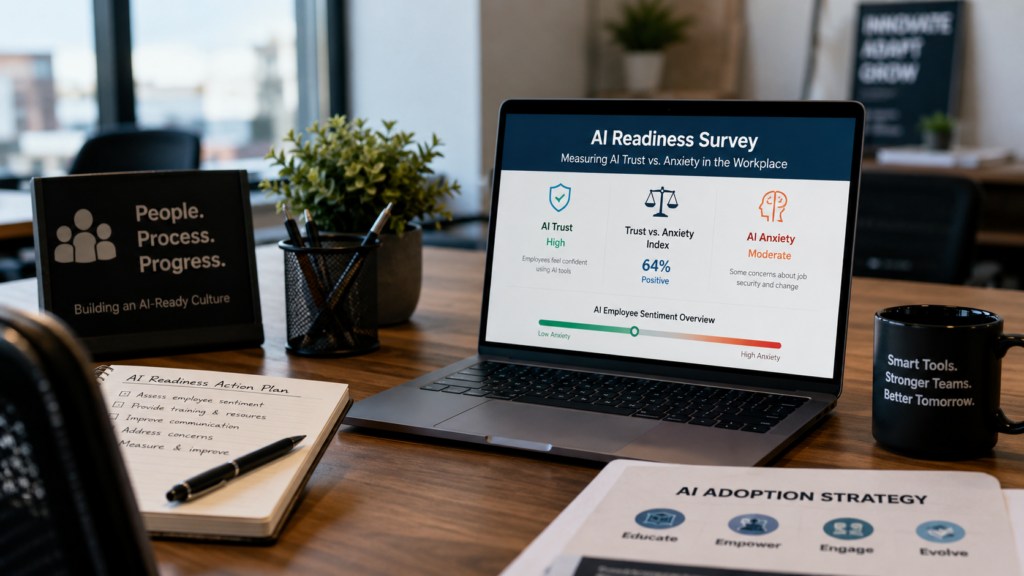
Artificial intelligence is no longer a distant concept in the workplace, it is now deeply embedded in everyday business operations. From automated reporting systems and AI-driven analytics to chatbots, HR tools, and productivity assistants, organizations are rapidly integrating AI into almost every workflow.
However, as adoption accelerates, a critical challenge is emerging beneath the surface.
It is not just about whether AI works.
It is about whether employees trust it enough to use it confidently or feel anxious and resistant toward it.
This emotional balance between trust and anxiety is becoming one of the most important predictors of successful AI transformation. Many companies invest heavily in tools and infrastructure but overlook the human factor that determines whether those tools are actually adopted.
To address this, modern organizations are turning to structured evaluation systems like an AI Readiness Survey, which helps measure employee sentiment, behavioral readiness, and emotional response toward AI adoption.
This is not just a technical assessment. It is a cultural diagnostic tool that reveals how people truly feel about the future of their work.
Why the AI Trust vs. Anxiety Balance Matters
The success of AI in any organization depends heavily on human behavior.
Even the most advanced AI systems will fail to deliver value if employees are hesitant to use them, misunderstand their purpose, or fear their impact.
In most workplaces, employee reactions to AI fall into two broad emotional categories:
On one side, there is AI trust. This is when employees feel confident, empowered, and supported by AI tools. They view AI as an assistant that enhances productivity rather than a threat to their job.
On the other side, there is AI anxiety. This occurs when employees feel uncertain, overwhelmed, or even threatened by automation. They may worry about job displacement, lack of control, or the complexity of new systems.
These emotional responses are not minor details. They directly influence:
- How quickly AI tools are adopted
- How effectively employees use them
- The overall return on AI investment
- Workplace morale and engagement
- Long-term innovation culture
A company with high AI trust will naturally see faster adoption and stronger performance outcomes. A company with high AI anxiety will often struggle with resistance, underutilization, and internal friction.
Understanding this emotional balance is essential for sustainable AI transformation.
What Is an AI Readiness Survey?
An AI Readiness Survey is a structured tool used to evaluate how prepared employees are for artificial intelligence adoption within their workplace.
It goes beyond basic training assessments or technical evaluations. Instead, it measures a combination of knowledge, behavior, and emotional readiness.
A well-designed AI readiness survey typically focuses on three key dimensions.
The first is awareness and understanding, which explores how familiar employees are with AI tools and concepts. This helps organizations identify knowledge gaps and training needs.
The second is behavioral readiness, which examines how often employees are actually using AI tools in their daily tasks. This provides insight into real-world adoption levels rather than theoretical acceptance.
The third and most important dimension is emotional readiness, which measures trust, confidence, and anxiety levels related to AI usage.
By combining these three areas, organizations gain a complete picture of workforce preparedness for AI integration.
Understanding the AI Trust vs. Anxiety Index
The AI Trust vs. Anxiety Index is a measurement framework designed to quantify employee sentiment toward AI systems.
Instead of treating AI adoption as a binary outcome (use or don’t use), this index captures the emotional spectrum behind adoption behavior.
Employees are not simply categorized as users or non-users. They are evaluated based on how they feel about AI tools in their workplace.
Some employees demonstrate high trust, meaning they actively embrace AI and integrate it into their workflows with confidence. Others fall into a neutral zone, where they may use AI occasionally but lack strong conviction. A third group experiences high anxiety, where hesitation or fear limits adoption entirely.
This index is typically calculated using data collected from an AI Adoption Questionnaire or broader AI readiness assessments.
Once responses are analyzed, organizations can assign sentiment scores that reflect overall workplace readiness for AI transformation.
These scores help leaders identify:
- Departments with strong AI adoption
- Teams struggling with resistance
- Training gaps that need attention
- Cultural barriers affecting implementation
Instead of guessing how employees feel, organizations gain measurable insight into workforce sentiment.
What Is AI Employee Sentiment?
AI Employee Sentiment refers to the collective emotional attitude employees have toward artificial intelligence in their workplace.
It includes how employees perceive:
- The usefulness of AI tools
- The impact of AI on job security
- The ease of using AI systems
- The fairness of AI-driven decisions
- The overall role of AI in their daily work
This sentiment is shaped by communication, training, leadership messaging, and personal experience with AI tools.
When AI employee sentiment is positive, employees are more likely to:
- Experiment with AI tools
- Adopt new workflows quickly
- Share feedback and improvement ideas
- Support digital transformation initiatives
When sentiment is negative, organizations often experience:
- Resistance to new systems
- Reduced productivity gains
- Lower engagement levels
- Slower adoption rates
This makes sentiment analysis a crucial component of successful AI implementation strategies.
Designing an Effective AI Adoption Questionnaire
An AI Adoption Questionnaire is one of the most practical tools for measuring how employees interact with AI systems and how they feel about them.
To be effective, it must be structured in a way that captures both behavioral and emotional insights.
A strong questionnaire typically includes three categories of questions.
The first category focuses on AI awareness and knowledge. These questions assess how well employees understand the AI tools available to them and whether they have received proper training.
The second category focuses on usage patterns. These questions explore how frequently employees use AI tools, which tools they rely on most, and which tasks they automate.
The third category focuses on trust and emotional response, which is the most important section for understanding the AI trust vs. anxiety index. These questions explore comfort levels, confidence, and concerns about AI usage.
By combining these categories, organizations can develop a complete understanding of adoption behavior and emotional readiness.
How to Measure the AI Trust vs. Anxiety Index
Measuring the AI trust vs. anxiety balance requires a structured, data-driven approach.
The process typically begins with collecting responses through an AI Readiness Survey or AI Adoption Questionnaire.
Once data is collected, responses are grouped into two primary categories: trust indicators and anxiety indicators.
Trust indicators include responses that show confidence, optimism, and willingness to use AI tools. Anxiety indicators include responses that reflect hesitation, concern, or resistance.
Each response can then be assigned a sentiment value based on its intensity. For example, strong agreement with AI confidence statements may carry a higher trust score, while strong disagreement may indicate higher anxiety.
After scoring, all responses are combined to generate an overall index score for the organization or specific departments.
This process allows businesses to visualize AI sentiment across teams and identify patterns that would otherwise remain hidden.
Some departments may show strong trust, while others may require targeted training and support.
Common Causes of AI Anxiety in the Workplace
AI anxiety does not appear randomly. It is usually driven by specific concerns and workplace conditions.
One of the most common causes is fear of job displacement. Employees often worry that automation may reduce their roles or make certain skills less valuable.
Another major factor is lack of training. When employees are not properly guided on how to use AI tools, they naturally feel uncertain and avoid using them.
Poor communication from leadership can also increase anxiety. If the purpose and benefits of AI adoption are not clearly explained, employees may interpret it as a threat rather than an opportunity.
Additionally, overly complex tools or negative past experiences with technology can reinforce resistance.
Understanding these causes allows organizations to design better adoption strategies that focus on education, clarity, and support rather than pressure.
Building AI Trust in the Workplace
Increasing AI trust requires a thoughtful and people-centered approach.
Organizations must focus on helping employees understand that AI is designed to support their work, not replace them.
Effective strategies include providing hands-on training sessions where employees can experiment with tools in a low-pressure environment. This helps build familiarity and confidence over time.
Clear communication from leadership is also essential. When leaders explain how AI improves workflows and productivity, employees are more likely to accept it.
Encouraging experimentation and celebrating early adopters can also help create a positive culture around AI usage.
When employees feel supported and informed, anxiety naturally decreases and trust increases.
Why AI Readiness Surveys Are Essential in 2026
In 2026, AI adoption is no longer just a technology decision—it is a workforce transformation challenge.
Organizations that fail to measure employee sentiment risk slow adoption, wasted investments, and internal resistance.
An AI Readiness Survey provides a structured way to understand how prepared employees are for AI integration. It helps identify emotional barriers, training gaps, and adoption risks before they become major problems.
By regularly measuring AI Employee Sentiment, organizations can ensure smoother transitions, stronger engagement, and more successful AI implementation strategies.
The Future of AI Sentiment Measurement
As AI becomes more deeply integrated into workplaces, sentiment measurement will become continuous rather than periodic.
Instead of one-time surveys, organizations will rely on ongoing feedback systems that track employee sentiment in real time.
AI-powered analytics will also play a major role in identifying patterns, predicting adoption behavior, and recommending targeted interventions.
This will allow companies to respond faster to employee concerns and create more adaptive, human-centered AI strategies.
The future of AI transformation will depend not just on technology, but on understanding how people feel about that technology.
Final Thoughts
Measuring the AI trust vs. anxiety index is one of the most important steps organizations can take in ensuring successful AI adoption.
An AI Readiness Survey provides the foundation for understanding workforce preparedness, while an AI Adoption Questionnaire helps capture detailed behavioral and emotional insights.
Together, they reveal the true state of AI Employee Sentiment within an organization.
In the end, successful AI transformation is not just about deploying tools—it is about building trust, reducing anxiety, and empowering people to work confidently alongside intelligent systems.
Frequently Asked Questions (FAQ)
1. What is an AI Readiness Survey?
An AI Readiness Survey is a structured assessment used to measure how prepared employees are to adopt artificial intelligence tools in the workplace. It evaluates awareness, usage behavior, and emotional readiness toward AI systems.
2. What is the AI Trust vs. Anxiety Index?
The AI Trust vs. Anxiety Index is a measurement framework that evaluates employee sentiment toward AI. It shows whether employees feel confident and positive about AI (trust) or uncertain and resistant (anxiety).
3. Why is AI Employee Sentiment important?
AI Employee Sentiment helps organizations understand how employees feel about AI tools. Positive sentiment increases adoption and productivity, while negative sentiment can slow down implementation and create resistance.
4. What is an AI Adoption Questionnaire?
An AI Adoption Questionnaire is a set of structured questions designed to evaluate how employees are using AI tools, their comfort level, and their concerns. It helps organizations measure adoption and identify training needs.
5. How do you measure AI trust vs anxiety in a workplace?
It is measured by collecting survey data, categorizing responses into trust and anxiety indicators, assigning sentiment scores, and analyzing overall patterns across teams or departments.
6. What causes AI anxiety among employees?
Common causes include fear of job loss, lack of training, unclear communication from leadership, and unfamiliarity with AI tools or systems.
7. How can companies increase AI trust in employees?
Companies can build trust by offering training, improving communication, showing real benefits of AI tools, encouraging experimentation, and providing ongoing support.
8. Who should use an AI Readiness Survey?
Any organization implementing AI tools—especially HR teams, managers, and digital transformation leaders—should use an AI Readiness Survey to understand employee readiness and reduce adoption risks.
9. How often should AI sentiment be measured?
AI employee sentiment should ideally be measured regularly (quarterly or continuously) to track changes in trust, anxiety, and adoption over time.
10. What is the future of AI sentiment analysis in workplaces?
The future includes real-time sentiment tracking, AI-powered feedback analysis, predictive adoption models, and continuous employee experience monitoring to improve AI integration success.
