
- 14 min read
Table of Contents
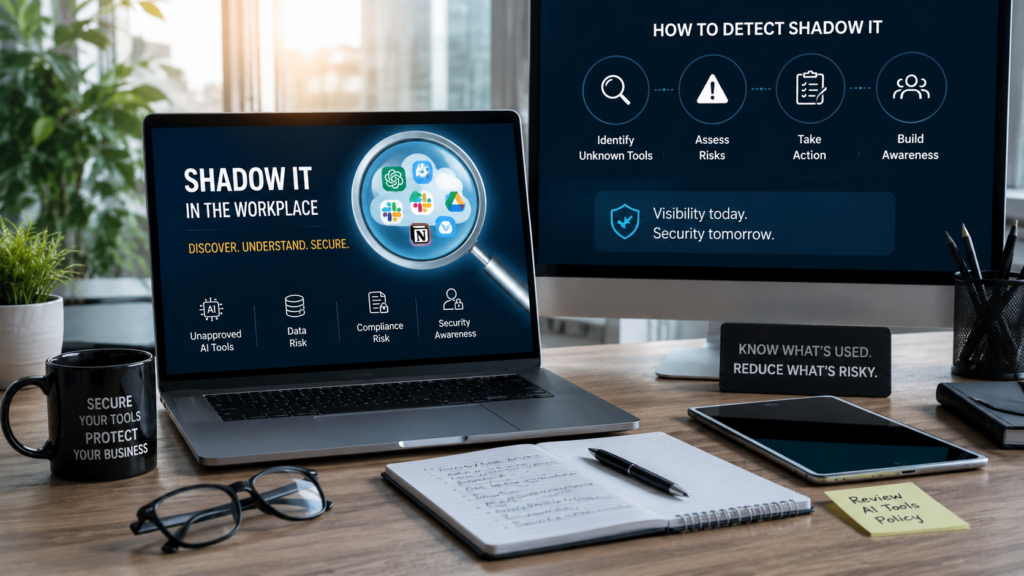
Artificial intelligence is rapidly becoming a standard part of the modern workplace. Employees use AI-powered tools to write emails, summarize meetings, generate reports, analyze data, create presentations, automate repetitive tasks, and improve productivity. The accessibility of these tools has allowed businesses to innovate faster than ever before. However, this rapid adoption has also created a growing challenge that many organizations are only beginning to understand: Shadow IT in the workplace.
Many employees are using AI tools that have never been reviewed, approved, or monitored by their organization’s IT department. In most cases, employees are not trying to bypass company policies. They simply want to complete tasks more efficiently and take advantage of new technologies that can help them perform better. Yet even when the intentions are positive, unauthorized technology use can introduce significant risks related to data privacy, cybersecurity, compliance, intellectual property protection, and operational governance.
As AI adoption accelerates across industries, organizations need better visibility into what tools employees are using and why. One of the most effective ways to gain this visibility is through a Shadow IT survey specifically designed for workplace AI tools.
A well-planned survey can reveal hidden technology usage, uncover employee needs, identify security risks, and help leadership create AI governance strategies that balance innovation with protection. Understanding how to design and implement such a survey has become an important skill for HR leaders, IT professionals, security teams, and business decision-makers.
Understanding Shadow IT in the Workplace
The concept of Shadow IT in the workplace is not new. For years, employees have used unapproved applications and services to solve business problems more quickly than traditional procurement or IT approval processes allowed.
In the past, Shadow IT often involved cloud storage platforms, messaging applications, file-sharing services, or project management tools. Employees would adopt these solutions because they were convenient, easy to use, and immediately available.
Artificial intelligence has dramatically expanded this phenomenon.
Today, employees have access to hundreds of AI-powered applications that require little or no technical expertise. Many of these tools offer free versions, browser-based access, or instant sign-up processes. As a result, employees can begin using AI applications within minutes without involving IT departments or management teams.
An employee may upload confidential documents to an AI chatbot for summarization. A marketing professional may use an external AI writing assistant to create campaign content. A developer may rely on an AI coding tool that has not undergone a security review. While these actions may seem harmless, they can expose organizations to risks that are often invisible until a problem occurs.
Understanding where and how these tools are being used is the first step toward managing those risks effectively.
Why AI Has Made Shadow IT More Common
Artificial intelligence has introduced a unique set of circumstances that make Shadow IT more widespread than traditional software adoption.
Unlike enterprise software, which often requires installation, licensing, and IT support, many AI tools are designed for immediate access. Employees can discover a new tool online, create an account, and begin using it during the same workday.
The rapid pace of AI innovation has also created a situation where employees frequently discover tools before organizations have an opportunity to evaluate them. New applications appear almost daily, each promising greater efficiency, automation, and productivity.
For many employees, waiting for formal approval feels slower than simply adopting the tool themselves.
This behavior is understandable. Employees are often under pressure to improve performance, meet deadlines, and accomplish more with limited resources. AI tools appear to offer an easy solution.
The challenge is that employees may not fully understand the security, privacy, or compliance implications of their actions. Information shared with external AI platforms could include sensitive customer data, proprietary business information, financial records, or confidential strategic documents.
This creates a significant need for organizations to understand which AI tools are being used and how those tools interact with company data.
What Is a Shadow IT Survey?
A Shadow IT survey is a structured questionnaire designed to collect information about technology usage across an organization.
When focused on workplace AI, the survey seeks to identify AI tools that employees are using, understand how those tools support business activities, and assess potential risks associated with their usage.
The goal is not to identify policy violations or punish employees.
Instead, the objective is to gain visibility into the real-world technology landscape that exists within the organization.
Many organizations are surprised to discover that employees are already using a wide variety of AI solutions without formal approval. A survey provides a non-confrontational method for gathering this information directly from employees.
Because employees are often the best source of information about their own technology habits, surveys can reveal insights that technical monitoring systems may miss.
The results help organizations make informed decisions about governance, training, software procurement, and security management.
Why Organizations Need Shadow IT Discovery
Shadow IT discovery has become increasingly important as AI adoption continues to expand.
Without visibility, organizations cannot effectively manage risk.
Leadership teams often assume they know which technologies employees are using because they maintain inventories of approved software. Unfortunately, approved software inventories rarely capture the full picture.
Employees frequently adopt tools independently, especially when they perceive those tools as valuable or necessary for completing their work.
A Shadow IT survey provides an opportunity to uncover these hidden technologies.
The process often reveals more than just unauthorized software.
It helps organizations understand why employees are seeking alternative solutions, what challenges they are trying to solve, and where current technology offerings may be falling short.
This information can be incredibly valuable for improving business processes, supporting innovation, and developing more effective technology strategies.
Rather than viewing Shadow IT solely as a security problem, organizations can use discovery efforts to identify opportunities for improvement and modernization.
Defining Clear Survey Objectives
Before creating a survey, organizations should establish clear objectives.
One of the most common mistakes is attempting to gather every possible piece of information in a single survey.
Effective surveys are focused and purposeful.
An organization may want to identify unauthorized AI tools, measure awareness of AI policies, evaluate security concerns, understand adoption trends, or assess employee demand for approved solutions.
Each objective should support a broader business goal.
When objectives are clearly defined, survey questions become more relevant and respondents are more likely to provide useful answers.
Clear objectives also simplify analysis and make it easier to translate survey findings into actionable recommendations.
Creating Questions That Encourage Honest Participation
The success of a Shadow IT survey depends heavily on employee honesty.
Employees are unlikely to disclose their use of unauthorized AI tools if they believe the survey is being used for enforcement or disciplinary purposes.
This makes survey design particularly important.
Questions should be written in a neutral and supportive manner.
The tone should emphasize learning, understanding, and improvement rather than compliance enforcement.
For example, asking employees which AI tools they use to improve productivity is generally more effective than asking whether they have violated company policies.
Organizations should also explain the purpose of the survey before employees begin responding.
When respondents understand that the goal is to improve support, training, and technology options, participation tends to increase significantly.
Transparency builds trust, and trust improves data quality.
Identifying Unapproved AI Tools at Work
One of the primary objectives of a Shadow IT survey is identifying Unapproved AI tools at work.
Employees may use a broad range of applications that leadership teams are unaware of.
These tools can include AI writing assistants, research platforms, meeting transcription software, coding assistants, image generation tools, analytics platforms, customer service automation systems, and workflow optimization applications.
By asking employees about the tools they currently use, organizations can create a more accurate inventory of AI technologies operating within the business.
This inventory can then be reviewed by IT, security, and compliance teams to determine whether any tools require further evaluation.
In many cases, organizations discover valuable tools that deserve official approval and broader deployment.
The survey therefore becomes both a governance exercise and a source of innovation insights.
How to Detect Shadow IT Beyond Employee Surveys
While surveys are extremely valuable, they work best when combined with additional discovery methods.
Organizations seeking to understand How to detect shadow IT should adopt a layered approach.
Technical monitoring tools can provide important visibility into application usage, cloud services, network traffic, and software installations.
Security systems may reveal applications communicating with external platforms. Identity management tools can highlight unauthorized accounts. Network monitoring can identify unusual data flows.
Combining technical insights with employee feedback creates a much more complete understanding of technology usage patterns.
Employees provide context and motivation, while technical systems provide verification and visibility.
Together, these approaches help organizations manage AI adoption more effectively.
Analyzing Survey Data for Meaningful Insights
Collecting responses is only the beginning.
The real value of a Shadow IT survey comes from careful analysis.
Organizations should look for patterns in adoption behavior, common use cases, frequently used applications, and recurring concerns.
For example, if employees across multiple departments are independently adopting the same AI tool, this may indicate a legitimate business need that existing systems are not meeting.
Similarly, if respondents express confusion about AI policies, additional communication and training may be necessary.
Analysis should focus not only on identifying risks but also on understanding opportunities.
Many of the most successful technology initiatives begin by recognizing and supporting innovations that employees have already discovered on their own.
Turning Survey Results Into Action
A survey without follow-up action provides little value.
Organizations should use survey findings to improve governance, strengthen security, and support responsible AI adoption.
This may involve updating AI usage policies, approving certain tools, introducing employee training programs, or implementing additional monitoring capabilities.
The goal should not be to eliminate innovation.
Instead, organizations should create frameworks that allow employees to benefit from AI while minimizing risks.
When employees feel supported rather than restricted, they are more likely to follow guidelines and participate in governance initiatives.
The Future of Shadow IT Discovery in AI-Powered Workplaces
As artificial intelligence continues to evolve, Shadow IT management will become increasingly important.
The number of available AI applications is expected to grow dramatically in the coming years. Employees will have more choices, more capabilities, and more opportunities to adopt tools independently.
Future Shadow IT discovery efforts will likely rely on a combination of employee surveys, automated monitoring systems, AI-powered risk assessments, and continuous feedback mechanisms.
Organizations that embrace transparency and proactive discovery will be better equipped to balance innovation with security.
Those that ignore Shadow IT may find themselves exposed to risks they never knew existed.
Final Thoughts
The rapid growth of artificial intelligence has made Shadow IT in the workplace one of the most important technology governance challenges facing organizations today.
Employees are increasingly adopting AI tools to improve productivity, streamline workflows, and solve business problems. While these tools can deliver tremendous value, they can also introduce significant security, compliance, and operational risks when used without oversight.
A carefully designed Shadow IT survey provides one of the most effective ways to achieve Shadow IT discovery, identify Unapproved AI tools at work, and understand How to detect shadow IT across the organization.
More importantly, it helps organizations understand employee needs, uncover innovation opportunities, and build AI governance strategies that support both business growth and risk management.
In the age of workplace AI, visibility is no longer optional. Organizations that actively monitor and understand AI adoption will be better positioned to innovate securely, protect valuable data, and build a future-ready workplace.
Frequently Asked Questions (FAQ)
1. What is Shadow IT in the workplace?
Shadow IT in the workplace refers to software, applications, devices, or technology services that employees use without approval or oversight from the organization’s IT department. In today’s AI-driven environment, this often includes AI chatbots, writing assistants, automation tools, and analytics platforms.
2. Why is Shadow IT becoming more common?
Shadow IT is growing because employees can easily access cloud-based and AI-powered tools without going through formal procurement or approval processes. Many workers adopt these tools to increase productivity, save time, and improve work quality.
3. What are unapproved AI tools at work?
Unapproved AI tools at work are artificial intelligence applications used by employees without formal authorization from the company. Examples may include AI writing assistants, image generators, coding assistants, meeting transcription tools, and external chatbot platforms.
4. Why should organizations be concerned about unapproved AI tools?
Unauthorized AI tools can create risks related to:
- Data privacy
- Cybersecurity
- Regulatory compliance
- Intellectual property protection
- Customer data security
- Corporate governance
Even well-intentioned employees can accidentally expose sensitive information when using external AI platforms.
5. What is Shadow IT discovery?
Shadow IT discovery is the process of identifying unauthorized software, applications, and technology services being used within an organization. The goal is to gain visibility into hidden technology usage and assess potential risks.
6. How can a Shadow IT survey help organizations?
A Shadow IT survey helps organizations:
- Identify unauthorized AI tools
- Understand employee technology usage
- Discover unmet business needs
- Improve AI governance
- Reduce security risks
- Support responsible innovation
It provides direct insight into how employees are using technology in their daily work.
7. How do you detect Shadow IT in an organization?
Organizations can detect Shadow IT through a combination of:
- Employee surveys
- Network monitoring
- Cloud application discovery
- Endpoint security tools
- Identity and access management systems
- Software asset management platforms
Using multiple methods provides a more complete view of technology usage.
8. How often should companies conduct Shadow IT discovery?
Most organizations should perform Shadow IT discovery at least quarterly. However, companies experiencing rapid AI adoption may benefit from continuous monitoring and more frequent employee surveys.
9. What questions should be included in a Shadow IT survey?
A Shadow IT survey should ask about:
- AI tools currently being used
- Frequency of usage
- Business purposes for using AI
- Awareness of company AI policies
- Security concerns
- Desired AI capabilities
- Challenges with approved technology solutions
The goal is to understand both behavior and motivation.
10. Should Shadow IT surveys be anonymous?
In most cases, yes. Anonymous surveys encourage employees to provide honest answers without fear of disciplinary action. This often results in more accurate and useful data.
11. Is Shadow IT always a security threat?
Not necessarily. While Shadow IT can introduce risks, it can also reveal innovation opportunities and unmet business needs. Many employees adopt new tools because existing systems are inefficient or lack required functionality.
12. How can organizations reduce Shadow IT risks?
Organizations can reduce Shadow IT risks by:
- Creating clear AI policies
- Providing approved AI alternatives
- Offering employee training
- Encouraging open communication
- Conducting regular Shadow IT discovery
- Implementing appropriate monitoring controls
A balanced approach is often more effective than strict restrictions.
13. What industries are most affected by Shadow IT?
Shadow IT affects virtually every industry, but it is especially common in:
- Technology
- Financial services
- Healthcare
- Education
- Marketing
- Professional services
- SaaS companies
Any organization adopting AI tools may encounter Shadow IT challenges.
14. How does Shadow IT impact compliance?
Unauthorized software may violate industry regulations, data protection requirements, contractual obligations, or internal governance policies. This can increase legal and operational risks for organizations.
15. What is the future of Shadow IT in AI-powered workplaces?
As AI adoption continues to grow, Shadow IT management will become a critical part of organizational governance. Future strategies will likely combine employee surveys, automated monitoring, AI-powered risk analysis, and continuous technology assessment to maintain visibility and control.
16. Why is Shadow IT discovery important in 2026?
In 2026, AI tools are expected to be deeply integrated into everyday work. Without effective Shadow IT discovery, organizations may struggle to manage security, compliance, and data governance risks while missing opportunities to support productive and innovative technology adoption.
