- 20 min read



When creating a survey or questionnaire, one of the most important decisions you’ll make isn’t choosing the colors, layout, or platform. It’s deciding how to ask your questions.
A well-designed questionnaire can uncover valuable customer insights, improve products, strengthen marketing campaigns, and support smarter business decisions. On the other hand, poorly structured questions often lead to incomplete responses, biased data, and misleading conclusions.
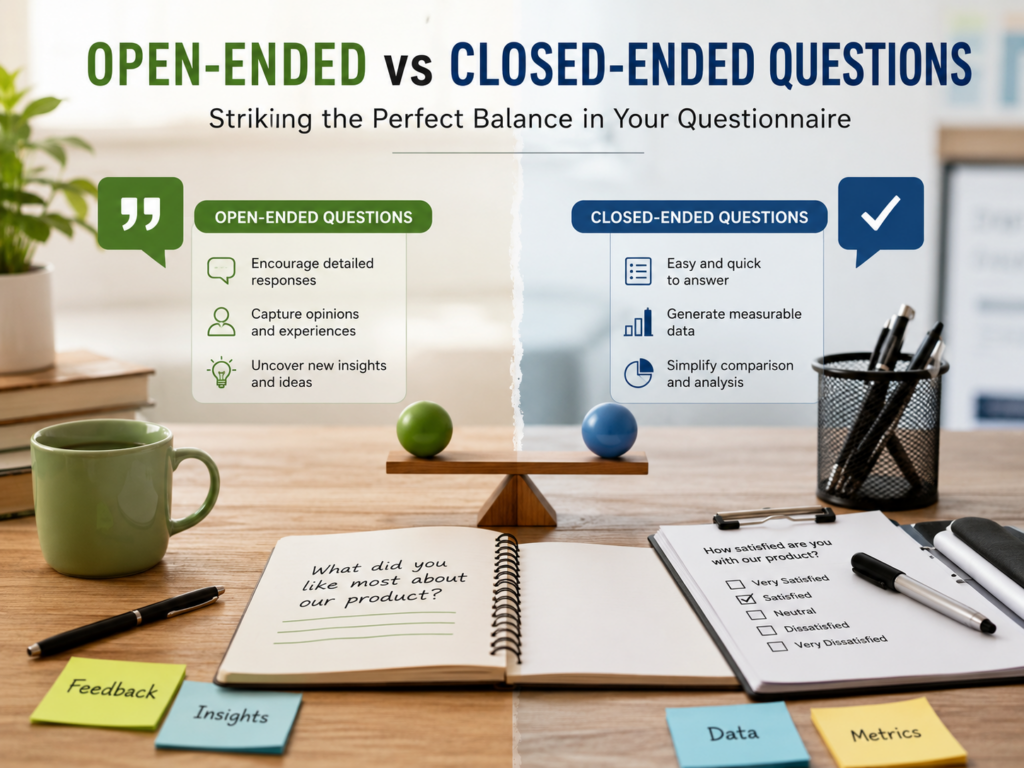
One of the biggest challenges in survey design is choosing between open ended vs closed ended questions. Both question types serve different purposes, and each offers unique advantages. While closed-ended questions make responses easier to analyze, open-ended questions allow respondents to explain their thoughts in their own words. The real challenge isn’t deciding which one is better—it’s knowing when to use each one.
Many organizations make the mistake of relying entirely on one question type. Some surveys contain nothing but multiple-choice questions, while others ask respondents to type long answers for every question. Both approaches can reduce response quality and increase survey fatigue.
The most effective surveys strike a balance. They combine structured data with detailed feedback, giving businesses both measurable insights and the context needed to understand customer behavior.
In this guide, you’ll learn the difference between open and closed ended questions, discover when each type works best, understand how they compare in the broader discussion of Survey vs Questionnaire, and learn how to mix open and closed questions in a survey to collect richer, more actionable data.
Why Question Types Matter More Than Most People Realize
Every survey has a purpose.
Some surveys measure customer satisfaction. Others collect market research, evaluate employee engagement, gather product feedback, or identify new business opportunities.
No matter the goal, the quality of your results depends largely on the quality of your questions.
Imagine asking customers:
“Did you enjoy our service?”
A simple “Yes” or “No” tells you very little. If someone answers “No,” you still don’t know why they were dissatisfied or what could have improved their experience.
Now consider asking:
“What could we have done to improve your experience?”
The respondent can explain exactly what happened, giving you insights that would never appear in a simple multiple-choice question.
Neither question is inherently better than the other.
The first provides measurable data.
The second provides meaningful context.
When combined thoughtfully, they create a much more complete picture of customer opinions and behaviors.
Understanding Open Ended vs Closed Ended Questions
To build better surveys, it’s essential to understand the strengths and limitations of both question types.
Although they often appear in the same questionnaire, they serve very different purposes.
What Are Closed-Ended Questions?
Closed-ended questions limit respondents to a predefined set of answers.
Instead of writing their own response, participants select one or more options provided by the survey creator.
Examples include:
- Yes or No
- Multiple choice
- Rating scales
- Likert scales
- Drop-down menus
- Ranking questions
- Checkboxes
For example:
How satisfied are you with our customer service?
- Very satisfied
- Satisfied
- Neutral
- Dissatisfied
- Very dissatisfied
Or:
How often do you purchase from our store?
- Weekly
- Monthly
- Every few months
- Once a year
- This is my first purchase
Because every respondent selects from the same list of answers, the results are easy to organize, compare, and analyze.
Benefits of Closed-Ended Questions
Closed-ended questions are popular because they make surveys faster for respondents and easier for researchers.
Some of the biggest advantages include:
Faster Completion Times
Respondents simply select an answer instead of writing one.
Shorter surveys generally produce higher completion rates.
Easier Data Analysis
Since responses follow a predefined format, businesses can quickly calculate percentages, averages, trends, and comparisons.
Charts and dashboards can be generated automatically.
Better for Large Sample Sizes
When thousands of people participate, standardized responses make statistical analysis much more reliable.
Consistent Results
Every participant answers using the same response options, reducing interpretation differences.
Limitations of Closed-Ended Questions
Despite their advantages, closed-ended questions have limitations.
They only collect information that the survey creator anticipated.
If an important answer isn’t included among the options, respondents may choose the closest available answer—even if it doesn’t accurately reflect their opinion.
For example, asking:
Why did you choose our product?
- Price
- Features
- Customer support
- Brand reputation
What if the real reason was a recommendation from a friend?
Or sustainability?
Or faster delivery?
The survey never captures those insights because the answer wasn’t available.
What Are Open-Ended Questions?
Open-ended questions allow respondents to answer in their own words.
Instead of selecting from predefined choices, participants explain their thoughts, opinions, experiences, or suggestions.
Examples include:
- What did you like most about our product?
- What improvements would you recommend?
- Why did you choose our service instead of a competitor?
- What challenges are you trying to solve?
These questions encourage detailed feedback that often reveals valuable insights businesses never expected to discover.
Why Open-Ended Questions Matter
Customers don’t always think the way businesses expect them to.
An open-ended question gives respondents the freedom to discuss issues that survey creators may never have considered.
For example, an online retailer might assume customers care most about pricing.
Instead, dozens of customers mention slow delivery times.
That insight could completely change business priorities.
Open-ended questions help uncover:
- Hidden customer frustrations
- Unexpected product ideas
- Common complaints
- Emotional motivations
- Customer language
- Purchase drivers
- Service improvement opportunities
These insights often become the foundation for product innovation and better customer experiences.
Benefits of Open-Ended Questions
Businesses often underestimate the value of qualitative feedback.
Some of the biggest advantages include:
Rich Customer Insights
Instead of selecting a predefined option, respondents explain their reasoning.
This creates deeper understanding.
Discovery of New Ideas
Customers frequently identify problems and opportunities businesses never considered.
Many successful product improvements begin with open-ended survey responses.
Better Understanding of Customer Emotions
Numbers can tell you satisfaction dropped.
Words explain why.
Understanding customer emotions often leads to more effective business decisions.
Stronger Marketing Messages
Customers naturally describe products using their own language.
That language can improve website copy, advertisements, email campaigns, and landing pages.
Challenges of Open-Ended Questions
Although powerful, open-ended questions require more effort from both respondents and researchers.
Long surveys with too many text fields often experience lower completion rates.
Analyzing hundreds or thousands of written responses also takes considerably more time.
Fortunately, modern AI tools now help categorize comments, detect sentiment, and identify recurring themes automatically.
This makes qualitative analysis far more practical than it was just a few years ago.
The Difference Between Open and Closed Ended Questions
The difference between open and closed ended questions becomes much clearer when comparing them side by side.
| Open-Ended Questions | Closed-Ended Questions |
| Respondents write their own answers | Respondents choose predefined answers |
| Collect qualitative data | Collect quantitative data |
| Reveal customer motivations | Measure customer opinions |
| Rich insights | Easy statistical analysis |
| Longer completion time | Faster completion time |
| Harder to analyze manually | Easy to analyze automatically |
| Discover unexpected insights | Confirm known assumptions |
Neither approach replaces the other.
Instead, they complement one another.
A strong survey usually includes both.
Survey vs Questionnaire: Why the Difference Matters
Many people use the terms Survey vs Questionnaire interchangeably.
Although closely related, they are not exactly the same.
A questionnaire is simply a collection of questions.
Its purpose is to gather information.
A survey is the complete research process.
It includes:
- Planning objectives
- Designing questions
- Selecting participants
- Collecting responses
- Analyzing data
- Drawing conclusions
In other words, every survey contains a questionnaire, but not every questionnaire is part of a formal survey.
Understanding this distinction helps businesses focus not only on writing good questions but also on designing an effective research process.
When Should You Use Closed-Ended Questions?
Closed-ended questions work best when you already know the information you’re trying to measure.
They’re ideal for:
- Customer satisfaction scores
- Employee engagement ratings
- Product usage frequency
- Brand awareness
- Demographic information
- Purchase behavior
- Net Promoter Score (NPS)
- Event evaluations
For example, if your goal is to determine what percentage of customers are satisfied with your service, a rating scale provides fast, measurable data.
Businesses that regularly monitor KPIs often rely heavily on closed-ended questions because the results can be tracked over time and compared across different customer groups.
When Should You Use Open-Ended Questions?
Open-ended questions work best when your goal is discovery rather than measurement.
Use them when you want respondents to explain their experiences, describe challenges, or suggest improvements that you may not have anticipated.
These questions are especially useful for:
- Product feedback
- Customer experience research
- Employee engagement surveys
- User experience (UX) research
- Market research
- Brand perception studies
- Customer interviews
- Exit surveys
For example, after asking customers to rate their satisfaction on a five-point scale, you might follow up with:
“What is the main reason for your rating?”
The first question tells you what customers think.
The second explains why they think that way.
That combination provides insights that are far more valuable than either question alone.
How to Mix Open and Closed Questions in a Survey
One of the most common questions businesses ask is how to mix open and closed questions in a survey without making the questionnaire too long or overwhelming.
The answer is balance.
A well-designed survey should begin with simple questions that encourage participation before gradually moving into more detailed feedback.
For example, a customer satisfaction survey might begin with several closed-ended questions measuring satisfaction, ease of use, and likelihood of recommending the product. Once those quantitative responses have been collected, the survey can include one or two carefully placed open-ended questions that encourage customers to explain their answers.
A logical survey flow might look like this:
- Overall satisfaction rating.
- Product quality rating.
- Ease of purchase rating.
- Customer service rating.
- “What did you like most about your experience?”
- “What could we improve?”
This approach keeps the survey fast while still collecting valuable qualitative insights.
Why Combining Both Question Types Produces Better Results
Imagine you’re analyzing responses from 2,000 customers.
Your closed-ended questions reveal that customer satisfaction dropped from 4.7 to 4.2 over the past quarter.
That’s useful information.
But it doesn’t explain what changed.
Now imagine that every dissatisfied customer also answered:
“What could we improve?”
Suddenly you discover that hundreds of customers mention delayed shipping.
Now you have both the measurement and the explanation.
Closed-ended questions identify problems.
Open-ended questions explain them.
Together, they support better business decisions.
Examples of Closed-Ended Questions
Closed-ended questions work well when responses need to be compared across many participants.
Examples include:
How satisfied are you with our product?
- Very satisfied
- Satisfied
- Neutral
- Dissatisfied
- Very dissatisfied
How often do you use our software?
- Daily
- Weekly
- Monthly
- Rarely
Would you recommend us to a friend?
- Yes
- No
Which device do you primarily use?
- Desktop
- Laptop
- Tablet
- Smartphone
These questions make reporting simple because responses can easily be converted into charts, percentages, and trends.
Examples of Open-Ended Questions
Open-ended questions encourage respondents to provide detailed feedback.
Examples include:
- What problem were you hoping our product would solve?
- What almost prevented you from making your purchase?
- What feature would you most like to see added?
- What was the best part of your experience?
- If you could improve one thing, what would it be?
- Why did you choose our company instead of a competitor?
- Is there anything else you’d like to share?
Questions like these often uncover insights that businesses never expected to receive.
Common Mistakes When Using Open-Ended Questions
Although open-ended questions provide valuable insights, overusing them can reduce survey quality.
One common mistake is asking too many text-based questions.
If respondents must type long answers throughout the survey, they may abandon it before completion.
Another mistake is asking vague questions such as:
“Tell us your thoughts.”
Most respondents won’t know where to begin.
Instead, ask specific questions that guide the conversation, such as:
“What was the biggest challenge you experienced during checkout?”
Specific questions produce more useful responses.
Common Mistakes When Using Closed-Ended Questions
Closed-ended questions also have weaknesses.
One of the biggest problems is providing incomplete answer choices.
For example:
Why did you buy our software?
- Price
- Features
- Brand
What if the customer purchased because of customer support?
Or because of a friend’s recommendation?
Whenever possible, include an “Other” option with a text field.
This allows respondents to provide answers you didn’t anticipate.
Using Open and Closed Questions for Customer Satisfaction Surveys
Customer satisfaction surveys are among the best examples of balanced survey design.
Instead of asking only for ratings, combine quantitative and qualitative questions.
For example:
How satisfied are you with our product?
(1–5 Rating)
Followed by:
What influenced your rating?
This combination gives you measurable satisfaction scores while also revealing the reasons behind those scores.
Businesses that analyze both types of responses gain a much clearer understanding of customer expectations.
Using Balanced Questions in Employee Surveys
Employee engagement surveys benefit from the same approach.
Instead of relying entirely on rating scales, include opportunities for employees to explain their experiences.
For example:
How satisfied are you with communication from leadership?
(Strongly Agree to Strongly Disagree)
Followed by:
What could leadership do to improve communication?
The rating measures engagement.
The written response identifies practical improvements.
How AI Is Transforming Open-Ended Survey Analysis
One reason organizations previously avoided open-ended questions was the time required to analyze responses.
Reviewing thousands of written comments manually was expensive and slow.
In 2026, AI has changed that.
Modern survey platforms can automatically:
- Detect customer sentiment
- Identify recurring themes
- Categorize comments
- Summarize large volumes of feedback
- Highlight frequently mentioned issues
- Generate reports within minutes
This makes open-ended questions far more practical than ever before.
Businesses can now collect rich qualitative feedback without dramatically increasing analysis time.
Best Practices for Writing Better Survey Questions
Whether you’re creating open-ended or closed-ended questions, following a few best practices can significantly improve response quality.
Always keep questions clear and concise.
Avoid technical jargon unless your audience is familiar with it.
Ask one question at a time instead of combining multiple ideas into a single question.
For example, avoid:
“How satisfied are you with our pricing and customer support?”
A customer might like one but dislike the other.
Instead, ask separate questions.
Use neutral wording that doesn’t encourage a particular response.
For example, instead of asking:
“How amazing was our customer service?”
Ask:
“How would you rate our customer service?”
Neutral wording produces more reliable data.
Finally, respect your respondents’ time.
Only ask questions that support your research objectives.
Every unnecessary question increases survey fatigue.
How SurveyFlip Helps You Build Better Surveys
Designing a balanced survey doesn’t have to be complicated.
SurveyFlip makes it easy to combine open-ended and closed-ended questions within a single survey, helping businesses collect both measurable data and meaningful customer insights.
With flexible question types, conditional logic, customizable templates, and powerful reporting tools, SurveyFlip enables organizations to create surveys that are easy to complete and even easier to analyze.
Whether you’re collecting customer feedback, conducting employee research, validating product ideas, or running market research campaigns, SurveyFlip helps you gather actionable insights that support better business decisions.
The Future of Survey Design
Survey design continues to evolve as artificial intelligence, automation, and customer expectations change.
Future surveys will likely become more conversational and adaptive.
Instead of presenting every respondent with the same questionnaire, AI-powered surveys will ask follow-up questions based on previous answers.
For example, a customer who reports dissatisfaction may automatically receive more detailed open-ended questions, while satisfied customers move directly to loyalty-related questions.
This creates shorter, more personalized survey experiences while improving data quality.
Organizations that combine thoughtful survey design with AI-powered analysis will be better positioned to understand their audiences and make faster, more informed decisions.
Final Thoughts
Understanding open ended vs closed ended questions is one of the most important skills in survey design. Closed-ended questions provide the structured data needed for reporting and benchmarking, while open-ended questions reveal the context, emotions, and motivations behind those numbers.
Rather than choosing one over the other, the most effective questionnaires combine both. By understanding the difference between open and closed ended questions, recognizing the role of a Survey vs Questionnaire, and learning how to mix open and closed questions in a survey, businesses can create surveys that deliver deeper insights and more reliable results.
The best surveys don’t just collect answers—they uncover stories, identify opportunities, and guide better decisions. When every question has a clear purpose and every response contributes to meaningful insights, your questionnaire becomes more than a data collection tool. It becomes a powerful asset for improving products, strengthening customer relationships, and driving long-term business growth.
Frequently Asked Questions (FAQ)
1. What is the difference between open ended and closed ended questions?
The main difference between open and closed ended questions is how respondents provide their answers.
Open-ended questions allow people to answer in their own words, providing detailed explanations, opinions, and suggestions.
Closed-ended questions require respondents to choose from predefined answer options, such as multiple-choice, Yes/No, rating scales, or checkboxes.
Open-ended questions collect qualitative insights, while closed-ended questions collect quantitative data that is easier to analyze.
2. Which is better: open ended vs closed ended questions?
Neither question type is inherently better. The right choice depends on your survey objectives.
If you want measurable, easy-to-analyze data, closed-ended questions are ideal.
If you want to understand customer opinions, motivations, experiences, or suggestions, open-ended questions are more effective.
The highest-quality surveys combine both question types to capture complete insights.
3. Why should I use both open-ended and closed-ended questions in a survey?
Using both question types provides the best of both worlds.
Closed-ended questions help you measure trends, satisfaction, and performance, while open-ended questions explain why respondents selected those answers.
Together, they provide richer insights that support better business decisions.
4. What are examples of open-ended questions?
Some common examples include:
- What did you like most about our product?
- What could we improve?
- Why did you choose our company?
- What challenges are you trying to solve?
- How can we improve your experience?
These questions encourage respondents to share detailed feedback in their own words.
5. What are examples of closed-ended questions?
Examples of closed-ended questions include:
- How satisfied are you with our service?
- Would you recommend us to a friend?
- How often do you use our product?
- Which feature do you use most?
- What device do you primarily use?
These questions offer predefined answer choices that simplify analysis.
6. What is the biggest advantage of open-ended questions?
The biggest advantage of open-ended questions is that they reveal insights businesses may not have anticipated.
Instead of limiting responses to predefined options, respondents can explain their experiences, frustrations, motivations, and suggestions in detail.
This often leads to new product ideas and valuable customer insights.
7. What is the biggest advantage of closed-ended questions?
Closed-ended questions make surveys faster to complete and easier to analyze.
Because every respondent selects from the same answer choices, businesses can quickly calculate percentages, identify trends, compare groups, and generate reports.
They are especially useful for large-scale surveys.
8. When should I use open-ended questions?
Open-ended questions work best when you want detailed feedback or are exploring a topic.
They’re commonly used in:
- Customer feedback surveys
- Product research
- Employee engagement surveys
- User experience (UX) research
- Market research
- Exit surveys
They help uncover customer motivations and identify improvement opportunities.
9. When should I use closed-ended questions?
Closed-ended questions are ideal when you need standardized data for reporting or comparison.
They’re commonly used to measure:
- Customer satisfaction
- Net Promoter Score (NPS)
- Product usage
- Demographic information
- Brand awareness
- Event feedback
- Employee satisfaction
They provide consistent, easy-to-analyze responses.
10. How do I mix open and closed questions in a survey?
If you’re wondering how to mix open and closed questions in a survey, the best approach is to begin with simple closed-ended questions and follow them with targeted open-ended questions.
For example:
- Rate your overall satisfaction (1–5).
- What is the main reason for your rating?
This structure collects measurable data while giving respondents the opportunity to explain their answers.
11. What is the ideal number of open-ended questions in a survey?
There is no fixed number, but most surveys perform well with one to five carefully placed open-ended questions.
Too many text-response questions can increase survey fatigue and lower completion rates.
Focus on asking open-ended questions only when detailed feedback will provide meaningful value.
12. Are open-ended questions harder to analyze?
Traditionally, yes.
Unlike multiple-choice questions, written responses require qualitative analysis.
However, modern AI-powered survey tools can automatically categorize responses, detect sentiment, identify recurring themes, and summarize large amounts of feedback, making analysis much faster and more efficient.
13. What is the difference between a survey and a questionnaire?
The debate around Survey vs Questionnaire often causes confusion.
A questionnaire is simply a set of questions used to collect information.
A survey is the complete research process, including planning, distributing the questionnaire, collecting responses, analyzing the data, and drawing conclusions.
Every survey contains a questionnaire, but not every questionnaire is part of a formal survey.
14. Should demographic questions be open-ended or closed-ended?
Most demographic questions should be closed-ended because they collect standardized information that is easier to analyze.
Examples include age ranges, education level, occupation, income brackets, and geographic location.
Using predefined answer choices improves consistency and reporting accuracy.
15. Can AI improve open-ended survey responses?
Yes.
Modern AI tools help businesses analyze open-ended responses by identifying common themes, measuring customer sentiment, detecting emerging trends, and summarizing thousands of comments within minutes.
This allows organizations to benefit from rich qualitative insights without spending hours reviewing responses manually.
16. What are common mistakes when writing survey questions?
Some common mistakes include:
- Asking leading questions
- Using confusing language
- Combining multiple questions into one
- Providing incomplete answer choices
- Asking too many open-ended questions
- Making surveys unnecessarily long
- Using biased wording
Avoiding these mistakes improves response quality and data accuracy.
17. How long should a survey be?
The ideal survey length depends on your audience and research goals, but shorter surveys generally achieve higher completion rates.
Most customer surveys perform best when they take between 5 and 10 minutes to complete.
Include only questions that directly support your research objectives.
18. Which industries benefit most from using both question types?
Nearly every industry benefits from combining open-ended and closed-ended questions, including:
- E-commerce
- SaaS
- Healthcare
- Education
- Financial services
- Hospitality
- Human resources
- Manufacturing
- Retail
- Nonprofit organizations
Any business that wants to better understand customers, employees, or stakeholders can improve decision-making by using both question types effectively.
19. How can SurveyFlip help create better surveys?
SurveyFlip makes it easy to design professional surveys using both open-ended and closed-ended question types. With customizable templates, conditional logic, advanced reporting, and AI-friendly survey features, businesses can collect richer feedback, analyze responses efficiently, and turn customer insights into smarter business decisions.
20. What is the key takeaway about open ended vs closed ended questions?
The biggest takeaway is that successful surveys don’t force you to choose one question type over the other. Closed-ended questions provide measurable data, while open-ended questions reveal the reasons behind that data. By combining both strategically, you can create questionnaires that deliver deeper insights, improve response quality, and support more informed business decisions.