- 14 min read



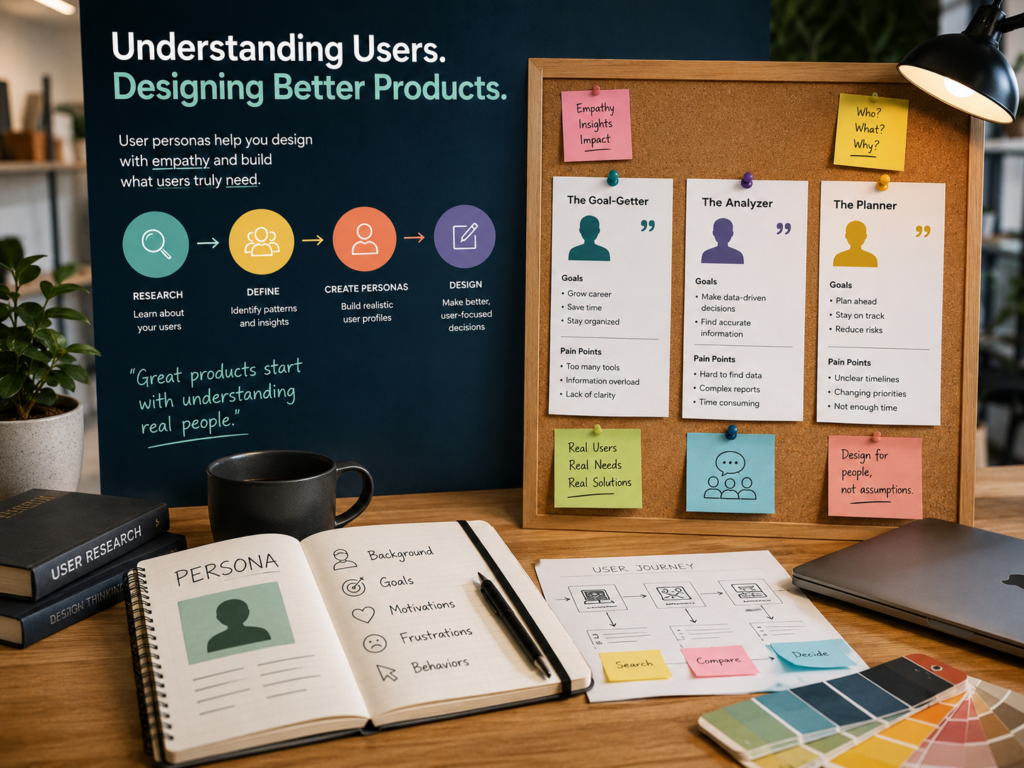
User-centered products are not created by guesswork. The most successful products are built by teams that deeply understand who their users are, what they need, what frustrates them, and what motivates them to take action.
This is where a user persona UX framework becomes invaluable.
Many companies create personas because they have heard they are an essential part of UX design. Unfortunately, many of those personas end up sitting unused in presentation slides, forgotten folders, or outdated documents. They become fictional characters that never influence product decisions.
The reality is that a well-researched user persona can help product managers, UX designers, developers, marketers, and stakeholders make better decisions throughout the entire product development lifecycle.
In this guide, you’ll learn how to create a user persona for UX, discover practical examples, explore a user persona template for product managers, and understand how personas fit into the modern user centered design process.
What Is a User Persona in UX?
A user persona is a research-based representation of a target user group. It summarizes key characteristics, behaviors, motivations, goals, needs, and challenges of real users.
Rather than designing for a vague audience, UX teams use personas to design for specific types of users.
Think of a persona as a realistic profile that helps your team answer an important question:
“Who are we designing for?”
A strong UX persona typically includes:
- Name and photo placeholder
- Demographic information
- Job role or occupation
- Goals and motivations
- Challenges and frustrations
- Behavioral patterns
- Technology usage
- Preferred communication methods
- Product expectations
Instead of saying:
“Our users are small business owners.”
A persona might say:
“Sarah, a 38-year-old marketing agency owner who needs faster ways to collect customer feedback without hiring a research team.”
The second description creates a much clearer picture of the user.
Why User Personas Matter in Product Design
Many products fail because teams build features based on assumptions rather than user needs.
Without personas, product decisions often become influenced by:
- Internal opinions
- Stakeholder preferences
- Personal assumptions
- Competitive pressure
- Feature requests from a small minority of users
A well-developed user persona UX framework keeps teams focused on actual user needs.
When product teams understand their users, they can:
- Prioritize the right features
- Improve user experiences
- Reduce friction
- Increase adoption rates
- Improve customer satisfaction
- Support business objectives
Personas provide a shared understanding that aligns designers, developers, marketers, and product managers around the same user goals.
The Role of Personas in the User Centered Design Process
The user centered design process places users at the center of every design decision.
Instead of asking:
“What features can we build?”
Teams ask:
“What problems are users trying to solve?”
User personas play a critical role throughout this process.
When research, personas help organize user insights.
For ideation, personas help identify relevant solutions.
During design, personas guide interface decisions.
During testing, personas help evaluate whether experiences meet user expectations.
Without personas, user-centered design becomes difficult because teams lose sight of who they are serving.
Common Mistakes Companies Make When Creating Personas
Before learning how to create a user persona for UX, it’s important to understand why many personas fail.
One common mistake is creating personas based entirely on assumptions.
For example:
“Our users are probably young professionals.”
Without research, statements like this can lead teams in the wrong direction.
Another mistake is focusing too heavily on demographics.
Age and job title may be useful, but they rarely explain why users behave a certain way.
What matters more is understanding:
- Goals
- Motivations
- Behaviors
- Pain points
- Decision-making patterns
A third mistake is creating too many personas.
If a team develops ten different personas, it becomes difficult to prioritize design decisions.
Most products benefit from two to five primary personas.
Finally, many organizations never update their personas. User expectations evolve over time, and personas should evolve as well.
How to Create a User Persona for UX
Understanding how to create a user persona for UX starts with research rather than imagination.
The best personas are built using real user data.
Step 1: Conduct User Research
Effective personas begin with understanding actual users.
Research methods may include:
- User interviews
- Customer surveys
- Product analytics
- Support tickets
- User testing sessions
- Customer feedback data
- Market research reports
The goal is to identify patterns across users rather than isolated opinions.
For example, if multiple users mention difficulty finding reports inside a dashboard, that recurring issue becomes valuable persona data.
The more research you collect, the more accurate your personas become.
Step 2: Identify Behavioral Patterns
After collecting research, look for similarities among users.
Questions to consider include:
- What goals do users share?
- What problems occur repeatedly?
- What motivates users?
- How do users interact with technology?
- What triggers product adoption?
Behavioral patterns often reveal distinct user groups.
For example, a survey platform may discover:
- Marketing professionals focused on customer insights
- HR teams focused on employee engagement
- Researchers focused on data accuracy
Each group may require a separate persona.
Step 3: Define User Goals
Goals are one of the most important parts of a persona.
People do not use products because they love software.
They use products to achieve outcomes.
For example:
A marketing manager’s goal may be:
“Understand customer satisfaction quickly.”
An HR manager’s goal may be:
“Collect honest employee feedback.”
The product is simply a tool that helps them reach those goals.
Understanding goals helps teams design more effective experiences.
Step 4: Document Pain Points
Pain points often drive product adoption.
Users typically seek solutions because something is difficult, inefficient, expensive, or frustrating.
Examples include:
- Surveys take too long to build
- Data analysis is difficult
- Response rates are low
- Existing tools are expensive
- Reporting is confusing
Understanding these frustrations helps product teams prioritize improvements.
Step 5: Build the Persona Profile
Once research is complete, create a clear persona document.
Include:
- Persona name
- Job role
- Goals
- Motivations
- Pain points
- Behavioral traits
- Product expectations
- Preferred tools
Keep the profile concise enough to be useful while detailed enough to guide decisions.
User Persona Template for Product Managers
A practical user persona template for product managers should include the following sections:
Basic Information
- Persona name
- Age range
- Job title
- Industry
- Experience level
Goals
- What are they trying to achieve?
- What outcomes matter most?
Challenges
- What obstacles do they face?
- What slows them down?
Motivations
- What drives decision-making?
- What creates success for them?
Behaviors
- How do they research solutions?
- How do they use technology?
Product Needs
- What features matter most?
- What would improve their experience?
This structure keeps personas actionable and easy to reference.
UX Persona Example: Marketing Manager
Let’s look at a practical example.
Persona: Sarah Thompson
Role: Marketing Manager
Age: 35
Company Size: 50-200 employees
Goals
Sarah wants to understand customer satisfaction and improve retention.
She needs quick access to reliable customer insights.
Challenges
She struggles with low survey response rates and limited reporting capabilities.
She often spends too much time analyzing data manually.
Motivations
Sarah wants to demonstrate measurable marketing impact and improve customer loyalty.
Product Expectations
She expects surveys to be easy to create, mobile-friendly, and supported by real-time analytics.
A product team designing for Sarah would prioritize simplicity, automation, and reporting features.
How Personas Influence Product Decisions
Personas are not merely research documents.
They should influence daily product decisions.
When evaluating a feature request, teams can ask:
“Would this help Sarah achieve her goals?”
When designing a workflow, teams can ask:
“Does this reduce Sarah’s frustrations?”
When prioritizing roadmap items, teams can ask:
“Which improvements create the greatest value for our primary personas?”
These questions help teams stay focused on user outcomes rather than internal preferences.
Using Surveys to Build Better Personas
One of the most effective ways to create personas is through surveys.
Surveys help organizations collect information directly from users about:
- Goals
- Challenges
- Behaviors
- Expectations
- Preferences
Instead of relying on assumptions, teams can gather real insights at scale.
Survey platforms such as SurveyFlip allow organizations to create targeted research surveys that support persona development and validation.
This helps teams build more accurate personas and make more informed product decisions.
How Often Should Personas Be Updated?
User behavior changes over time.
Markets evolve.
Technology changes.
Customer expectations shift.
Because of this, personas should be reviewed regularly.
Many organizations update personas every 6 to 12 months.
Regular updates help ensure product decisions remain aligned with current user needs rather than outdated assumptions.
The Future of User Personas
AI, behavioral analytics, and real-time customer insights are transforming persona development.
Traditional static personas are evolving into dynamic personas that update based on actual user behavior.
Future personas may include:
- Real-time behavioral data
- Predictive insights
- AI-generated recommendations
- Dynamic segmentation
- Automated updates
These advances will help organizations understand users more accurately and respond to changing needs faster.
Final Thoughts
A successful user persona UX strategy is not about creating fictional characters. It is about understanding real people and using those insights to drive better product decisions.
When organizations learn how to create a user persona for UX, use a practical user persona template for product managers, and integrate personas into the user centered design process, they create products that better serve users and achieve stronger business outcomes.
The best personas are grounded in research, updated regularly, and actively used during design, development, and product planning.
When personas become part of everyday decision-making, they stop being documents and start becoming powerful tools for creating exceptional user experiences.
Frequently Asked Questions (FAQ)
1. What is a user persona in UX?
A user persona UX is a research-based representation of a target user group. It helps designers, product managers, and developers understand user goals, behaviors, motivations, and pain points so they can create products that better meet user needs.
2. Why are user personas important in UX design?
User personas help teams make user-focused decisions rather than relying on assumptions. They improve product design, feature prioritization, user experience, customer satisfaction, and product adoption by keeping real user needs at the center of the design process.
3. How do user personas support the user centered design process?
The user centered design process focuses on designing products around users rather than business assumptions. User personas provide a clear understanding of who the users are, what they need, and what challenges they face, helping teams make informed design decisions throughout the product lifecycle.
4. How do you create a user persona for UX?
To learn how to create a user persona for UX, start by conducting user research through surveys, interviews, analytics, customer feedback, and usability testing. Identify patterns in user behavior, define goals and pain points, and organize the findings into a structured persona profile.
5. What information should a UX persona include?
A strong UX persona typically includes:
- Name and role
- Demographic details
- Goals and motivations
- Pain points and frustrations
- Behavioral patterns
- Technology preferences
- Product expectations
- Decision-making factors
These elements help teams understand users beyond basic demographics.
6. How many user personas should a product have?
Most products benefit from having between two and five primary personas. Too many personas can make product decisions confusing, while too few may overlook important user segments.
7. What is the difference between a user persona and a buyer persona?
A user persona focuses on the people who actually use a product, while a buyer persona focuses on the individuals responsible for purchasing decisions. In some businesses, these may be the same person, but in many organizations they are different.
8. Are user personas based on real data?
Yes. Effective personas should always be based on real user research rather than assumptions. Surveys, interviews, customer feedback, analytics, and usability testing help ensure personas accurately represent actual users.
9. What are the most common mistakes when creating personas?
Common mistakes include:
- Using assumptions instead of research
- Focusing only on demographics
- Creating too many personas
- Ignoring user goals
- Failing to update personas regularly
- Not using personas in decision-making
These mistakes can reduce the value of persona-driven design.
10. What is a user persona template for product managers?
A user persona template for product managers is a structured framework that helps organize information about target users. It typically includes user goals, pain points, motivations, behaviors, product needs, and demographic information to support product planning and prioritization.
11. Can small businesses benefit from user personas?
Absolutely. User personas help businesses of all sizes better understand customers, improve user experiences, prioritize resources, and develop products that address real market needs.
12. How do surveys help create user personas?
Surveys allow organizations to collect data directly from users about their goals, challenges, preferences, and behaviors. This information helps create accurate personas based on actual user feedback rather than assumptions.
13. How often should UX personas be updated?
Most organizations review and update personas every 6 to 12 months. However, rapidly changing industries may require more frequent updates to reflect evolving customer behaviors and expectations.
14. What are examples of user persona goals?
Examples of persona goals include:
- Improving team productivity
- Collecting customer feedback faster
- Reducing manual work
- Increasing sales performance
- Making better business decisions
- Simplifying data analysis
Goals help teams understand why users seek solutions.
15. What are persona pain points?
Pain points are problems, frustrations, obstacles, or inefficiencies users experience while trying to achieve their goals. Understanding pain points helps product teams identify opportunities for improvement and innovation.
16. How do user personas improve product development?
User personas help teams prioritize features, improve usability, reduce friction, enhance customer experiences, and align product decisions with user needs. This often leads to better adoption rates and higher customer satisfaction.
17. Can AI help create user personas?
Yes. AI tools can analyze customer feedback, survey responses, support tickets, and behavioral data to identify patterns and generate persona insights. However, human validation is still important to ensure accuracy and business relevance.
18. What is the difference between a proto-persona and a user persona?
A proto-persona is an assumption-based persona created before research is conducted. A user persona is developed using real user data and validated through research. User personas are generally more reliable for guiding design decisions.
19. How many users should be researched before creating personas?
There is no fixed number, but researchers typically look for recurring patterns across interviews, surveys, usability tests, and customer data. The goal is to identify meaningful trends rather than collect a specific number of responses.
20. What is the ultimate purpose of a user persona UX strategy?
The ultimate purpose of a user persona UX strategy is to help organizations understand users deeply enough to design products, features, and experiences that solve real problems, improve satisfaction, and support business goals through a strong user centered design process.