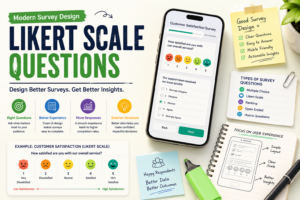
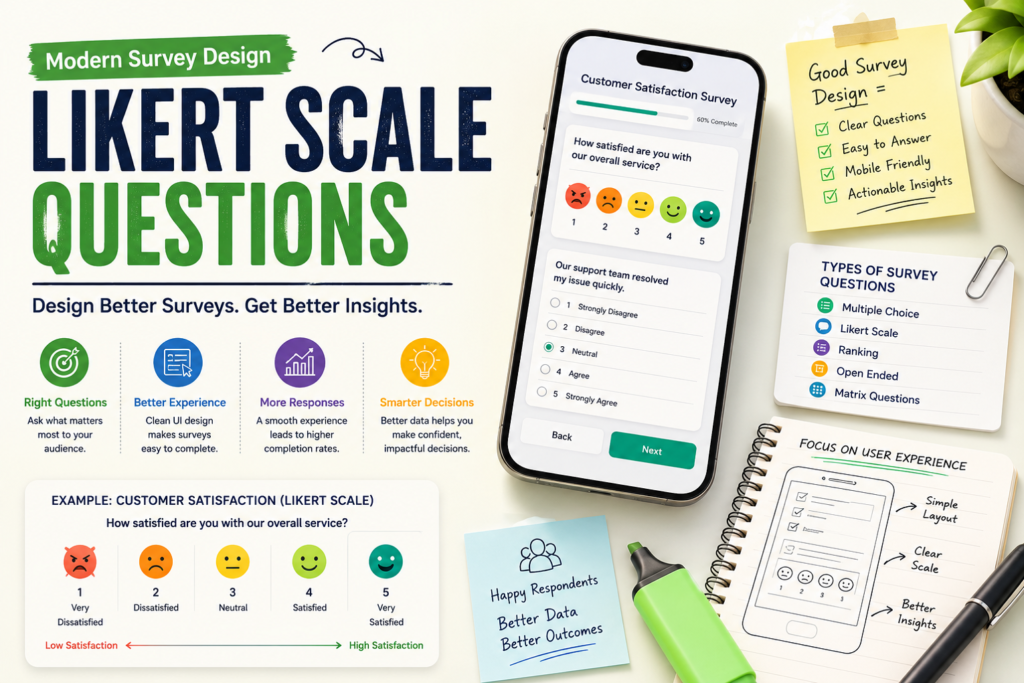
Data drives decisions in the modern business world. Organizations need to understand exactly what their customers and employees think. To do this, researchers rely on specific types of survey questions. One tool stands out above the rest for measuring attitudes and opinions. That tool is the Likert scale.
Using likert scale questions allows you to turn subjective human feelings into clean, quantifiable data. But designing these questions correctly requires skill. Poorly constructed scales produce bad data. Bad data leads to wrong business strategies.
To build flawless campaigns, smart brands use SurveyFlip. The platform provides the advanced framework needed to build, deploy, and analyze scaling questions without technical friction.
This comprehensive guide will master the art of the rating scale survey. You will learn the psychological principles behind scaling, explore concrete likert scale question examples for customer satisfaction, and discover exactly how many points should a likert scale have to maximize your data quality.
What are Likert Scale Questions?
The Likert scale was invented by psychologist Rensis Likert. It is a psychometric scale commonly used in research. It allows respondents to specify their level of agreement or disagreement with a series of statements.
Unlike simple yes-or-no questions, this method captures the intensity of a person’s feelings. Human emotion is rarely binary. People do not just love or hate a product. They often fall somewhere in the middle. The Likert scale honors this nuance.
Core Anatomy of a Likert Scale
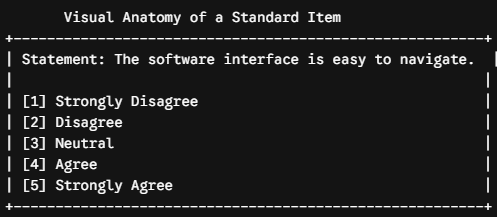
A standard Likert question consists of two main parts:
- The Statement: A clear, declarative sentence that takes a specific position.
- The Scale Points: A symmetrical set of options ranging from one extreme opinion to the opposite extreme opinion.
How Many Points Should a Likert Scale Have?
One of the most common questions in survey design is simple: how many points should a likert scale have?
The number of options you choose alters how respondents behave. It also changes the statistical power of your results. When designing with SurveyFlip, you have the ultimate flexibility to toggle between these various scale points instantly to match your research objectives.
The 5-Point Scale: The Industry Standard
The 5-point scale is the most popular choice for general market research. It is simple, highly intuitive, and easy to read on mobile screens.
- Structure: Strongly Disagree, Disagree, Neutral, Agree, Strongly Agree.
- Pros: It offers a clear neutral choice. It provides enough variance without causing decision fatigue.
- Cons: It may lack granular detail for advanced statistical analysis.
The 7-Point Scale: The Academic Choice
When you need deep analytical precision, a 7-point scale is often the best choice. It adds two extra dimensions of nuance.
- Structure: Strongly Disagree, Disagree, Somewhat Disagree, Neutral, Somewhat Agree, Agree, Strongly Agree.
- Pros: It provides more variance. This extra detail is excellent for running complex regressions and analysis.
- Cons: It increases the cognitive load. Respondents may take longer to choose an answer.
Odd vs. Even Scales: The Neutral Dilemma
The biggest decision you must make is whether to include a neutral option.
- Odd-Numbered Scales (5 or 7 points): These scales include a central neutral point. This allows users to say they have no opinion or feel indifferent. It prevents forced answers.
- Even-Numbered Scales (4 or 6 points): These scales completely remove the neutral option. This is called a “forced-choice” scale. It forces the respondent to lean either toward the positive or negative side. Use this only when you absolutely need a definitive stance.
Likert Scale Question Examples for Customer Satisfaction
Customer satisfaction is the lifeblood of US commerce. To keep retention high, you must measure specific touchpoints.
Here are practical, ready-to-use likert scale question examples for customer satisfaction across multiple business sectors.
1. Product Performance and Usability
- Statement: The product functions exactly as I expected it to.
- Scale: Strongly Disagree / Disagree / Neutral / Agree / Strongly Agree
- Statement: Learning how to use this software was simple.
- Scale: Strongly Disagree / Disagree / Neutral / Agree / Strongly Agree
- Statement: The product features help me save time during my workday.
- Scale: Strongly Disagree / Disagree / Neutral / Agree / Strongly Agree
2. Customer Service and Support Interaction
- Statement: The support representative resolved my issue quickly.
- Scale: Strongly Disagree / Disagree / Neutral / Agree / Strongly Agree
- Statement: The representative was knowledgeable and polite.
- Scale: Strongly Disagree / Disagree / Neutral / Agree / Strongly Agree
- Statement: It was easy to connect with a live support agent.
- Scale: Strongly Disagree / Disagree / Neutral / Agree / Strongly Agree
3. Post-Purchase and Delivery Experience
- Statement: My order arrived within the promised delivery window.
- Scale: Strongly Disagree / Disagree / Neutral / Agree / Strongly Agree
- Statement: The packaging protected the item securely during transit.
- Scale: Strongly Disagree / Disagree / Neutral / Agree / Strongly Agree
- Statement: The online checkout process was smooth and error-free.
- Scale: Strongly Disagree / Disagree / Neutral / Agree / Strongly Agree
Key Variations of the Rating Scale Survey
Likert scales are not limited to measuring agreement. You can adapt the labels to measure frequency, importance, quality, or likelihood. This flexibility makes them a staple in modern research.
The Frequency Scale
Use this to track user habits and behavior patterns over time.
- Options: Never, Rarely, Occasionally, Frequently, Always.
- Example: How often do you use our mobile app to check account balances?
The Importance Scale
Use this when prioritizing product roadmaps or service upgrades.
- Options: Not Important At All, Slightly Important, Moderately Important, Important, Very Important.
- Example: Rate the importance of real-time text notifications for your orders.
The Quality Scale
Use this to gather quick feedback on specific assets or physical goods.
- Options: Poor, Fair, Good, Very Good, Excellent.
- Example: How would you rate the video quality of our streaming platform?
Comparative Analysis: Likert Scales vs. Other Question Types
To design the best possible research instrument, you must know when to use a Likert item and when to select an alternative framework.
| Question Type | Best Used For | Pros | Cons |
| Likert Scale Questions | Measuring nuanced attitudes, satisfaction levels, and human opinions. | Turns qualitative feelings into structured numbers. Easy to analyze. | Can suffer from central tendency bias where users choose only neutral answers. |
| Net Promoter Score (NPS) | Measuring long-term brand loyalty and referral potential. | Extremely fast to answer. Offers a single, globally understood benchmark metric. | Does not explain why a customer is loyal or unhappy. |
| Multiple Choice (Single Select) | Collecting demographic categories or choosing a single explicit option. | Clear, clean, and leaves zero room for interpretation. | Limits user choice to a fixed list. Cannot capture subtle feelings. |
| Open-Ended Text Fields | Gathering deep, rich qualitative color and unexpected insights. | Captures the authentic voice of the customer without constraints. | Time-consuming to analyze. High abandonment rates on mobile screens. |
Designing Better Likert Scales: Best Practices
Writing good survey questions takes care. Small mistakes in your wording can completely distort your data. Follow these essential design rules to protect your research integrity.
1. Always Use Balanced Wording
Your scale options must be perfectly symmetrical. If you offer two positive options, you must offer two matching negative options.
- Flawed (Unbalanced): Poor, Fair, Good, Very Good, Excellent. (This scale is heavily weighted toward the positive side).
- Optimized (Balanced): Very Poor, Poor, Fair, Good, Very Good.
2. Keep Your Statements Neutral
The statement itself should not push the user toward an answer. It should state a fact or behavior plainly.
- Flawed (Biased): Our customer support team is incredibly helpful.
- Optimized (Neutral): The customer support team resolved my issue effectively.
3. Ensure Interval Consistency
The conceptual distance between each point on your scale should feel equal to the user. The jump from “Disagree” to “Neutral” should feel identical to the jump from “Neutral” to “Agree.” Keep your wording simple to maintain this mental balance.
4. Close the Loop Instantly
Data is only useful if it triggers action. When you host your rating scale survey on SurveyFlip, you can build a real-time feedback engine. For example, if a customer selects “Strongly Disagree” on a satisfaction metric, the native SurveyFlip Slack integration can instantly ping your customer success channel. This allows your team to reach out and resolve the issue immediately.
Conclusion: Turning Insights into Corporate Action
Building a great rating scale survey is a science. By selecting the right scale length, writing neutral statements, and using balanced labels, you unlock deep consumer insights.
Remember to align your question selection with your analytical goals. If you need quick benchmarks, use a 5-point customer satisfaction scale. If you are prepping data for deep academic modeling, look toward a 7-point scale.
Craft your surveys with respect for the user experience. By deploying your campaigns through a powerful feedback engine like SurveyFlip, you get mobile-first design, seamless workflow automation, and rapid access to clear, actionable insights. Your users will experience zero completion friction, and your business will get the clean data it needs to grow.
Frequently Asked Questions (FAQ)
1. What are Likert scale questions?
Likert scale questions are survey questions that measure opinions, attitudes, satisfaction, or perceptions using a structured rating scale.
Respondents select an answer from a range of options, such as:
- Strongly Disagree
- Disagree
- Neutral
- Agree
- Strongly Agree
They are commonly used in customer feedback, employee engagement, and market research surveys.
2. Why are Likert scales important in survey design?
Likert scales help organizations measure subjective opinions in a structured and measurable way.
They allow researchers to:
- Identify trends
- Compare responses
- Quantify attitudes
- Improve decision-making
They are also easier for respondents to answer than lengthy open-ended questions.
3. What is the most common Likert scale?
The 5-point Likert scale is the most widely used format.
Example:
- Strongly Disagree
- Disagree
- Neutral
- Agree
- Strongly Agree
It offers a good balance between simplicity and response accuracy.
4. How many points should a Likert scale have?
There is no universal answer.
The ideal scale depends on survey goals.
Common options:
- 3-point scale → Simple surveys
- 5-point scale → General business surveys
- 7-point scale → Detailed research studies
- 10-point scale → Advanced analytics
For most customer surveys, a 5-point scale is usually recommended.
5. What are some Likert scale question examples for customer satisfaction?
Examples include:
Product Satisfaction
How satisfied are you with our product?
- Very Dissatisfied
- Dissatisfied
- Neutral
- Satisfied
- Very Satisfied
Customer Support
Our support team resolved my issue quickly.
- Strongly Disagree
- Disagree
- Neutral
- Agree
- Strongly Agree
Website Experience
How easy was it to use our website?
- Very Difficult
- Difficult
- Neutral
- Easy
- Very Easy
6. Are Likert scales considered rating scale surveys?
Yes.
Likert scales are one type of rating scale survey.
Other rating scales include:
- Star ratings
- Numerical scales
- NPS scores
- Slider scales
Likert scales specifically focus on measuring attitudes and opinions.
7. Should I include a neutral option?
In most situations, yes.
A neutral option allows respondents to express:
- No opinion
- Uncertainty
- Genuine neutrality
Removing neutral responses may force respondents to provide inaccurate answers.
8. What industries commonly use Likert scales?
Likert scales are widely used in:
- SaaS businesses
- Healthcare
- Education
- Retail
- Human Resources
- Market research
- Government research
- Customer experience programs
Almost every industry benefits from structured opinion measurement.
9. What is the difference between a Likert scale and a multiple-choice question?
A multiple-choice question asks respondents to select one option from several unrelated choices.
A Likert scale measures intensity or degree of opinion.
Multiple Choice Example:
Which product do you use?
- Product A
- Product B
- Product C
Likert Example:
How satisfied are you with Product A?
- Very Dissatisfied
- Dissatisfied
- Neutral
- Satisfied
- Very Satisfied
10. Can Likert scales measure customer satisfaction?
Absolutely.
Likert scales are among the most effective methods for measuring:
- Customer satisfaction
- Product experience
- Service quality
- Brand trust
- User sentiment
This is why they are heavily used in customer feedback surveys.
11. Are Likert scales suitable for employee surveys?
Yes.
Employee engagement surveys often rely heavily on Likert scales.
Examples include:
- I feel valued at work.
- My manager supports my growth.
- I would recommend this company to others.
These scales make employee sentiment measurable.
12. What are common mistakes when creating Likert scale questions?
Common mistakes include:
- ❌ Asking two questions at once
- ❌ Using confusing wording
- ❌ Changing scale direction
- ❌ Creating excessively large matrices
- ❌ Using too many response options
Simple and clear questions usually perform best.
13. Are 7-point scales better than 5-point scales?
Not always.
7-point scales provide more detail but also increase respondent effort.
For most businesses:
✅ 5-point scales are easier to complete.
For academic or highly detailed research:
✅ 7-point scales may provide additional insights.
14. Can Likert scales be used in mobile surveys?
Yes.
However, they should be optimized for smartphones.
A mobile friendly Likert survey should:
- Use large buttons
- Avoid horizontal scrolling
- Keep questions concise
- Use responsive layouts
Poor mobile experiences can significantly reduce completion rates.
15. How do Likert scales improve data analysis?
Likert scales transform opinions into measurable data.
Organizations can:
- Calculate averages
- Compare segments
- Track trends over time
- Visualize satisfaction levels
- Build dashboards and reports
This makes analysis much easier than using only open-ended responses.
16. Are matrix questions and Likert scales the same thing?
No.
A matrix question is a question format.
A Likert scale is the response scale.
However, matrix questions often use Likert scales for answers.
17. What are the best practices for writing Likert scale questions?
Best practices include:
✅ Keep wording simple
✅ Use balanced response options
✅ Maintain consistent scales
✅ Optimize for mobile users
✅ Avoid double-barreled questions
✅ Use clear labels
Good question design improves response quality.
18. Can AI analyze Likert scale survey responses?
Yes.
Modern survey platforms increasingly use AI to:
- Identify patterns
- Detect sentiment
- Generate insights
- Recommend actions
AI-powered analysis helps organizations move beyond basic reporting.
19. Are Likert scales still relevant in 2026?
Absolutely.
Despite advances in AI and interactive survey design, Likert scales remain one of the most effective tools for measuring opinions and satisfaction.
Their simplicity and analytical value make them highly relevant today.
20. How does SurveyFlip support Likert scale surveys?
SurveyFlip allows organizations to build modern Likert-based surveys with:
✅ Mobile-friendly interfaces
✅ Matrix question support
✅ Custom scale labels
✅ Real-time dashboards
✅ AI-powered analytics
✅ Advanced reporting tools
This makes it easier to collect, analyze, and act on feedback efficiently.