- 6 min read
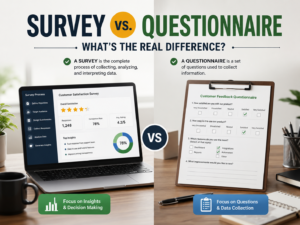

Survey Research in 2026 is no longer limited to static questionnaires or simple data-collection forms. It has become a highly strategic research process that combines digital infrastructure, artificial intelligence, strict ethics frameworks, and global participation.
Researchers today operate in complex environments.
- They manage multi-country studies.
- They work under tight regulatory rules.
- They collect large volumes of behavioral and attitudinal data.
- They must publish results quickly while protecting participants.
SurveyFlip was created for this reality.
It is a platform designed specifically to support advanced Survey Research from planning to publication. It helps researchers design accurate surveys, maintain ethical standards, analyze responses at scale, and convert results into actionable insights.
This blog explains how Survey Research works in 2026, what problems researchers face, and why SurveyFlip is built to solve them.
What Survey Research Means in 2026
Survey Research is the systematic method of gathering structured information from people using questionnaires, digital forms, or mobile-based instruments. These surveys are used in academic research, government programs, social studies, healthcare trials, business intelligence, education systems, and public policy analysis.
In 2026, Survey Research has expanded into a technology-driven discipline. It now includes:
- AI-supported question drafting that reduces ambiguous wording
- Automatic checks for leading or biased language
- Adaptive flows that present different questions based on prior answers
- Multilingual deployment for international projects
- Accessibility tools for people with disabilities
- Real-time monitoring dashboards
- Privacy-first data architecture
- Seamless export to academic analysis software
Researchers now view Survey Research platforms as research infrastructure, not just data-collection tools.
Why High-Quality Survey Research Is Critical Today
The impact of any study depends on the quality of its data. Weakly designed surveys lead to unreliable results. They increase sampling errors, reduce response rates, and damage credibility during peer review.
- Strong Survey Research helps organizations:
- Generate evidence for funding proposals
- Support policy decisions
- Improve public services
- Guide product development
- Track population-level changes
- Validate theoretical models
- Support longitudinal studies
- Strengthen academic publication outcomes
In 2026, many institutions require proof that survey tools follow ethical standards and privacy rules. A modern Survey Research platform is no longer optional. It is essential.
The Biggest Challenges Facing Survey Research
Even with advanced tools, researchers face structural problems.
Participant recruitment has become more expensive and competitive. Many people ignore online questionnaires. Survey fatigue is rising.
Regulatory environments are growing more complex. Privacy laws differ by country. Cross-border data transfer requires careful controls. Institutional review boards demand documentation.
AI tools create new risks. Automated wording can introduce bias. Algorithms must be transparent. Researchers must remain in control.
Manual analysis still consumes time. Cleaning datasets. Coding open-ended responses. Formatting tables for reports. These steps delay publication.
SurveyFlip was designed to reduce these pressures.
How SurveyFlip Supports the Entire Survey Research Lifecycle
SurveyFlip does not focus on one stage of the research process. It supports every phase of Survey Research, from early planning to final reporting.
1. Advanced Survey Design Tools
SurveyFlip gives researchers professional design systems that go beyond simple form builders.
Researchers can:
- Create questionnaires from academic templates
- Customize scales and response formats
- Randomize items to reduce order bias
- Use branching logic to personalize paths
- Apply quotas for sampling control
- Pre-test surveys with pilot groups
- Track completion time and drop-off points
AI-assisted writing tools suggest neutral phrasing and detect emotionally loaded words. This helps protect scientific validity.
These features lead to cleaner data and higher response quality.
2. Mobile-First and Global-Scale Distribution
Most respondents now complete surveys on smartphones. SurveyFlip optimizes every study for:
- Touch-friendly navigation
- Fast loading on weak connections
- Clear typography
- Short screen layouts
- Progress indicators
- Offline capture for field studies
SurveyFlip also enables multilingual deployment from a single project workspace. Researchers can translate surveys, localize phrasing, and compare responses across countries.
This makes global Survey Research far easier to manage.
3. Ethics, Privacy, and Compliance by Design
Modern Survey Research must meet strict ethical rules. SurveyFlip embeds these requirements into the workflow.
The platform includes:
- Customizable informed-consent screens
- Anonymity and pseudonymization controls
- Data-retention settings
- Right-to-withdraw mechanisms
- Secure hosting
- Audit trails for institutional review
- Permission-based access for research teams
These systems help researchers satisfy ethics boards and regulators without building manual processes.
4. Deep Analytics and Research-Grade Reporting
Survey Research does not end when the last response is submitted.
SurveyFlip provides:
- Live dashboards for monitoring fieldwork
- Cross-tabulation tools for subgroup analysis
- Filters for demographic comparisons
- Text analysis for open responses
- Sentiment detection
- Trend tracking
- Weighted analysis
- Exports to SPSS, R, Stata, Excel, and CSV
Researchers can generate publication-ready tables and charts quickly. This shortens the time between data collection and academic output.
5. Collaboration for Institutions and Teams
SurveyFlip supports multi-user research environments.
Universities can standardize Survey Research processes across departments. Government agencies can manage multiple projects securely. Corporate research teams can collaborate across regions.
Role-based permissions protect sensitive datasets. Shared dashboards improve coordination. Version histories track changes in questionnaires.
This makes large-scale Survey Research programs easier to govern.
A Detailed, Publish-Ready Survey Research Template
SurveyFlip provides long-form templates that institutions can adapt.
Research Practices and Trends in Survey Research – 2026
Introduction
This study examines how professionals conduct Survey Research in 2026.
Participation is voluntary.
Responses will remain confidential.
You may leave the survey at any time.
Section 1: Professional Background
Questions explore discipline, career stage, experience, and geographic focus.
Section 2: Survey Research Methods
This section measures frequency of surveys, use of AI tools, data types collected, and mixed-method approaches.
Section 3: Platforms and Technical Needs
Respondents evaluate features such as mobile design, multilingual support, analytics, compliance tools, and data exports.
Section 4: Ethics and Regulation
Questions focus on privacy confidence, institutional approval processes, cross-border data issues, and algorithmic transparency.
Section 5: Operational Challenges
Researchers describe recruitment barriers, budget limits, response quality problems, and time pressures.
Section 6: Future Outlook
Participants assess emerging trends and desired platform features.
Why SurveyFlip Is the Right Choice for Survey Research
SurveyFlip is built for long-term research programs, not just one-off projects.
It helps researchers:
- Launch complex studies quickly
- Improve methodological rigor
- Protect participants
- Meet regulatory demands
- Scale across countries
- Collaborate across institutions
- Publish faster
- Defend findings during peer review
Survey Research in 2026 demands professional systems. SurveyFlip delivers them.
📌 FAQs
What is Survey Research and why is it important in 2026?
Survey Research is a method for collecting structured data from people using questionnaires. In 2026 it is vital because decisions in policy, business, and science depend on fast, ethical, and reliable data collection.
How does SurveyFlip improve Survey Research quality?
SurveyFlip provides AI-assisted design tools, bias detection, mobile optimization, advanced analytics, and ethics controls. These features improve accuracy and reduce methodological errors.
Can SurveyFlip handle international research projects?
Yes. SurveyFlip supports multilingual surveys, global deployment, and cross-country analysis from one platform.
How does SurveyFlip help with ethics approvals?
SurveyFlip includes consent templates, audit logs, anonymization tools, and compliance settings that make institutional review processes easier.
What analysis formats does SurveyFlip support?
SurveyFlip exports data to SPSS, R, Stata, Excel, and CSV so researchers can run advanced statistical tests.
Who should use SurveyFlip for Survey Research?
Academic researchers, universities, government agencies, nonprofits, policy institutes, and corporate research teams all benefit from SurveyFlip.